
How Do Airline Alliance Lounge Access Rules Work? The Foreign Status Loophole
How Do Airline Alliance Lounge Access Rules Work? The Foreign Status Loophole
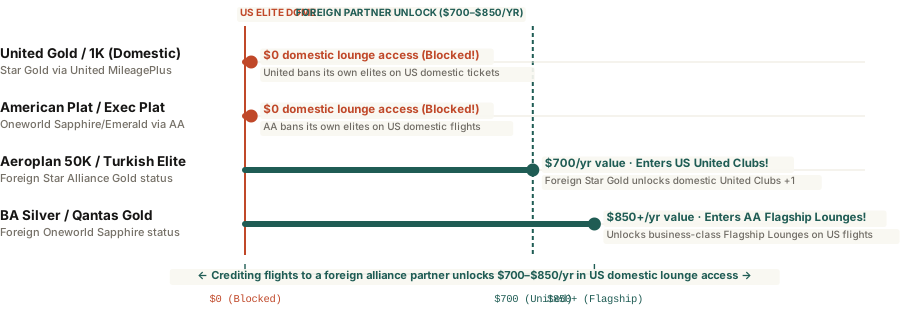
While United and American Airlines bar their own Star Alliance Gold and Oneworld Sapphire elites from domestic U.S. lounges on domestic tickets, holding the exact same alliance tier via a foreign partner unlocks complimentary U.S. lounge access with a guest.
Imagine two frequent flyers walking up to the reception desk at the United Club in Chicago O'Hare (or the American Airlines Flagship Lounge in Miami) before boarding a three-hour domestic Economy flight to Seattle. Flyer A holds top-tier United Premier 1K (or American AAdvantage Executive Platinum) status, earned by flying 100,000 miles a year with the home airline. Flyer B holds mid-tier Air Canada Aeroplan 50K (or British Airways Executive Club Silver) status.
The agent scans both boarding passes. Flyer A—the airline's own elite—is turned away at the door and told to buy a $700–$850 annual club membership. Flyer B is welcomed inside for free, allowed to bring a complimentary guest, and (at American Airlines hubs) directed straight into the international business-class Flagship Lounge with champagne and chef-carved entrees.
This counterintuitive quirk is known in frequent-flyer strategy as the Foreign Alliance Status Loophole. Understanding how Star Alliance, Oneworld, and SkyTeam enforce reciprocal lounge access rules lets you unlock hundreds of dollars in domestic airport lounge privileges without paying for a club membership card.
Why United and American Block Their Own Elites on U.S. Flights
Across Europe, Asia, and Australia, earning mid-to-high frequent flyer status (Star Alliance Gold or Oneworld Sapphire / Emerald) automatically grants airport lounge access whenever you fly any member airline—even on a 45-minute domestic Economy hop from London to Manchester or Sydney to Melbourne.
In the United States, however, millions of corporate travelers and co-branded credit card holders hold elite status, and U.S. airlines generate hundreds of millions of dollars selling standalone lounge memberships (`$700/year` for a United Club membership; `$750–$850/year` for an Admirals Club membership). To protect that subscription revenue and prevent overcrowding, United Airlines, American Airlines, and Alaska Airlines wrote an explicit home-program carve-out into their terms:
- United MileagePlus Star Alliance Golds (`Premier Gold, Platinum, 1K`): Receive zero United Club access when flying solely on U.S. domestic itineraries. They only gain lounge access when connecting to an international Star Alliance flight.
- American AAdvantage Oneworld Sapphires & Emeralds (`Platinum, Platinum Pro, Executive Platinum`): Receive zero Admirals Club or Flagship Lounge access on purely domestic U.S. itineraries (outside of select 3-cabin transcontinental Business/First tickets).
Under global alliance treaties, U.S. airlines can restrict their own frequent flyer members on domestic flights—but they are contractually obligated to admit foreign partner elites.
How to Use the Foreign Partner Sweet Spot (Star Gold vs. Oneworld vs. SkyTeam)
Because Star Alliance and Oneworld reciprocal treaties require member airlines to honor partner status across the network, holding the alliance tier through a non-U.S. frequent flyer program bypasses the domestic exclusion completely:
- Star Alliance Gold via Foreign Partner (`Aeroplan 50K`, `Turkish Miles&Smiles Elite`, `Aegean Miles+Bonus Gold`): Gives you and one guest complimentary access to every United Club in the United States whenever you fly a same-day United domestic flight in any cabin (including Basic Economy).
- Oneworld Sapphire / Emerald via Foreign Partner (`British Airways Silver/Gold`, `Qantas Gold/Platinum`, `Qatar Platinum`, `Finnair Gold`): Gives you and one guest access not only to every American Airlines Admirals Club, but also to international-style AA Flagship Lounges (in JFK, MIA, ORD, DFW, and LAX) and Alaska Lounges when flying any same-day domestic AA or Alaska itinerary.
- Why SkyTeam Is the Exception: Unlike Star Alliance and Oneworld, SkyTeam (`Delta Air Lines`, `Air France-KLM`, `Korean Air`, `Virgin Atlantic`) closed the domestic loophole alliance-wide: SkyTeam Elite Plus members (regardless of whether they hold status with Delta or a foreign partner) only receive lounge access when traveling on, or connecting to, a same-day international flight.
To compare mileage earning rates, elite qualification thresholds, and transfer-partner redemptions across global airline alliances, you can Compare award tax valuations on Pointsuno before crediting your next flight.