
Are Airline Miles Taxable? IRS Rules for Credit Card Rewards
Are Airline Miles Taxable? IRS Rules for Credit Card Rewards
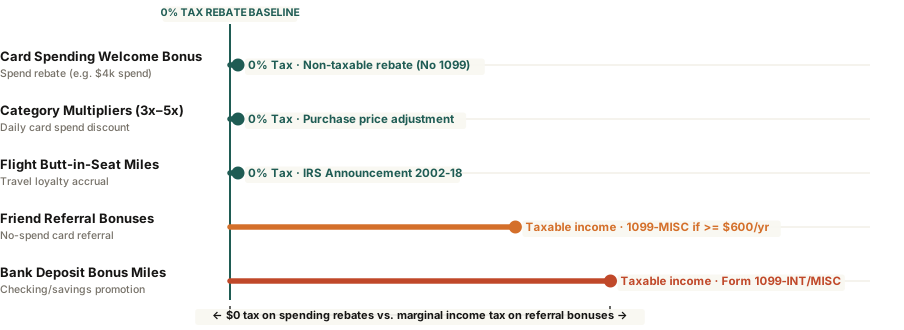
Under IRS Announcement 2002-18 and Revenue Ruling 2012-32, miles earned through credit card spending and flights are non-taxable rebates, but bank account referral bonuses and deposit promotions trigger Form 1099-MISC.
Opening a credit card that awards 80,000 airline miles or redeeming 120,000 points for a $4,500 business class seat to Tokyo is one of the most satisfying achievements in modern personal finance. Yet for award travel enthusiasts and small business owners, an uneasy question frequently emerges come tax season: does the Internal Revenue Service consider those miles taxable income, and will you receive a surprise Form 1099 in the mail?
The short answer is that the vast majority of credit card points and frequent flyer miles are 100% tax-free. However, the IRS draws a strict legal distinction between miles earned as a purchase rebate versus rewards received as miscellaneous compensation. Crossing that line can turn a seemingly harmless referral link or bank bonus into reportable taxable income.
The Purchase Rebate Doctrine: Why Spending Bonuses Are Tax-Free
The legal foundation protecting reward points is the IRS "Rebate Doctrine," codified under Revenue Ruling 76-96 and affirmed in subsequent tax court jurisprudence. Under this principle, a discount or rebate given to a consumer upon purchasing an item is not gross income under Internal Revenue Code § 61; it is an adjustment to the purchase price of the acquired property.
When a card issuer offers 60,000 points after you spend $4,000 in your first three months, you were required to spend money to unlock the reward. The IRS treats those 60,000 points as a 15% discount on the goods and services you purchased—not earned compensation. Furthermore, in IRS Announcement 2002-18, the agency officially stated that it will not challenge the tax treatment of frequent flyer miles earned through business travel or routine card spending due to the administrative complexity of tracking valuations.
If you have to spend personal or commercial funds to earn the reward, the IRS views the points as a non-taxable rebate.
The Taxable Exceptions: Referrals and Bank Deposit Bonuses
Reward points lose their rebate protection whenever you earn them without incurring a corresponding purchase. Two common scenarios trigger taxable events:
- Credit Card Referral Bonuses (1099-MISC): When you share your card referral link with a friend and earn 20,000 points upon their approval, you did not spend a single dollar to earn those miles. The IRS classifies referral rewards as compensation for services. Card issuers such as American Express and Chase issue Form 1099-MISC whenever an individual earns $600 or more in referral bonuses in a calendar year, typically valuing points at 1.0 cent each (e.g., 60,000 referral points = $600 of taxable income).
- Bank Account Opening Bonuses (1099-INT): Cash or mileage bonuses earned by opening a checking account or depositing $25,000 for 90 days are categorized as interest income. Because depositing money into an account is not a consumer purchase, banks issue Form 1099-INT or 1099-MISC for bonuses exceeding $10.
When tracking your loyalty portfolio, separate your tax-free spend bonuses from referral programs that could generate 1099 filings. You can Compare award tax valuations on Pointsuno to audit redemption cents-per-point efficiency against potential tax liabilities.