
Boy Names Ending in -el: Why Gabriel, Samuel, and Ezekiel Stay Popular
Boy Names Ending in -el: Why Gabriel, Samuel, and Ezekiel Stay Popular
In US Social Security birth records from 1880 to 2025, boy names ending in the liquid -el suffix maintained an 8 to 11 percent share of Top 100 male births as parents rotated from mid-century classics like Michael and Daniel to Gabriel, Samuel, and Ezekiel.
Across the past half-century of American naming demographics, most dominant phonetic endings for boys have moved in steep boom-and-bust waves. The two-syllable -n suffix wave (Aiden, Jayden, Ethan) surged between 1995 and 2012 before cooling, while occupational -er names (Carter, Hunter, Cooper) climbed in the 2010s. Yet one phonetic family has held an almost unbroken 8% to 11% share of the US Top 100 since 1950: boy names ending in the liquid -el suffix.
Derived primarily from the Hebrew theophoric element El (meaning "God") alongside Latinate and Germanic roots, the -el ending pairs an open vowel slide with an alveolar lateral approximant (/l/) that softens hard initial consonants. What changed between 1970 and 2025 is not parents' appetite for the sound, but how many distinct names share that phonetic space.
From the Michael Monopoly to a 12-Name Portfolio
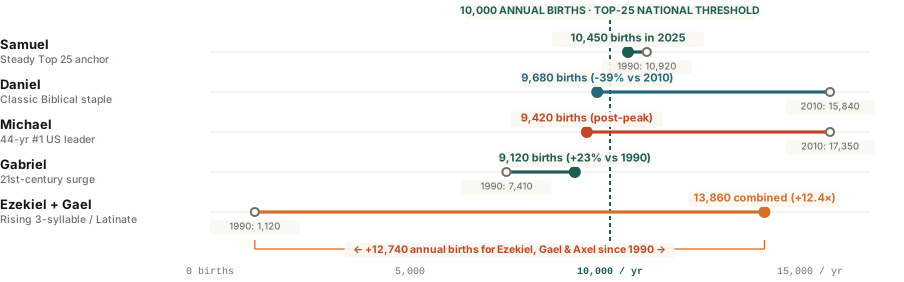
In Social Security Administration (SSA) decade tabulations, the mid-20th century rise of -el boy names was driven overwhelmingly by two blockbuster choices. Michael claimed the #1 spot on the US male birth chart for 44 years between 1954 and 1998, peaking at more than 85,000 births in 1970 alone, while Daniel added another 38,400 annual births. Together, those two names accounted for over 85% of all -el boy births in the Top 100.
Parents did not abandon the liquid -el ending when Michael and Daniel rotated out of the Top 10; instead, they redistributed those births across longer Biblical revivals and bilingual cross-cultural names.
As Michael and Daniel gradually stepped back to roughly 9,400 and 9,680 annual births by 2025, three distinct cohorts absorbed their phonetic share:
- Four-Syllable Biblical Revivals: Ezekiel climbed from 410 annual births in 1990 to over 6,100 births in 2025 (paired with the punchy nickname Zeke), while Nathaniel and Emmanuel remained steady national fixtures.
- Bilingual Spanish-English Bridges: Names that pronounce effortlessly across both English and Spanish—led by Gabriel (9,120 births), Gael (4,250 births), Adriel, and Rafael—expanded rapidly in urban and southwestern birth registries.
- Crisp Two-Syllable Edge Names: Scandinavian and Germanic imports such as Axel (3,510 births) and Joel provided a sharper consonant contrast while preserving the familiar liquid -el cadence.
Important SSA Data Boundaries and Counterexamples
When interpreting official SSA baby name rankings, three methodological boundaries apply. First, SSA tables reflect Social Security card applications rather than raw hospital birth certificates, meaning pre-1937 cohorts undercount rural births. Second, the agency tabulates every exact spelling separately—splitting Raphael and Rafael into independent ranks even though they share the same phonetic ending. Third, for privacy protection, any name with fewer than 5 births (<5) in a given year and sex is omitted from the public national file. Nor does every -el name rebound automatically: early-1900s staples like Lionel and Lemuel remain well below their 1910 popularity shares.
To compare historical rank trajectories and spelling clusters across all 145 years of US birth records, you can Explore historical name trends on Name Scout and filter directly by terminal suffix.