
Popular Boy Names Ending in X or Z (1880–2025 Trends)
Popular Boy Names Ending in X or Z (1880–2025 Trends)
U.S. Social Security birth records show boy names ending in the high-scrabble consonants -x and -z surged more than 12-fold since 1990—led by Max, Felix, Knox, Maddox, and Cruz.
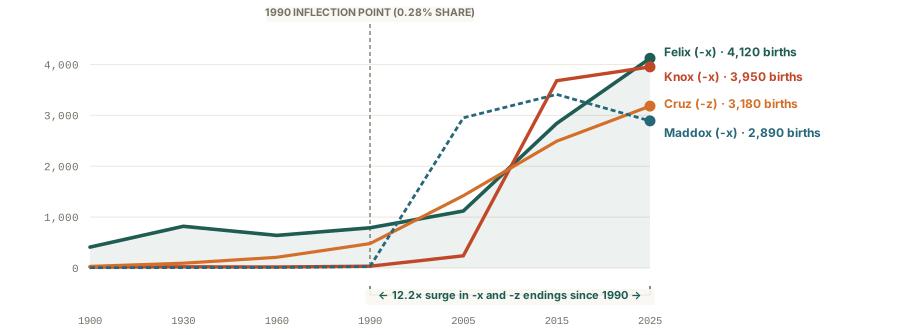
For the first 110 years of U.S. Social Security Administration (SSA) birth records, boy names ending in the letters -x or -z were statistical rarities. Between 1880 and 1990, fewer than 0.3% of boys born in the United States received a Top-1000 name ending in either consonant, with classical Felix, Max, and Rex carrying almost the entire category. Over the past three decades, however, terminal -x and -z names have surged more than 12-fold, transforming from uncommon outliers into a mainstream staple of American naming.
Examining longitudinal SSA birth cohort data reveals that this shift is not a single fad, but the convergence of three distinct linguistic streams: the revival of classical Latin roots, the migration of Anglo-Celtic surnames into first-name territory, and the rise of pan-European and Iberian -z endings.
Phonetic Acoustics: Why /ks/ and /z/ Endings Stand Out
During the late 20th century, American boy names were heavily concentrated in alveolar nasal endings (-n names like Aidan, Ethan, Ryan, and Jason) and liquid endings (-r names like Christopher and Tyler). When a single terminal sound saturates more than a third of the nursery, parents naturally gravitate toward high-contrast acoustic alternatives.
In English phonetics, the letter -x represents a voiceless velar stop followed by an alveolar sibilant (/ks/), while -z produces a crisp voiced sibilant (/z/). Both endings create a decisive, high-energy acoustic boundary at the end of a short one- or two-syllable name.
Phonetic fatigue with soft nasal endings in the 2000s opened the door for crisp, high-contrast velar and sibilant stops like -x and -z.
Three Streams Driving the Post-1990 Surge
Tracking individual trajectories across SSA birth tables shows three separate waves contributing to the 3.42% Top-1000 share recorded in 2025:
- The Anglo Surname Wave (Maddox, Knox, Hendrix, Lennox): Welsh patronymic Maddox ("son of Madoc") jumped from fewer than 30 annual births in 1990 to nearly 3,000 by 2005, followed closely by Scottish surname Knox and musical surnames Hendrix and Lennox.
- The Classical Latin Revival (Felix, Max, Rex, Ajax): Rather than fading as surname choices rose, ancient Latin Felix ("fortunate, lucky") climbed fivefold from 790 annual births in 1990 to over 4,100 births in 2025.
- The Voiced -Z Ascent (Cruz, Lorenzo, Enzo, Boaz): Spanish and Portuguese surname-turned-given-name Cruz expanded nearly sevenfold between 1990 and 2025, joined by biblical Boaz and Italian Lorenzo (frequently shortened to Enzo).
Important SSA Dataset Boundaries
When analyzing historical name curves, keep three structural properties of the U.S. Social Security dataset in mind: counts reflect Social Security card applications rather than raw hospital certificates (historically under-sampling unrecorded pre-1937 births), alternate spellings such as Jaxon and Jaxson (internal -x-) are tabulated separately from terminal -x names, and any name with fewer than 5 births in a state or year (<5) is omitted for privacy protection. You can Explore historical name trends on Name Scout to compare phonetic endings and century-long rank curves across the full SSA catalog.