
Should You Buy Points to Top Up an Award? A Break-Even Worksheet
A small points purchase can lower the cash needed for an award, but the purchase price and the award's cash charges must be counted together. Start with an available booking, subtract the points you already hold, and price the amount you would actually need to buy.
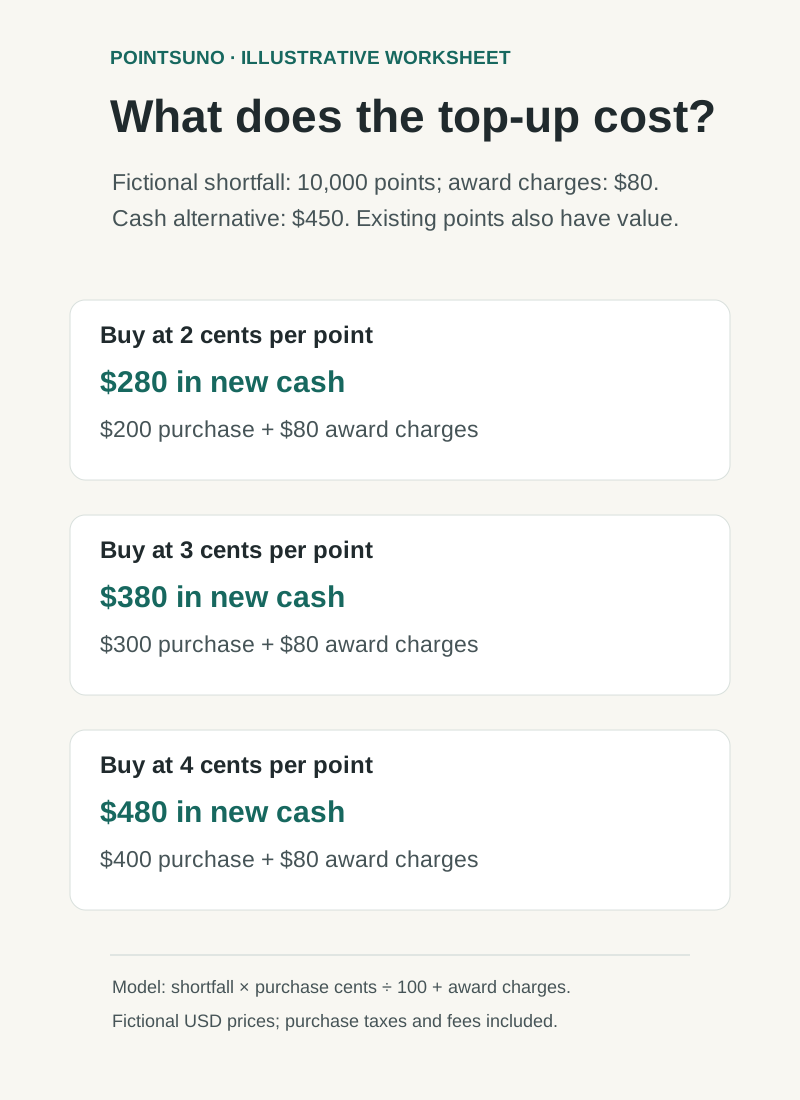
The worksheet below uses a fictional 40,000-point award, a 30,000-point existing balance, $80 in award charges and a $450 cash alternative. It is a calculation example, not a current promotion, quoted fare or recommendation to buy a particular currency.
Price the shortfall, including purchase charges
The fictional shortfall is 40,000 − 30,000 = 10,000 points. At an all-in purchase price of two cents per point, buying that amount costs $200. Adding the $80 award payment gives $280 in new cash.
At three cents, the purchase costs $300 and the new cash total is $380. At four cents, the total becomes $480, already above the $450 cash alternative before assigning any value to the existing points.
Use the checkout total rather than an advertised per-point headline. If the programme sells only fixed blocks, price the whole block you must buy, including surplus points. A promotional bonus can change the number received; it does not remove purchase taxes or award charges.
Find the new-cash ceiling
For this example, the purchase can consume at most $450 − $80 = $370 before the new cash equals the alternative. Dividing by the 10,000-point shortfall gives $370 ÷ 10,000 × 100 = 3.7 cents per purchased point.
That is a cash-only ceiling. A purchase below 3.7 cents does not establish that the award is the better overall use of your resources.
Existing points still have an alternative use
Suppose, solely for illustration, you assign the 30,000 existing points an alternative-use value of one cent each: $300. The two-cent top-up then uses $200 for the purchase, $80 for award charges and $300 of assumed existing-point value, totalling $580.
The result depends on the assumption. A balance with another useful redemption is different from one with few realistic uses. Keep that judgement separate from the cash arithmetic rather than treating already-earned points as universally worthless.
Check availability and cancellation before buying
Purchased points do not guarantee a seat. Delta's Buy Miles terms explicitly warn that award availability is limited, require cash payment of award taxes and fees, and describe purchase fees as non-refundable. These are examples from that programme's terms, not universal rules for every currency. Read the programme's own purchase terms.
Check the programme you intend to use for posting time, purchase limits, minimum blocks, eligibility and what happens after cancelling the award. A return of miles to an account is different from a refund of the cash spent buying them. Compare matching dates, room or cabin, baggage and flexibility.
Keep purchase and redemption calculations distinct
Pointsuno includes a buy-points calculation for the cost per point received and a redemption calculation that subtracts award cash charges. Use each for its own question: acquisition price first, then the booking comparison. The app's programme metadata is a reference; confirm your actual offer and award at checkout.
For flexible bank points, the transfer-bonus guide explains a separate calculation. Before committing to a destination balance, check the applicable expiry model.
Sources checked 13 October 2026. All worksheet prices and valuations are fictional; the calculation excludes travel earnings and assumes comparable bookings.