
Did Jonathan Swift Invent the Name Vanessa in 1713? What Baby Name History Shows
Open almost any popular baby-name website or parenting book and look up the name Vanessa, and you will see two confident claims: that Vanessa comes from an ancient Greek word meaning “butterfly,” or that it honors an ancient Orphic mystic goddess named “Phanessa.” Both claims are 100% historical fiction. Prior to the year 1713, the name Vanessa did not exist in Greek, Latin, Hebrew, or any other language on Earth.
Unlike names that were merely popularized by literature (such as Wendy in J. M. Barrie's 1904 Peter Pan, which had scattered pre-1904 Welsh and surname records), Vanessa is a pure, documented literary invention—created from scratch in 1713 by the Anglo-Irish satirist and cleric Jonathan Swift (author of Gulliver's Travels) as a secret poetic code name for a real woman, Esther Vanhomrigh. Even better, the reason people associate Vanessa with butterflies is that a Danish scientist named a butterfly genus after Swift's poem 94 years later! Here is the complete story of how a private 18th-century syllable puzzle grew into a Top 30 American and Top 10 European name.
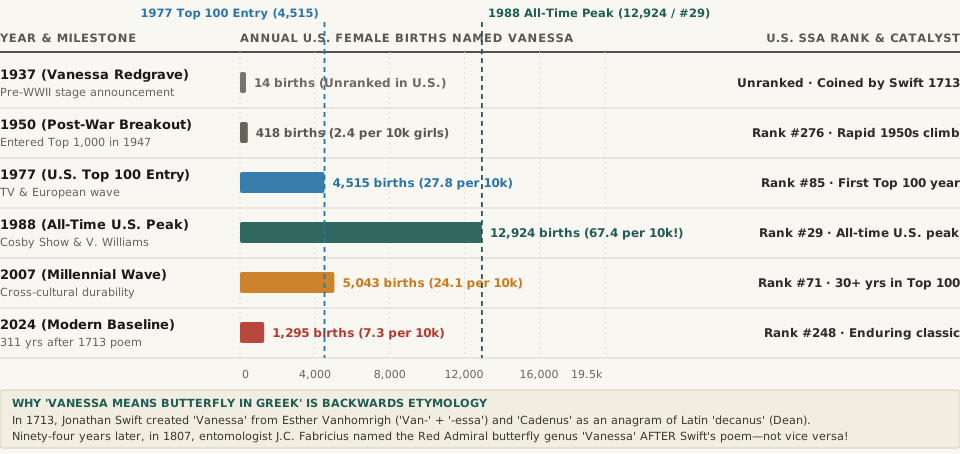
#29) in 1988. Download the full dataset: vanessa-baby-name-history-1713-jonathan-swift-to-1988-us-peak.csv.1. The 1713 Cipher: Jonathan Swift, Esther Vanhomrigh, and Cadenus and Vanessa
In 1708, while living in London as an emissary for the Irish Church, the 40-year-old writer Jonathan Swift met the family of Esther Vanhomrigh (pronounced van-UM-ree, 1688–1723), the brilliant 20-year-old daughter of a Dutch-born merchant and former Lord Mayor of Dublin, Bartholomew Vanhomrigh. Because Swift was already secretly attached to another woman also named Esther—Esther Johnson, whom he nicknamed “Stella” (from the Latin for “star”)—he needed a private, uncompromised name for Esther Vanhomrigh in their correspondence and verse.
Around 1713, the same year he was appointed Dean of St. Patrick's Cathedral in Dublin, Swift composed a 900-line autobiographical poem titled Cadenus and Vanessa. Both names in the title were deliberate wordplay puzzles:
- Cadenus (Swift Himself): A direct seven-letter anagram of the Latin word decanus (“Dean”), referring to Swift's clerical office as Dean of St. Patrick's.
- Vanessa (Esther Vanhomrigh): A melodic portmanteau combining Van- (the first three letters of her Dutch surname, Vanhomrigh) with -essa (Swift's affectionate pet diminutive for her first name, Esther).
Swift never intended the poem for public print during their lifetimes. However, after a painful estrangement from Swift, Esther Vanhomrigh died of tuberculosis in June 1723 at age 35—and in her will, she instructed her executors to publish Swift's poem and letters. When Cadenus and Vanessa appeared in print in 1726 (the exact same year Swift published Gulliver's Travels), it became a literary sensation across Britain and Ireland, introducing the word Vanessa to the world for the very first time.
“Before Jonathan Swift joined 'Van' (from Vanhomrigh) with 'Essa' (from Esther) in his 1713 poem Cadenus and Vanessa, no person in history had ever borne the name Vanessa.”
2. Debunking the “Greek Butterfly” Myth: Fabricius's 1807 Taxonomic Tribute
If Swift invented Vanessa in 1713 from a Dutch surname and a Hebrew/Persian given name (Esther), where did baby-name books get the idea that Vanessa means “butterfly” in Greek?
In 1807—ninety-four years after Swift wrote his poem—the pioneering Danish entomologist Johan Christian Fabricius (a student of Carl Linnaeus who classified over 10,000 insect species) needed new Latinized genus names for several groups of brush-footed butterflies (family Nymphalidae). Drawing on classical mythology and literature, Fabricius christened the genus containing the Red Admiral (Vanessa atalanta) and the Painted Lady (Vanessa cardui) as Vanessa. Later 20th-century baby-name compilers saw that Vanessa was the scientific genus for Painted Lady butterflies, assumed the genus name must have come from an ancient Greek root, and invented a non-existent Greek deity (“Phanessa”) to explain it—completely inverting the chronological arrow from Swift (1713) to Fabricius (1807)!
3. How Vanessa Climbed From 14 U.S. Births in 1937 to #29 in 1988
Even more surprising is how long it took Swift's invention to transition from a literary curiosity (such as John Everett Millais's famous 1868 oil painting Vanessa and Hugh Walpole's 1933 novel Vanessa) into a mainstream baby name. In the U.S. Social Security Administration baby name database (which begins in 1880 and notes standard SSA coverage limits: tracking Social Security card applications, separating exact spellings like Vanessa vs. Vanesa, and suppressing cells with fewer than 5 births), Vanessa did not enter the U.S. Top 1,000 until after World War II:
| Year or Historical Milestone | Annual U.S. Female Births Named Vanessa | U.S. SSA Popularity Rank | Share per 10,000 Female Births | Literary, Scientific & Pop-Culture Catalyst |
|---|---|---|---|---|
| 1713 (Swift Writes Poem) | 0 (Private manuscript cipher) | Pre-SSA | 0.00 per 10k | Jonathan Swift coins Van (Vanhomrigh) + Essa (Esther) |
| 1726 (First Print Publication) | 0 (Literary debut) | Pre-SSA | 0.00 per 10k | Cadenus and Vanessa published 3 years after Vanhomrigh's death |
| 1807 (Butterfly Genus Named) | <5 (Zoological taxonomy) | Pre-SSA | 0.00 per 10k | J.C. Fabricius names butterfly genus Vanessa after Swift's poem |
| 1937 (Vanessa Redgrave Born) | 14 female births | Unranked (>1,000) | 0.13 per 10k | Laurence Olivier announces Vanessa Redgrave's birth at the Old Vic |
| 1950 (Post-WWII Breakout) | 418 female births | #276 (Entered 1947) | 2.37 per 10k | Transatlantic stage adoption; Samuel Barber's 1958 Pulitzer opera Vanessa |
| 1977 (U.S. Top 100 Entry) | 4,515 female births | #85 | 27.75 per 10k | Love of Life TV heroine Vanessa Dale & European Top 100 surge |
| 1988 (All-Time U.S. Peak) | 12,924 female births | #29 (All-Time Peak) | 67.42 per 10k | Vanessa Williams's debut album & The Cosby Show's Vanessa Huxtable |
| 2007 (Millennial Wave) | 5,043 female births | #71 | 24.08 per 10k | 31 consecutive years in the U.S. Top 100 (1977–2007); #7 in 1990s Germany |
| 2024 (Modern Baseline) | 1,295 female births | #248 | 7.32 per 10k | Enduring trilingual classic 311 years after Swift's 1713 invention |
Two 20th-century catalysts turned Swift's 18th-century neologism into a global staple: first, on January 30, 1937, English actor Sir Michael Redgrave named his newborn daughter Vanessa Redgrave (inspired by Hugh Walpole's 1933 novel and Swift's poem), and Laurence Olivier famously announced to the audience at London's Old Vic after a performance of Hamlet: “Ladies and gentlemen, tonight a great actress has been born—Laertes has a daughter.” Second, during the 1970s and 1980s, television characters (including Vanessa Huxtable on The Cosby Show) and singer/actress Vanessa Williams propelled the name to #29 in the United States in 1988 (12,924 births) and #7 across Germany during the 1990s.
Explore Literary Inventions and Generational Curves on Name Scout
Want to compare how Jonathan Swift's Vanessa (1713), J. M. Barrie's Wendy (1904), and William Shakespeare's Jessica (The Merchant of Venice, 1596) and Miranda (The Tempest, 1611) rose and peaked across U.S. decades? Explore historical name trends on Name Scout to inspect year-by-year birth counts, spelling splits, and rank momentum.