
Did 'Peter Pan' Invent the Name Wendy in 1904? What Historical Baby Name Records Show
A beloved piece of literary trivia claims that Scottish playwright and novelist J. M. Barrie single-handedly invented the given name Wendy out of thin air for his heroine Wendy Moira Angela Darling when his stage play Peter Pan; or, The Boy Who Wouldn't Grow Up premiered at the Duke of York's Theatre in London on December 27, 1904. According to the story, no child in the English-speaking world had ever been named Wendy before that night.
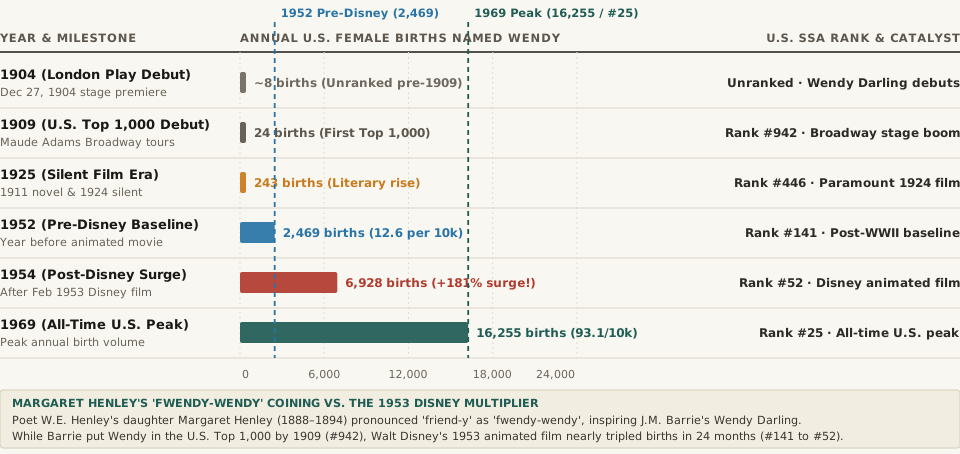
When you audit historical British parish registers, 19th-century U.S. Census schedules, and the U.S. Social Security Administration (SSA) baby name ledger from 1880 to 2024, the empirical truth turns out to be even more fascinating than the myth. While rare scattered occurrences of the letter sequence Wendy existed before 1904, J. M. Barrie independently coined the modern given name from a child's speech impediment (“fwendy-wendy”)—and two distinct cultural waves (Barrie's 1904–1911 stage/book phenomenon and Walt Disney's February 1953 animated film) propelled Wendy from fewer than 10 U.S. female births per year to #25 nationwide (16,255 girls in 1969).
1. The Tragic Real-Life Inspiration: Margaret Henley (1888–1894) and “Fwendy-Wendy”
Where did J. M. Barrie get the name for Wendy Darling? In the early 1890s, Barrie was a close friend of the English poet and critic William Ernest Henley (best remembered for his 1875 poem “Invictus” and as Robert Louis Stevenson's inspiration for Long John Silver in Treasure Island). Henley and his wife Anna had a single child, a spirited golden-haired daughter named Margaret Emma Henley, born on September 4, 1888.
As a toddler, Margaret adored Barrie and called him her great “friend” or “friend-y.” Because of a childhood rhotacism—the common early-childhood tendency to pronounce the English r sound as a labial-velar w—she pronounced “friend-y” as “fwendy” or “my fwendy-wendy.”
Tragically, Margaret Henley died of cerebral meningitis on February 11, 1894, at just five years old, and was buried at Cockayne Hatley in Bedfordshire. Ten years later, when Barrie wrote the script for Peter Pan in 1904, he memorialized Margaret in two ways: he turned her coined word Wendy into the given name of the Darling family's eldest daughter, and he wove into the play the famous detail that Peter Pan's house in Neverland was built around Wendy after the Lost Boys accidentally shot her down—wearing the button-necklace gift that Margaret herself had once called her “kiss.”
“Margaret Henley called J. M. Barrie her 'fwendy-wendy'—a five-year-old's pronunciation of 'friend-y'—before she died in 1894. Ten years later, Barrie immortalized her nickname as Wendy Moira Angela Darling.”
2. Did Anyone Have the Name Wendy Before December 27, 1904?
If Barrie coined Wendy from Margaret Henley's “fwendy-wendy,” why do onomasticians note that he wasn't the absolute first person in history to write the five letters W-e-n-d-y? Historical census and parish records show two tiny, unrelated pre-1904 streams:
- Rare Welsh Hypocoristic of Gwendolen / Gwendoline: In Wales and western England, names beginning with the Welsh element gwen (“white, fair, blessed,” such as Gwendolen, Gwendoline, and Guinevere) were occasionally shortened in spoken family usage to Wen or Wendy during the late 19th century.
- Rare English Surname and Masculine Given Name in 1880 Census Records: As documented on Wikipedia's history of the name Wendy, the 1880 United States Census recorded roughly 20 individuals (many of them boys or men) bearing Wendy or Wende as a transferred English surname (historic patronymic/toponymic surname borne by 16th-century physician Thomas Wendy, royal physician to King Henry VIII and Queen Mary I).
However, as a recognized mainstream female first name, Wendy was functionally non-existent before 1904. In the U.S. Social Security Administration database (which tracks every year from 1880 onward and suppresses year-gender cells with fewer than 5 occurrences), Wendy did not crack the U.S. Top 1,000 once between 1880 and 1908.
3. The Two Empirical Waves: 1909 Broadway Debut vs. 1953 Walt Disney Surge
Tracking the year-by-year SSA trajectory of Wendy reveals a classic two-stage cultural rocket—first propelled by live theater and print, and forty years later supercharged by Technicolor animation and television:
| Year / Cultural Milestone | Annual U.S. Female Births Named Wendy | U.S. SSA Female Popularity Rank | Share per 10,000 Female Births | Cultural & Historical Catalyst |
|---|---|---|---|---|
| 1880 (Pre-Barrie Baseline) | <5 female births | Unranked (>1,000) | 0.02 per 10k | Rare Welsh pet form of Gwendolen or transferred surname |
| 1894 (Death of Margaret Henley) | <5 female births | Unranked (>1,000) | 0.02 per 10k | Margaret Henley (1888–1894) coins “fwendy-wendy” for Barrie |
| 1904 (Dec 27 London Play Debut) | 8 female births | Unranked (>1,000) | 0.03 per 10k | J. M. Barrie debuts Wendy Moira Angela Darling on stage |
| 1909 (U.S. Top 1,000 Debut) | 24 female births | #942 (Debut) | 0.07 per 10k | Maude Adams's Broadway tours of Peter Pan reach U.S. cities |
| 1912 (Post-1911 Novel) | 58 female births | #695 | 0.06 per 10k | Barrie publishes novelization Peter and Wendy (1911) |
| 1925 (Silent Film Adaptation) | 243 female births | #446 | 0.20 per 10k | Paramount's December 1924 silent film starring Mary Brian as Wendy |
| 1952 (Pre-Disney Baseline) | 2,469 female births | #141 | 12.63 per 10k | Post-WWII baseline immediately before Disney animated release |
| 1954 (Post-Disney Surge) | 6,928 female births (+181%) | #52 | 34.18 per 10k | Walt Disney's Feb 5, 1953 animated Peter Pan triggers boom |
| 1969 (All-Time U.S. Peak) | 16,255 female births | #25 (Peak) | 93.10 per 10k | NBC Mary Martin broadcasts, Disney theatrical re-issues & Wendy's (1969) |
| 2024 (Modern Baseline) | 398 female births | #720 | 2.25 per 10k | Enduring 120-year literary classic still inside the U.S. Top 750 |
Wave 1 (1905–1935): From Stage Novelty to Established Literary Name
After American actress Maude Adams opened Peter Pan on Broadway at the Empire Theatre in November 1905 and toured across the United States, combined with Barrie's 1911 novel Peter and Wendy and Paramount's 1924 silent film adaptation, Wendy steadily climbed from #942 in 1909 to #446 in 1925 and broke into the Top 200 during the late 1930s after British actress Wendy Hiller (born 1912, herself part of the first British post-Barrie cohort) starred in Pygmalion (1938).
Wave 2 (1953–1970): The Walt Disney Multiplier and the 1969 Peak
The biggest inflection point in the name's American history arrived on February 5, 1953, when Walt Disney Productions released its animated feature Peter Pan (with Kathryn Beaumont voicing Wendy Darling), followed in 1954–1960 by Mary Martin's live NBC color television broadcasts watched by over 65 million Americans. In just two calendar years (1952 to 1954), annual U.S. female births named Wendy nearly tripled from 2,469 (#141) to 6,928 (#52).
As the children who grew up watching the 1953 Disney release and the NBC broadcasts began naming their own daughters in the late 1960s, Wendy reached its all-time American popularity peak at #25 across four consecutive years (1967–1970), topping out at 16,255 baby girls in 1969 (the exact same year Dave Thomas named the Wendy's restaurant chain after his eight-year-old daughter Melinda Lou “Wenda/Wendy” Thomas, born in 1961 during the Disney boom).
Compare Literary and Pop-Culture Name Inflections on Name Scout
Curious how Wendy's two-wave trajectory (1904 stage premiere + 1953 Disney release) compares with one-year movie explosions like Madison after Splash (1984) or literary inventions like Vanessa (coined by Jonathan Swift in 1713) and Miranda (coined by William Shakespeare in The Tempest, 1611)? Explore historical name trends on Name Scout to plot century-long birth curves, rank velocity spikes, and generational peaks across the full U.S. Social Security dataset.