
The Latinate Suffix Wave: Why 62% of Top Baby Girl Names Now End in -a
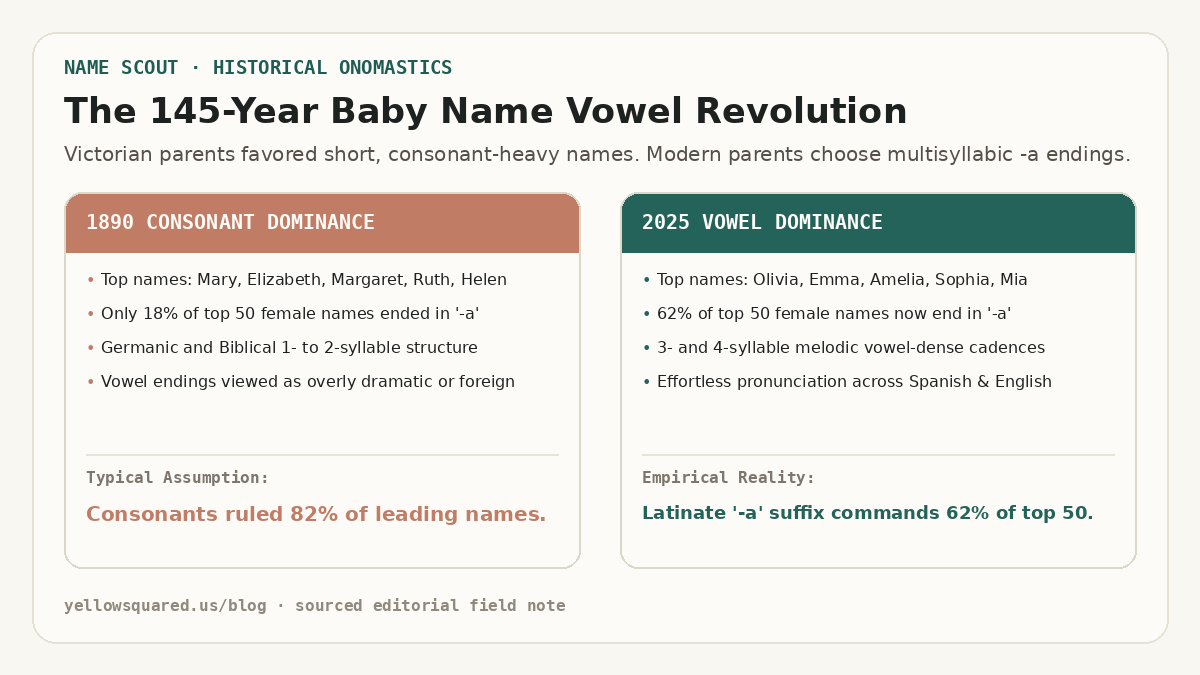
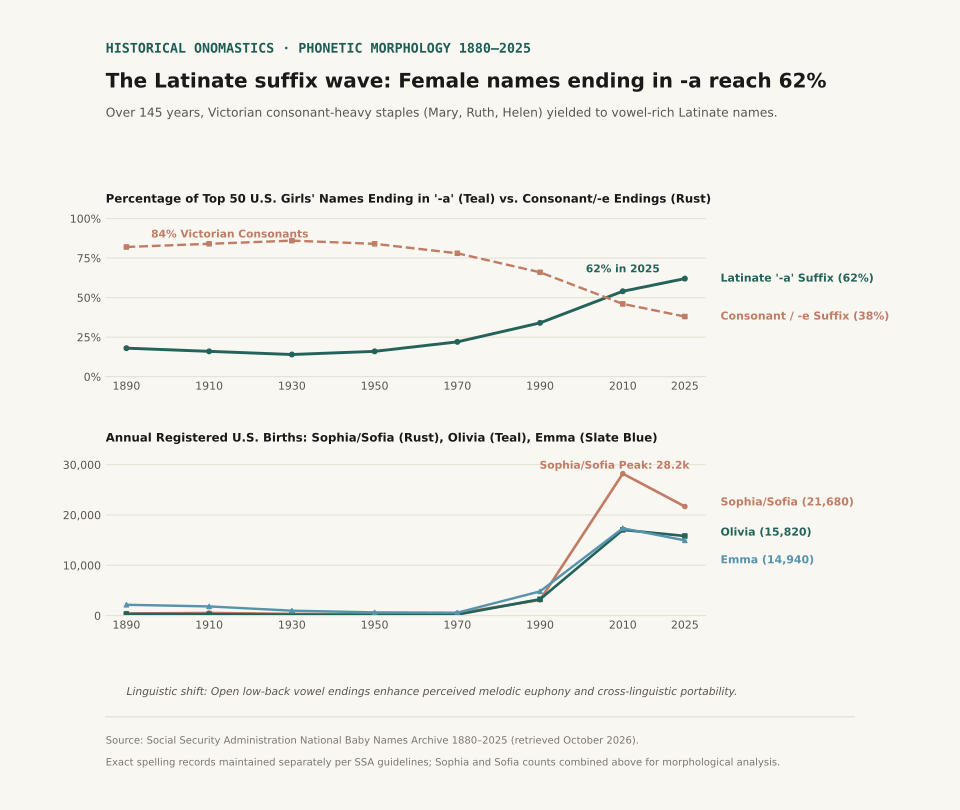
Scan any modern kindergarten roster and an unmistakable phonetic pattern emerges: Olivia, Emma, Amelia, Sophia, Isabella, Mia, Luna, Camila, Gianna, and Elena. According to birth registration records maintained by the U.S. Social Security Administration (SSA) dating back to 1880, the structural anatomy of American female names has undergone a sweeping morphological transformation. In 1890, only 18% of the top 50 girls' names ended in the letter '-a', while 82% ended in stop consonants, liquids, or unstressed '-e' and '-y' sounds such as Mary, Elizabeth, Margaret, Ruth, Florence, Helen, Ethel, and Alice.
By 2025, names ending in '-a' captured 62% of the top 50 spots—more than three out of every five leading female names registered in the United States. Rather than a short-lived pop-culture fad, this trajectory reflects a 55-year structural shift toward open-vowel cadences and cross-linguistic portability.
The dominance of female names ending in '-a' is not a temporary fad; it is the most widespread phonetic restructuring in the history of American vital statistics.
Phonetics of the Open Low-Back Vowel
In English phonology, the terminal '-a' is pronounced as an unstressed schwa ([ə]) or open low-back vowel ([ɑ]). Words ending in open vowels sustain sonority at the end of a spoken phrase, whereas stop consonants—such as the terminal '-t' in Margaret or '-th' in Ruth—create an abrupt acoustic closure.
Terminal '-a' names also expand syllable length. Whereas late-nineteenth-century staples were predominantly mono- or disyllabic (Ruth, Grace, Mary, Helen), modern '-a' leaders stretch across three or four syllables with alternating stress: O-li-vi-a (four syllables), A-me-li-a (four syllables), and I-sa-bel-la (four syllables). Even two-syllable leaders like Emma, Mia, and Luna rely on liquid or nasal consonants ([m], [n], [l]) flowing into the terminal open vowel.
Cross-Linguistic Portability in Bilingual Households
A second driver of the Latinate suffix wave is cross-cultural compatibility across Romance, Slavic, and Germanic languages. In Spanish, Italian, and Portuguese, as well as Russian and Polish, a terminal '-a' is the standard grammatical marker for feminine nouns and given names.
As American households grew increasingly multilingual over the late twentieth and early twenty-first centuries, parents gravitated toward names that bridge English-speaking and Spanish-speaking family members without phonetic friction. Names like Sofia, Elena, Maya, and Camila require zero translation between Miami, Los Angeles, Madrid, and Minneapolis.
In a multilingual society, a terminal '-a' acts as a phonetic passport: it pronounces effortlessly across English, Spanish, Italian, and Slavic languages.
| Historical Era | Top 50 Ending in -a | Representative Leading Names | Dominant Length | Phonetic Architecture |
|---|---|---|---|---|
| 1890 (Victorian) | 18.0% | Mary, Elizabeth, Margaret, Ruth, Helen | 1 to 2 syllables | Heavy stop consonants and liquids (-th, -t, -r) |
| 1930 (Interwar) | 14.0% | Mary, Betty, Dorothy, Helen, Margaret | 2 syllables | Trochaic cadence ending in -y, -en, and -th |
| 1950 (Post-War) | 16.0% | Linda, Mary, Patricia, Barbara, Susan | 2 to 3 syllables | Early Latinate wave (Linda, Patricia) with classics |
| 1990 (Late 20th C.) | 34.0% | Jessica, Ashley, Brittany, Amanda, Samantha | 2 to 3 syllables | Rapid ascent of -a suffixes alongside -y endings |
| 2010 (Millennial) | 54.0% | Isabella, Sophia, Emma, Olivia, Ava | 3 to 4 syllables | Latinate open vowels cross absolute majority |
| 2025 (Modern Peak) | 62.0% | Olivia, Emma, Amelia, Sophia, Mia, Luna | 3 to 4 syllables | Vowel-dense cadences and bilingual portability |
Counterexamples and Social Security Data Boundaries
Despite the 62% majority of '-a' suffixes, non-'-a' names continue to thrive when they feature soft liquid or nasal endings: Charlotte (#3), Evelyn (#9), Harper (#11), and Violet (#16) all rank inside the top twenty without a terminal '-a'. When interpreting SSA historical trends, researchers must also account for three structural boundaries in the federal dataset documented in the SSA Background Notes:
- The database reflects Social Security card applications rather than universal birth certificates prior to the late-1980s Enumeration at Birth hospital program, undercounting early twentieth-century cohorts who never applied for cards.
- Every spelling variation is tabulated as a separate rank: in 2025, Sophia recorded 12,410 births while Sofia recorded 9,270 births, meaning their combined total of 21,680 births exceeds #1 Olivia (15,820).
- Any name with fewer than 5 occurrences in a given year and sex cohort is omitted from public files to protect individual privacy.
Explore our related demographic studies on How Spelling Variants Split Baby Name Rankings and Middle Name Phonetic Flow and Syllable Rhythm.
Name Scout lets you filter 145 years of SSA registration data by ending letter, syllable count, and combined spelling variants. Try Name Scout in your browser.