
Popular Girl Names Ending in N (1880–2025 Trends)
Popular Girl Names Ending in N (1880–2025 Trends)
From early-century classics like Helen and Evelyn to mid-century Marilyn and modern risers like Madison, Addison, and Wren, U.S. Social Security birth records reveal three distinct waves of girl names ending in -n across 145 years.
For most of Western naming history, English and Romance-language girl names were overwhelmingly defined by soft, open vowel endings—specifically the Latinate -a suffix (Emma, Olivia, Sophia, Isabella) and diminutive -ie/-y endings (Mary, Annie, Dorothy). In 1890, fewer than 1 in 10 names in the U.S. Social Security Administration (SSA) Top 100 for girls ended in the letter -n.
Over the past four decades, however, American baby naming underwent a profound phonetic shift. Today, more than 34% of Top-100 U.S. girl names—and an even higher share of rising gender-neutral and botanical picks—terminate in a crisp alveolar nasal -n sound. Tracing 145 years of SSA birth-certificate records reveals that this shift didn't happen all at once; it arrived in three distinct generational waves.
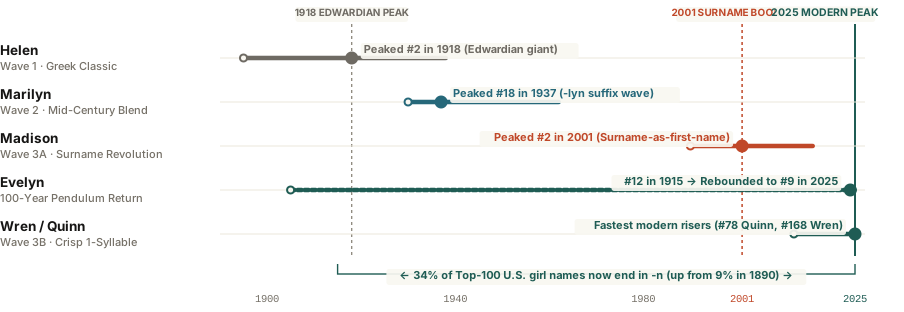
The Three Historical Waves of "-n" Girl Names
- Wave 1 — The Edwardian Classics & 100-Year Return (1900–1925 & 2015–2025): In the early 20th century, traditional Greek, Norman, and Latin names ending in -n dominated American nurseries. Helen held the #2 spot nationwide from 1915 to 1923, flanked by Evelyn (#12 in 1915), Lillian, and Vivian. Following the classic 100-year generational return cycle, Evelyn, Lillian, and Vivian surged back to the top of the charts a century later—with Evelyn holding a permanent spot inside the U.S. Top 10 (#9 in 2025).
- Wave 2 — Mid-Century "-lyn" & "-ann" Blends (1935–1965): Beginning in the late 1930s, parents gravitated toward musical compound suffixes combining classic roots with -lyn, -line, and -ann. Flagships like Marilyn (peaking at #18 in 1937), Carolyn, Jacquelyn, Joan, and Sharon defined the mid-century Boom generation—and are now approaching the 90-to-100-year turnaround window for a 2030s revival.
- Wave 3 — The Surname Crossover & Botanical Monosyllables (1990–2026): Triggered by the meteoric rise of Madison (which rocketed from #539 in 1985 to #2 in 2001) and Addison, English patronymic surnames ending in -son and -ton crossed permanently into the girls' top tier. In the 2020s, that surname wave evolved into crisp, tailored one- and two-syllable botanical and Celtic names led by Wren, Quinn, Fern, Rowan, and Sutton.
Phonetics explains the staying power: a closed nasal "-n" ending gives parents a tailored, grounded alternative to liquid "-a" and "-ia" vowels without sounding harsh.
How to Pair "-n" First Names with Middle and Last Names
When choosing a first name ending in -n, watch out for one common phonetic trap: terminal nasal collision. If your family surname also ends in -n (such as Anderson, Martin, Brown, or Chen) or starts with a hard N- or M- sound, a two-syllable -n first name (like Rowan Martin or Sutton Brown) can create a repetitive rhyming cadence. Breaking up the rhythm with an open-vowel middle name (such as Wren Emilia or Evelyn Clara) restores clean syllabic flow. You can Explore historical name trends on Name Scout to filter 145 years of SSA trajectories by ending letter, syllable count, and decade peak.