
Golden Hour vs. Blue Hour: What Is the Difference?
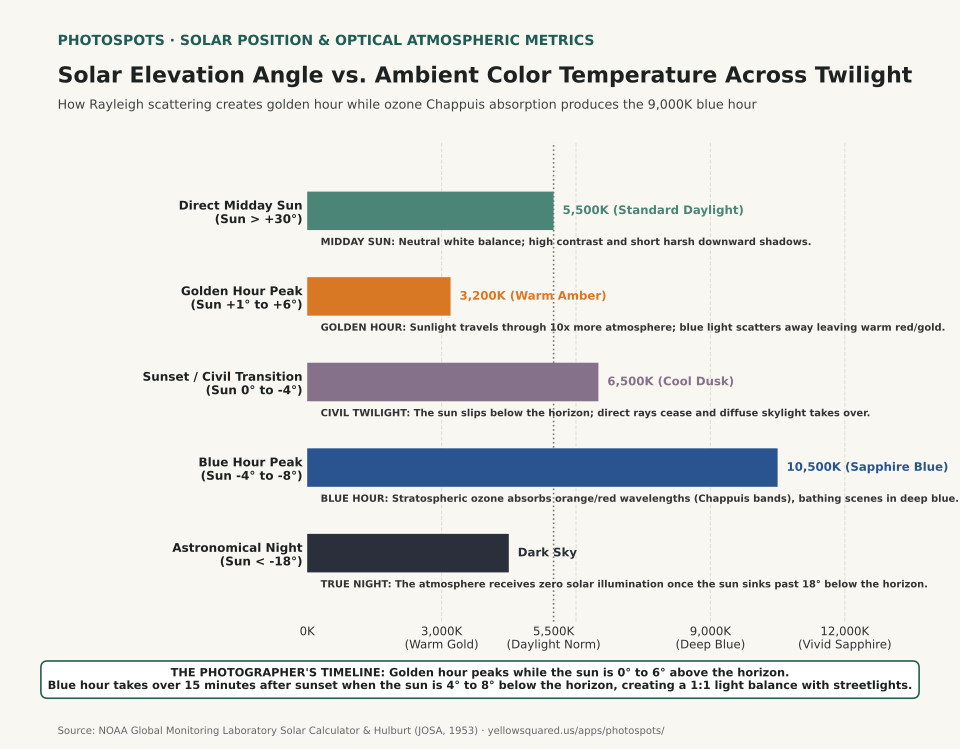
Golden hour occurs when the sun is between 0 and 6 degrees above the horizon producing warm 3,200K amber illumination, while blue hour takes place when the sun is 4 to 8 degrees below the horizon driven by stratospheric ozone absorption that bathes scenes in 9,000K to 12,000K sapphire light. Knowing the exact solar elevation thresholds for each phase allows photographers to anticipate rapid exposure shifts and capture balanced cityscapes before natural sky detail fades.
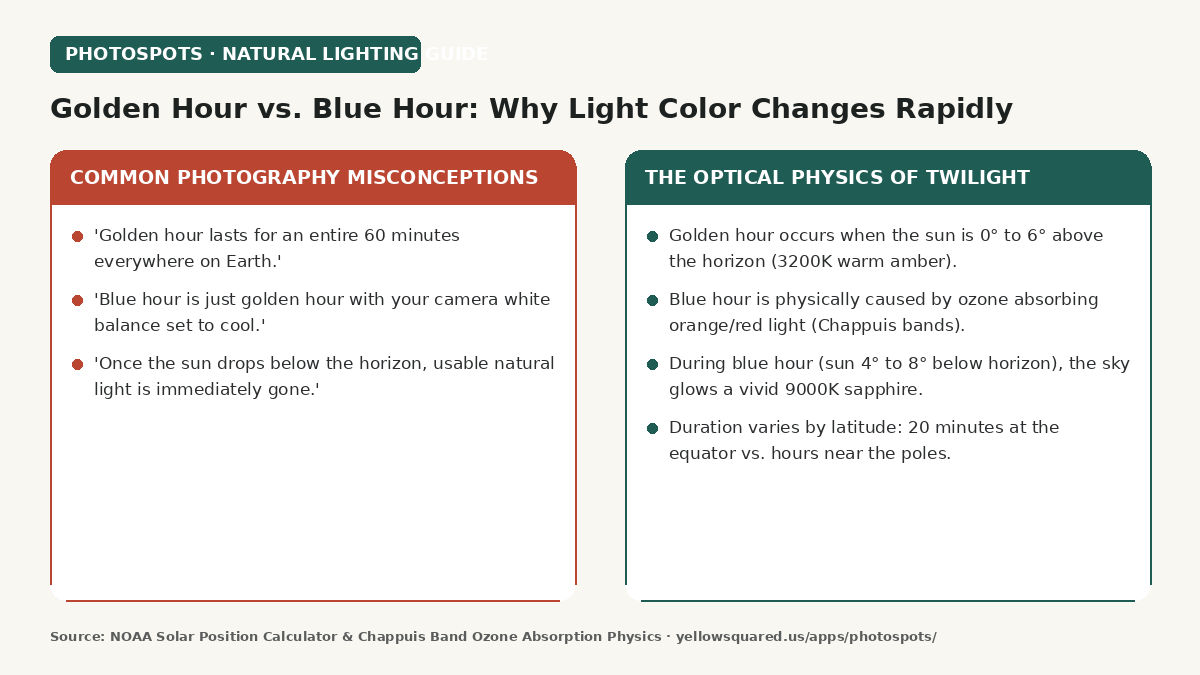
Every photographer has heard that the best light happens around sunrise and sunset. However, many creators treat twilight as a generic warm gradient. In atmospheric optics, golden hour and blue hour are caused by completely different physical phenomena governed by precise solar elevation angles relative to the horizon.
Golden hour is defined by sunlight surviving the atmosphere; blue hour is defined by ozone absorbing every color except sapphire blue.
The Physics of Golden Hour: Rayleigh Scattering
When the sun approaches the horizon (+6° to 0°), solar rays must travel through nearly ten times more atmospheric air mass than at midday. Along this extended path, short blue and violet wavelengths scatter away via Rayleigh scattering. The longer red, orange, and amber wavelengths penetrate directly to earth, casting warm, directional light with soft contrast and elongated shadows that flatter facial features and accentuate architectural texture.
The Physics of Blue Hour: Chappuis Ozone Absorption
For decades, popular photography guides falsely claimed that blue hour was merely residual Rayleigh scattering in reverse. In 1953, atmospheric geophysicist E.O. Hulburt proved that the vivid blue color of the twilight sky is caused by the Chappuis absorption bands of the stratospheric ozone layer.
When the sun is between 4° and 8° below the horizon, direct solar rays pass obliquely through the ozone layer high above the earth. Ozone molecules selectively absorb yellow and orange light (500 to 700 nm), allowing only deep blue light to illuminate the troposphere below. This yields a rich, saturated 9,000K to 12,000K sapphire illumination that cannot be replicated by camera white balance alone.
Golden Hour vs. Blue Hour Comparison
| Lighting Phase | Solar Elevation Angle | Color Temperature | Ideal Camera Subjects |
|---|---|---|---|
| Golden Hour | 0° to +6° Above Horizon | 3,000K to 3,500K (Warm) | Portraits, natural landscapes, backlit foliage, warm architectural facades |
| Civil Twilight | 0° to -4° Below Horizon | 5,500K to 7,000K (Neutral) | Street photography, environmental portraits, transitional cityscapes |
| Blue Hour | -4° to -8° Below Horizon | 9,000K to 12,000K (Sapphire) | Illuminated city skylines, bridges, water reflections, long exposures |
| Astronomical Night | < -18° Below Horizon | Sky Dark (<4,500K) | Astrophotography, Milky Way, star trails, light painting |
Shooting Strategies for Each Window
- Shoot blue hour cityscapes with 1:1 exposure balance: During peak blue hour (roughly 20 to 30 minutes after sunset), the ambient sapphire glow of the sky matches the exposure level of illuminated building windows, eliminating blown-out highlights.
- Use manual white balance to preserve mood: Auto White Balance (AWB) will attempt to correct the warm gold or deep blue into clinical neutral grey. Set your camera white balance manually to 5,500K (Daylight) to capture true atmospheric tones.
- Track sun angles on your photowalks: To plan outdoor shoots around exact solar elevation angles and track your walking routes, discover scouting features in PhotoSpots.