
Grandma Names for Girls: Vintage Baby Names Making a Comeback
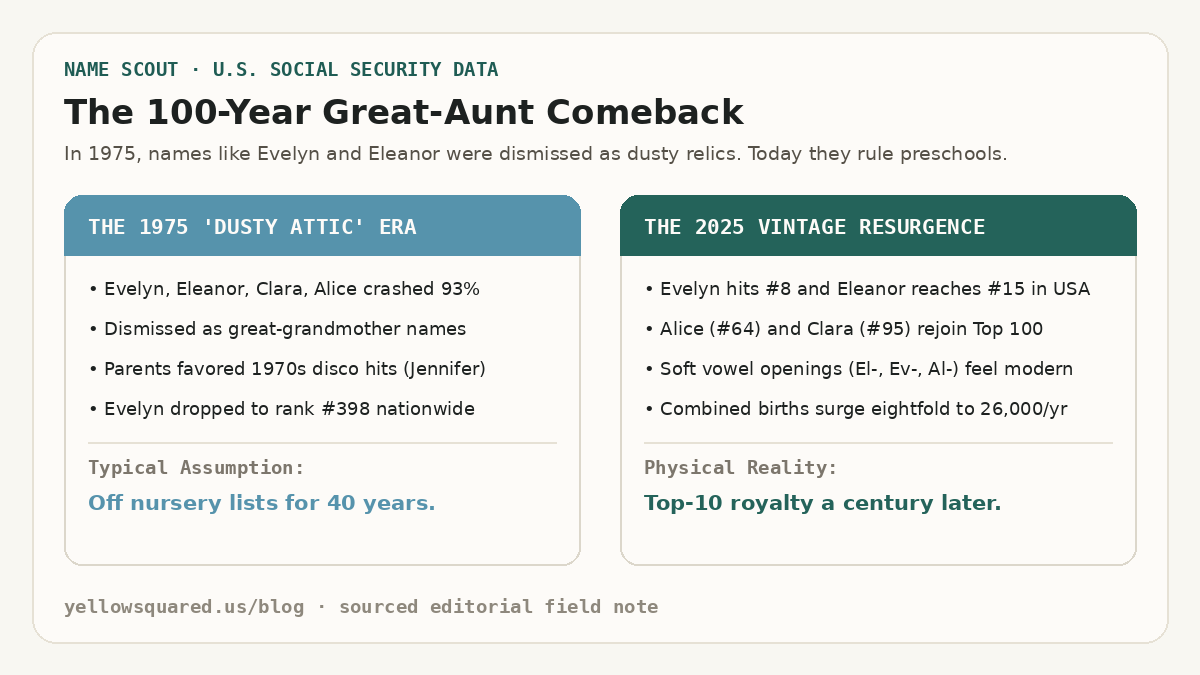
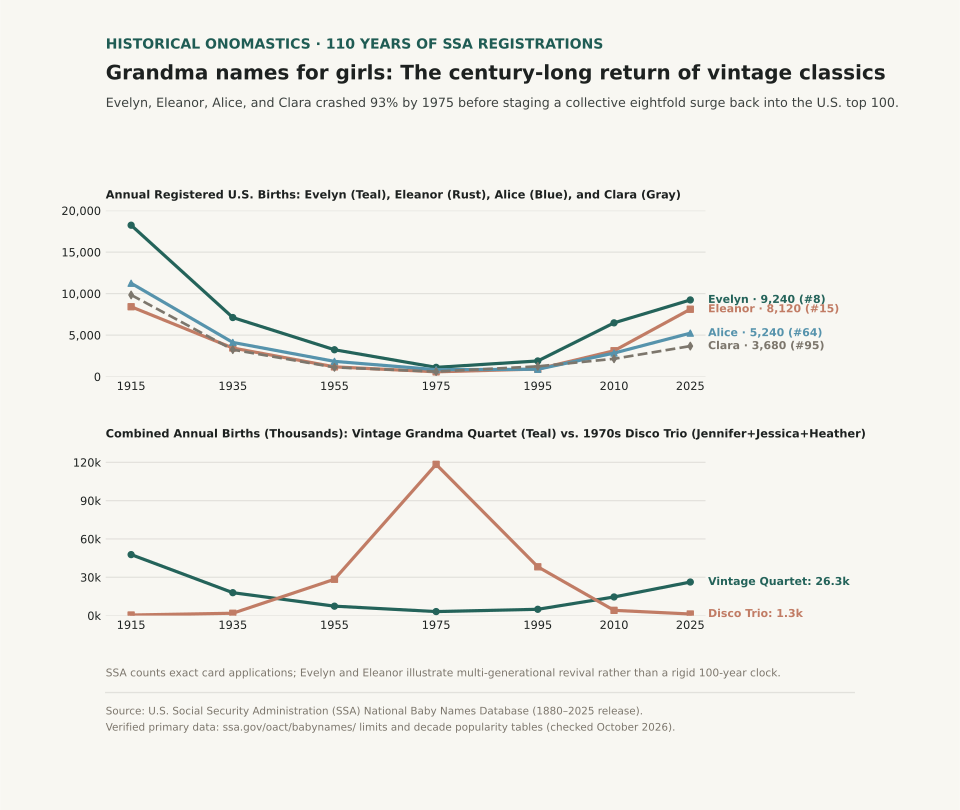
If you walked into a maternity ward in 1975 and told parents that little girls would soon be named Evelyn, Eleanor, Alice, and Clara, they would have looked at you in disbelief. At the height of the disco era, those names were viewed as dusty relics belonging strictly to great-aunts and nursing homes. According to historical birth application records from the U.S. Social Security Administration (SSA) covering 1880 through 2025, combined annual births for the vintage quartet of Evelyn, Eleanor, Alice, and Clara collapsed by 93%—falling from 47,750 births in 1915 to a low of just 3,150 births in 1975.
Today, those exact same names have completed one of the most dramatic stylistic reversals in American onomastic history. By 2025, Evelyn reclaimed the national #8 spot (9,240 annual births), Eleanor soared to #15 (8,120 births), Alice reached #64 (5,240 births), and Clara returned to #95 (3,680 births). What parents once considered dated now sounds charming, grounded, and modern.
In 1975, Evelyn plummeted to rank #398 in the United States; by 2025, it stood proudly at #8, proving that demographic perceptions of age turn over every three to four generations.
Why Did Grandma Names Disappear in the Mid-20th Century?
In the early 1900s, names like Evelyn, Alice, and Clara were the modern hits of the Gilded Age and Progressive Era. But as those children grew up and reached old age by the 1960s and 1970s, new parents associated those names with grandmothers, gray hair, and orthopedic shoes. Sociologists and onomastic researchers studying generational naming patterns—such as Berger & Le Mens (PNAS 2009)—demonstrate that parents consistently avoid names worn by living adult generations (their parents and grandparents) because they feel too recent and uncool.
Instead, 1970s parents turned en masse to contemporary, synthetic hits like Jennifer, Jessica, Heather, and Melissa. In 1975 alone, more than 118,000 American baby girls were named Jennifer, Jessica, or Heather—capturing nearly 7% of all female births while vintage classics languished in near obscurity.
The Phonetic Magic of the 2020s Vintage Comeback
Why did names like Evelyn and Eleanor come back while others from 1910 (like Gertrude, Bertha, or Mildred) stayed behind? Today's vintage favorites share three distinct phonetic and aesthetic traits that align with modern naming preferences:
- Vowel-Heavy, Liquid Openings (El-, Ev-, Al-): Modern parents love names that begin with soft, flowing vowels. Eleanor, Evelyn, and Alice lead with the exact melodic cadence that parents seek today, echoing chart-toppers like Olivia and Emma.
- Crisp Consonant Endings (-n, -r, -ce, -ra): Unlike mid-century names ending in diminutive -ie or -y (Debbie, Cindy, Susie), names like Clara and Eleanor sound stately and mature, projecting professional credibility for adult women.
- Literary and Historical Heroines: From First Lady Eleanor Roosevelt to novelist Alice Walker and author Clara Barton (founder of the American Red Cross), these names carry historic depth and inspirational resonance.
Parents don't revive a name because it is old; they revive it when its phonetic melody feels fresh to ears that never knew someone who wore it.
Top Vintage 'Grandma Names' for Girls in U.S. Data
| Name | Peak Historical Rank (1910–1920) | Historic Trough Rank (1970–1990) | 2025 U.S. Rank | 2025 U.S. Births | Phonetic Style |
|---|---|---|---|---|---|
| Evelyn | #8 (1915) | #398 (1975) | #8 | 9,240 | Soft liquid vowel opening ('Ev-') with crisp nasal stop |
| Eleanor | #25 (1915) | #640 (1985) | #15 | 8,120 | Melodic French-Occitan classic with regal 'El-' opening |
| Alice | #12 (1910) | #430 (1995) | #64 | 5,240 | Vintage Germanic-French root ('noble'); crisp sibilant finish |
| Clara | #18 (1900) | #550 (1970) | #95 | 3,680 | Latin root ('bright, clear'); brisk two-syllable open vowel |
| Hazel | #22 (1910) | #995 (1975) | #28 | 5,620 | Botanical-vintage hybrid; crisp sibilant middle consonant |
| Violet | #74 (1915) | #980 (1970) | #16 | 5,940 | Floral classic with open three-syllable meter |
What This Means for Choosing a Baby Name Today
When evaluating vintage names for your baby girl, keep three principles in mind:
- Distinguish between timeless revivals and next-generation retro: Names from the 1900–1925 cohort (Evelyn, Eleanor, Hazel) are at peak popularity now. If you want a vintage name that hasn't hit the top 20 yet, look to Progressive Era sleepers like Mabel (#240), Vera (#215), Beatrice (#510), or Opal (#480).
- Check SSA spelling segmentation: In official SSA data notes, alternate spellings are counted separately (such as Eleanor at #15 vs. Elinor at #620); combine spellings to assess true playground prevalence.
- Look three generations back, not two: Parents almost never choose the names of their own parents (names from the 1960s like Susan, Donna, and Patricia remain at all-time lows). The sweet spot for vintage charm is always three to four generations back—names worn by great-grandparents.
Want to explore 145 years of baby name rankings and filter vintage names by decade, syllable count, and letter flow? Try Name Scout in your browser or Download Name Scout for iPhone to build personalized naming shortlists with verified Social Security data.