
Guide Number (GN) Flash Math: How Distance and Aperture Control On-Camera and Studio Strobe Power
Before through-the-lens (TTL) pre-flashes existed, photographers calculated every flash exposure in two seconds of mental arithmetic using a single number stamped on the back of the strobe: its Guide Number (GN) (Guide number - Wikipedia). Even today, whenever you switch a speedlight or studio strobe to manual power (1/1 down to 1/128) so your lighting stays 100% consistent across a portrait session, the ISO 1230 Guide Number equation tells you the exact aperture required for any flash-to-subject distance (Flash (photography) - Wikipedia).
Understanding how Guide Numbers scale with the square root of flash power and ISO lets you position key lights, softboxes, and rim strobes with mathematical precision—and verify your ambient-to-flash ratio when you Measure ambient and studio lighting in Lumet.
The Core ISO 1230 Formula: GN = Aperture × Distance
Standardized at ISO 100 (and stated in either meters or feet), a flash's Guide Number is the product of the lens f-number (N) and the flash-to-subject distance (d) that produces a proper middle-gray exposure (Guide number - Wikipedia):
GN = N × d · f-number (N) = GN / d · Distance (d) = GN / N
Why does a simple product of f-number and distance hold constant across every distance? Because both lens aperture and point-source light propagation follow an inverse-square law (F-number - Wikipedia):
- Distance Falloff (1 / d²): Moving a flash twice as far from your subject (say, from
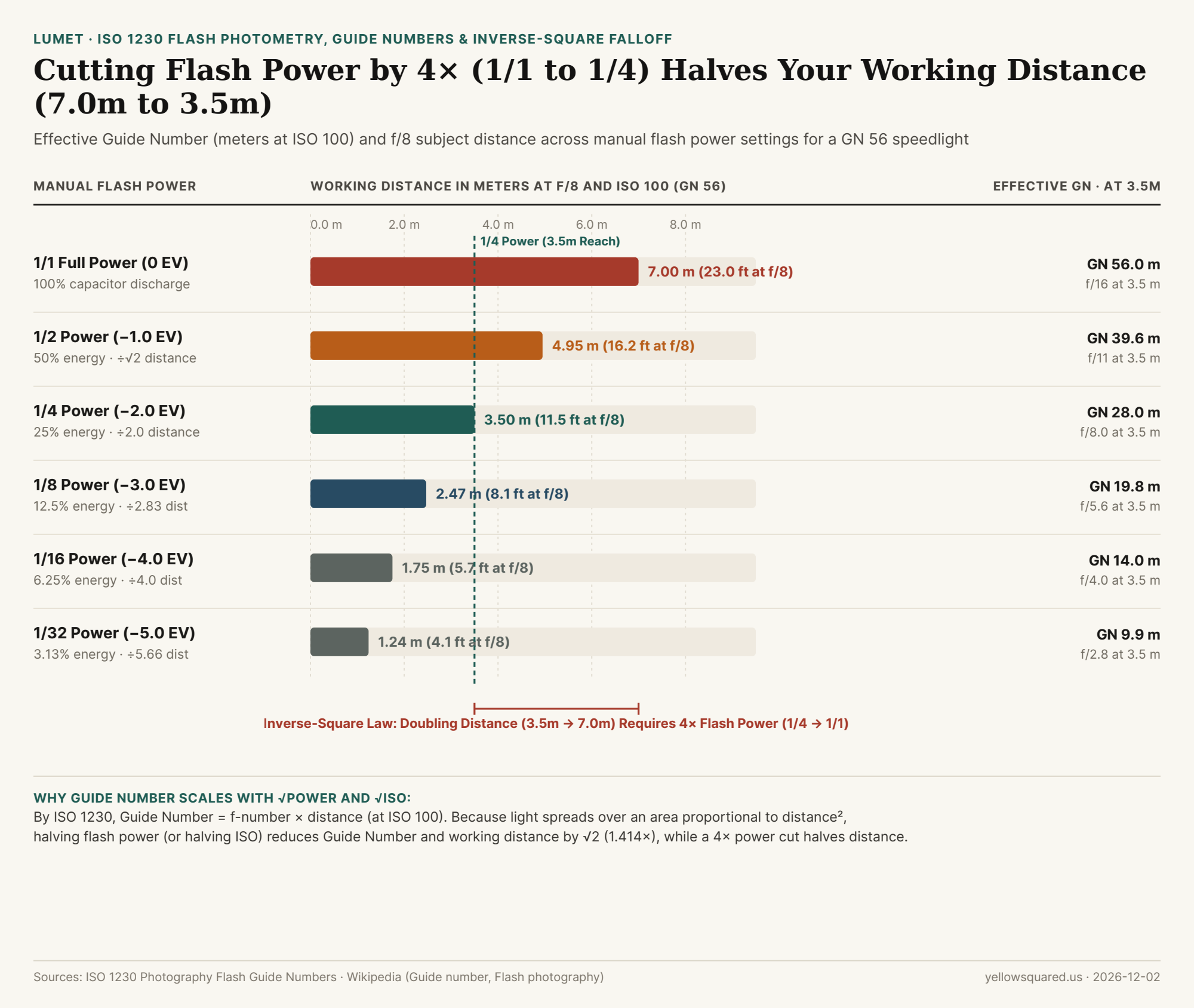
3.5 meters to 7.0 meters) spreads the beam over 4× the surface area, reducing subject illuminance to1/4(−2.0 EV). - Aperture Area Scaling (1 / N²): Opening your lens by two full stops—from
f/16tof/8(dividing the f-numberNby2)—increases the entrance pupil area by 4× (+2.0 EV), exactly canceling the4×distance loss (Guide number - Wikipedia).
"Because both light falloff (1/d²) and lens pupil area (1/N²) scale with squares, their square roots cancel out—leaving a clean linear equation: Guide Number = f-stop × distance."
Why Halving Manual Flash Power Divides Working Distance by √2 (1.414×), Not 2×
The most common mistake in manual flash photography is assuming that dialing a speedlight from 1/1 full power down to 1/2 power cuts its reach in half. Because illuminance varies with the square of distance, reducing flash energy by one stop (1/2 power, −1.0 EV) divides the effective Guide Number—and therefore your working distance at a fixed aperture—by √2 ≈ 1.414 (Guide number - Wikipedia). To cut working distance in half, you must cut flash power by two full stops (4× energy reduction, from 1/1 to 1/4 power):
| Manual Power Setting | Relative Flash Energy | Stop Offset | Effective GN (ISO 100) | Reach at f/8 | Aperture at 3.5 m |
|---|---|---|---|---|---|
1. 1/1 Full Power |
100.0% (1.00×) |
0.0 EV |
GN 56.0 m (184 ft) | 7.00 m (23.0 ft) | f/16 |
2. 1/2 Half Power |
50.0% (0.50×) |
−1.0 EV |
GN 39.6 m (130 ft) | 4.95 m (16.2 ft) | f/11 |
3. 1/4 Quarter Power |
25.0% (0.25×) |
−2.0 EV |
GN 28.0 m (92 ft) | 3.50 m (11.5 ft) | f/8.0 |
4. 1/8 Eighth Power |
12.5% (0.125×) |
−3.0 EV |
GN 19.8 m (65 ft) | 2.47 m (8.1 ft) | f/5.6 |
5. 1/16 Sixteenth Power |
6.25% (0.063×) |
−4.0 EV |
GN 14.0 m (46 ft) | 1.75 m (5.7 ft) | f/4.0 |
6. 1/32 Power |
3.13% (0.031×) |
−5.0 EV |
GN 9.9 m (32 ft) | 1.24 m (4.1 ft) | f/2.8 |
How ISO Sensitivity and Zoom Head Spec Tricks Affect Real-World Guide Numbers
Two practical adjustments complete your field Guide Number toolkit (Guide number - Wikipedia):
- ISO Scaling by √(ISO / 100): Raising camera sensitivity by one stop (from
ISO 100 to ISO 200) multiplies your effective Guide Number by√2 ≈ 1.414; quadrupling sensitivity by two stops (fromISO 100 to ISO 400) doubles your effective Guide Number (turning aGN 28 msetting intoGN 56 m, so1/4power at ISO 400 reaches the exact same7.0 m at f/8as1/1full power at ISO 100 while recycling 4× faster). - Watch Out for 200mm Telephoto Zoom-Head Ratings: Modern speedlight manufacturers almost always advertise their headline Guide Number (
GN 60 m) with the internal Fresnel zoom head racked all the way out to 200mm. When you zoom the flash head back to a normal 35mm or 50mm coverage angle—or diffuse it through an umbrella or softbox—the effective Guide Number typically drops by1.0 to 2.0 stops(GN 36 m to GN 42 m).
To measure ambient background lux and balance your manual strobe key light on set or outdoors, Measure ambient and studio lighting in Lumet.