
How Did Presidential Last Names (Madison, Kennedy, Reagan, and Lincoln) Become Popular U.S. First Names?
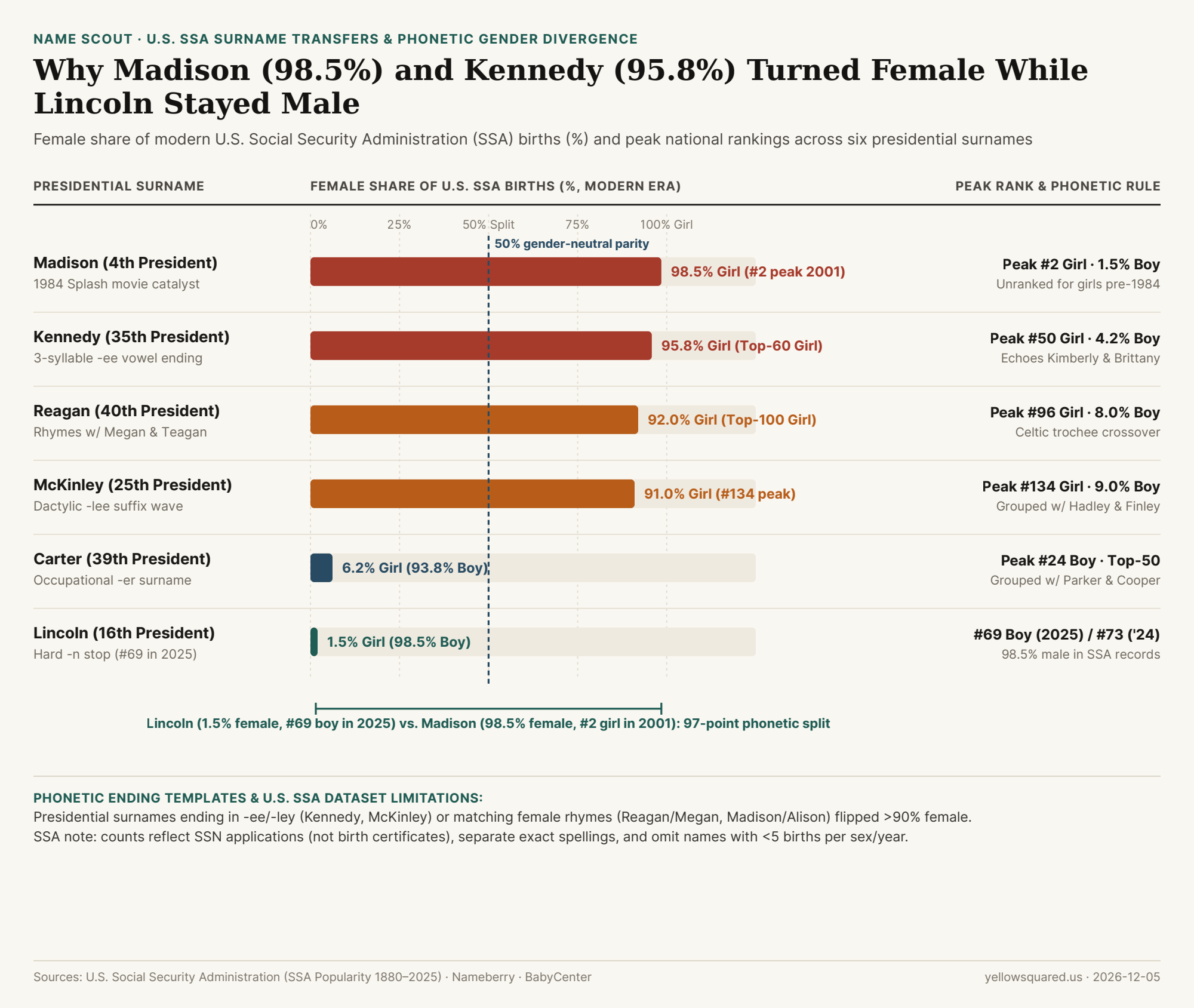
From the 1880s through the 1970s, giving a child a U.S. president's last name—Washington, Jefferson, Jackson, Lincoln, Grant, Harrison, or Carter—was an almost exclusively male tradition in American birth records. Yet over the past four decades, U.S. Social Security Administration (SSA) national baby name rankings and onomastic analyses from Nameberry's presidential girl-name history and BabyCenter's presidential naming study reveal a dramatic 97-percentage-point gender split: Madison (98.5% female), Kennedy (95.8% female), Reagan (92.0% female), and McKinley (91.0% female) crossed over to become overwhelmingly female first names, whereas Lincoln (98.5% male, ranked #69 for boys in 2025) and Carter (93.8% male) remained anchored on the boys' chart.
The March 1984 "Splash" Catalyst and the Phonetic Rules That Flipped Surnames Female
Why did four specific presidential surnames—honoring James Madison (4th President), John F. Kennedy (35th), Ronald Reagan (40th), and William McKinley (25th)—detach from male political commemoration and surge past 90% female share? As documented in Nameberry's analysis of presidential baby name trajectories, the crossover followed three distinct phonetic and pop-culture mechanisms:
- The 1984 Splash Effect on Madison (
98.5%Female, Peak#2in 2001): Prior to 1984, Madison (an English matronymic meaning "son of Maud," popularized as a surname by Founding Father James Madison) did not even appear in the U.S. top 1,000 for girls, while ranking occasionally in the bottom half of the boys' top 1,000. In March 1984, Ron Howard's romantic comedy Splash featured Daryl Hannah as a mermaid who walks down Manhattan's Madison Avenue (named after James Madison), points to the street sign, and chooses "Madison" as her human name—prompting Tom Hanks's character to joke, "Madison's not a name!" Because Madison shared the three-syllable dactylic cadence of 1980s girl favorites Allison and Addison (and yielded the nickname Maddie), it debuted at#628for girls in 1985, broke the top 30 by 1993, and peaked at#2nationwide in 2001. - Three-Syllable
-eeEndings in Kennedy (95.8%Female) and McKinley (91.0%Female): In the 1990s, parents moving on from 1980s three-syllable-eestaples (Kimberly, Brittany, Tiffany, Stephanie) gravitated toward Irish and Scottish surnames with the exact same rhythmic stress pattern (DA-da-dee). Boosted by MTV VJ Kennedy (Lisa Kennedy Montgomery, named after JFK) in 1992, Kennedy entered the girls' top 100 in 1999 and peaked at#50nationally, while McKinley climbed to#134for girls in 2015 alongside Finley and Hadley. - The Celtic Trochee Rhyme in Reagan (
92.0%Female): Although Ronald Reagan left office in 1989, the surname Reagan (`RAY-gən`) rhymed directly with established female Celtic names Megan and Teagan, carrying it into the girls' top 100 (peaking at#96) with over92%female usage.
"Parents didn't choose Kennedy, Reagan, or Madison as partisan ballots—they selected them because three-syllable dactyls ending in -ee and -son matched the dominant acoustic templates of American girls' names."
Why Lincoln (#69 in 2025), Jackson, and Carter Stayed Over 93% Male
By contrast, presidential surnames that lacked a female rhyme partner or carried hard velar/alveolar consonant stops remained overwhelmingly male:
- Lincoln (
98.5%Male, Ranked#69in 2025 /#73in 2024): Per the SSA 2024–2025 national popularity tables, Lincoln (16th President Abraham Lincoln) rose from outside the top 200 in 2008 to a peak of#38in 2017 and currently holds#69nationwide for boys in 2025 (climbing 4 spots from#73in 2024), driven by the modern male two-syllable-ntrend and the crisp nickname Link. - Carter (
93.8%Male, Peak#24Boy): Grouping phonetically with occupational-erboys' names like Parker, Cooper, and Hunter, Carter (39th President Jimmy Carter) has stayed nearly94%male inside the U.S. top 50.
| Presidential Surname | Presidential Origin | Modern Girl Share | Modern Boy Share | SSA Peak National Rank | Phonetic & Cultural Mechanism |
|---|---|---|---|---|---|
| Madison | James Madison (4th) | 98.5% | 1.5% | #2 Girl (2001) | 1984 film Splash + matches Allison cadence & Maddie |
| Kennedy | John F. Kennedy (35th) | 95.8% | 4.2% | #50 Girl (2015–2021) | 3-syllable -ee ending echoes Kimberly & Brittany |
| Reagan | Ronald Reagan (40th) | 92.0% | 8.0% | #96 Girl (2012–2016) | Two-syllable trochee rhymes with Megan & Teagan |
| McKinley | William McKinley (25th) | 91.0% | 9.0% | #134 Girl (2015) | Dactylic -lee suffix joins Hadley & Finley wave |
| Carter | Jimmy Carter (39th) | 6.2% | 93.8% | #24 Boy (2016–2019) | Occupational -er suffix groups with Parker & Cooper |
| Lincoln | Abraham Lincoln (16th) | 1.5% | 98.5% | #38 Boy (2017) · #69 (2025) | Velar stop + hard -n ending; #69 boy in 2025 SSA data |
Three U.S. SSA Dataset Limitations Every Name Researcher Should Know
When comparing historical surname transfers across decades in U.S. Social Security Administration baby name files, keep three structural dataset constraints in mind:
- SSN Card Applications vs. Birth Certificates: SSA totals count Social Security Number card applications (
Form SS-5and hospital Enumeration at Birth filings) rather than direct NCHS vital-statistics birth certificates; pre-1937 cohorts reflect retroactive adult registrations. - Exact-Spelling Separation: The SSA tabulates every spelling variant as an independent rank. Combining phonetic siblings—such as Madison, Madisyn, and Maddison, or Reagan and Raegan, or Jackson and Jaxon—makes the underlying phonetic wave substantially larger than any single ranked row.
- Privacy Suppression Below 5 Births (
<5Rule): To protect individual privacy, the SSA omits any name given to fewer than 5 babies (<5) of the same sex in a given year (or state), slightly undercounting rare cross-gender usage in early decades.
Want to inspect decade-by-decade gender ratios, state heatmaps, and phonetic ending clusters across 145 years of records? Explore historical U.S. baby name trends in Name Scout.