
How Do Airline Alliances (Star Alliance, Oneworld, and SkyTeam) Work for Booking Partner Award Flights?
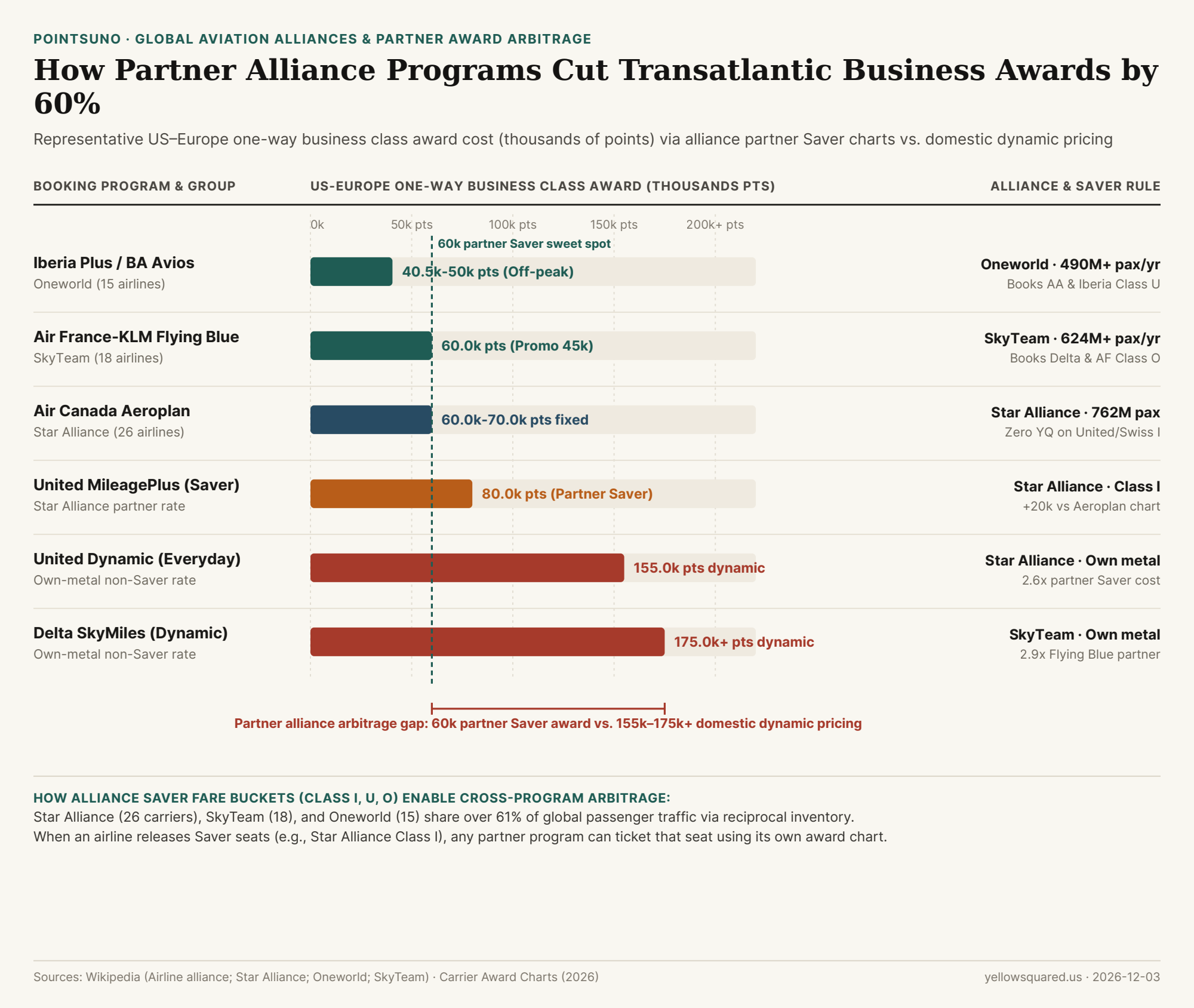
Search for a summer business-class award ticket from New York or Chicago to Paris directly on Delta.com or United.com, and you will routinely see dynamic pricing quotes of 155,000 to 295,000 miles one way. Yet on that exact same departure, another passenger sitting in the very next lie-flat pod booked the exact same flight for 50,000 to 60,000 points—without holding airline elite status or waiting for a flash sale.
The mechanism that makes this 60% discount possible is the global airline alliance system. Over 61% of all scheduled global air traffic is operated by three coalitions—Star Alliance, Oneworld, and SkyTeam. Under reciprocal loyalty agreements, whenever a member airline releases Saver-level award inventory, every other airline in that alliance can book that seat using its own award chart. Before moving transferable bank points for your next international trip, you can Compare airline transfer ratios and point valuations in Pointsuno to see which bank currencies transfer 1:1 to each alliance's sweet-spot programs.
The Big Three Alliances by the Numbers: Star Alliance vs. SkyTeam vs. Oneworld
To prevent cross-border antitrust conflicts while offering global connectivity, airlines formed three major multilateral networks between 1997 and 2000:
- Star Alliance (Founded May 14, 1997): The oldest and largest alliance, comprising
26 member airlinesoperating over5,000aircraft to more than1,300airports across195countries (~762 millionannual passengers,23.0%global RPK share). Core members include United Airlines, Air Canada, Lufthansa, SWISS, ANA, Singapore Airlines, Turkish Airlines, and EVA Air. - SkyTeam (Founded June 22, 2000): The second-largest alliance by passenger volume (
~624 to 667 millionannual passengers,20.4%global RPK share), uniting18 active member airlinesacross960+destinations in165+countries. Core members include Delta Air Lines, Air France, KLM, Korean Air, Virgin Atlantic, and Aeromexico. - Oneworld (Founded February 1, 1999): Unites
15 member airlinesoperating roughly3,300aircraft across~1,000airports in170countries (~490 to 535 millionannual passengers,17.8%global RPK share). Core members include American Airlines, Alaska Airlines (with Hawaiian Airlines), British Airways, Cathay Pacific, Japan Airlines, Qatar Airways, Iberia, Finnair, and Qantas.
"You never have to book a United flight with United miles or an American flight with American miles: if Saver award inventory (Class I or Class U) is open, any partner program in the same alliance can ticket that exact seat at its own price."
How Saver Fare Buckets (Class I, U, O, X) Unlock Partner Arbitrage
Why does the same physical seat cost 60,000 points on one website and 155,000 points on another? Every airline divides its cabin into single-letter reservation booking designators (fare buckets). When an airline sells its own flights to its own loyalty members, it uses dynamic pricing (JN or Z buckets on United; Z or D on Delta) tied to the cash ticket price. However, alliance contracts require carriers to designate specific Saver award buckets that are shared across the entire alliance at fixed wholesale clearing rates:
- Star Alliance Standard Saver Buckets:
Class X(Economy),Class I(Business), andClass O(First Class). When United or Lufthansa opens aClass Ibusiness seat across the Atlantic, United MileagePlus charges80,000 miles(or155,000+ milesdynamically whenIis closed), whereas Air Canada Aeroplan prices that sameClass Iseat on its distance chart at60,000 to 70,000 pointswith zero carrier fuel surcharges. - Oneworld Standard Saver Buckets:
Class X(Economy),Class U(Business), andClass Z(First Class). Because the Avios currency is freely convertible1:1between British Airways, Iberia, Qatar Airways, and Finnair, travelers can book off-peak Madrid flights on Iberia for40,500 Aviosin business class or domestic American Airlines flights without touching AAdvantage miles. - SkyTeam Partner Pricing Floors: While Delta SkyMiles often prices transatlantic Delta One flights at
175,000 to 300,000+ miles, Air France–KLM Flying Blue prices business-class Saver seats (Class O) between North America and Europe at a standardized60,000 miles(and45,000 milesduring monthly Promo Rewards).
| Booking Loyalty Program | Alliance & Member Count | Shared Saver Bucket | US–Europe 1-Way Business | Key Transfer & Fee Advantage |
|---|---|---|---|---|
| Iberia Plus / BA Avios | Oneworld (15 airlines) |
Class U (Biz) / X (Econ) |
40,500 – 50,000 pts |
1:1 transfers from Chase, Amex, Bilt, Capital One, Wells Fargo |
| Air France–KLM Flying Blue | SkyTeam (18 airlines) |
Class O (Biz) / X (Econ) |
60,000 pts (45k Promo) |
Transfers from all 5 major banks; free stopovers on awards |
| Air Canada Aeroplan | Star Alliance (26 airlines) |
Class I (Biz) / X (Econ) |
60,000 – 70,000 pts |
Zero fuel surcharges (YQ) on United, SWISS, Lufthansa, ANA |
| United MileagePlus (Saver) | Star Alliance (26 airlines) |
Class I (Partner Saver) |
80,000 – 88,000 pts |
No close-in fees and free online changes, but +20k higher chart |
| United MileagePlus (Dynamic) | Star Alliance (Own metal) | Class JN / Z (Non-Saver) |
155,000+ pts |
Available on almost every flight, but 2.6x partner Saver rate |
| Delta SkyMiles (Dynamic) | SkyTeam (Own metal) | Class Z / D (Non-Saver) |
175,000 – 295,000+ pts |
High dynamic floor; always check Flying Blue or Virgin Atlantic first |
The Golden Rule Before You Transfer Credit Card Points
Credit card point transfers to airline loyalty programs are one-way and irreversible. Never transfer Chase Ultimate Rewards, Amex Membership Rewards, Capital One Miles, Bilt Points, or Wells Fargo Rewards into an airline account until you have verified on the booking partner's own website that the partner Saver bucket (Class I, U, or O) is live and bookable—because an airline's high-priced dynamic "Everyday" award seats (155k+) are invisible to alliance partners. To map out every bank-to-airline transfer path and compare cents-per-point redemption values offline, Compare airline transfer ratios and point valuations in Pointsuno.