
How Long Does It Actually Take to Form a Habit?
Popular self-help advice claims that forming a new habit takes exactly 21 days, but empirical research from University College London proved that reaching automaticity takes an average of 66 days, with individual habits ranging from 18 to 254 days depending on task complexity. Understanding the asymptotic nature of habit formation prevents premature discouragement when going to the gym or meditating still requires conscious effort after three weeks.
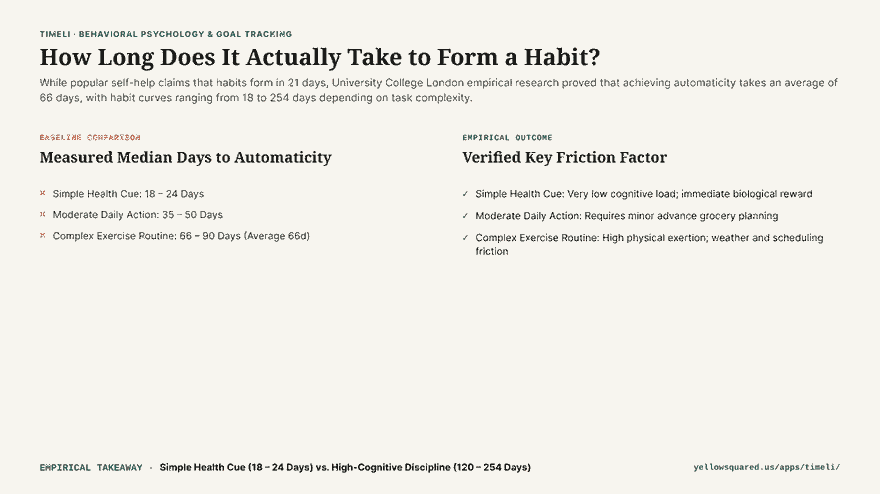
Every January, millions of people embark on ambitious wellness routines, expecting that by day 21, healthy behaviors will operate on effortless autopilot. When day 22 arrives and waking up at 6:00 AM still feels painful, many assume they lack innate willpower and abandon their goals. In behavioral science, habit formation is not an on/off switch that flips after three weeks—it is a non-linear asymptotic curve governed by cue repetition and neurological automaticity.
Habits do not snap into place after 21 days; automaticity accumulates along a non-linear curve that rewards patience over perfection.
The Origin of the 21-Day Myth: A Plastic Surgeon's Observation
The ubiquitous “21-day rule” was never based on an empirical scientific experiment. It originated in 1960 with Dr. Maxwell Maltz, a plastic surgeon who published the runaway bestseller Psycho-Cybernetics. Maltz noticed that patients who underwent facial plastic surgery took a minimum of approximately 21 days to grow accustomed to seeing their new face in the mirror, and amputees experienced phantom limb sensations for roughly three weeks before adjusting to the loss.
Maltz specifically wrote that it takes “a minimum of about 21 days” for a mental image to alter. However, over subsequent decades, motivational speakers and commercial self-help authors dropped the word “minimum” and transformed an informal clinical observation into an absolute universal law.
The Landmark 2009 UCL Study: 66 Days to Automaticity
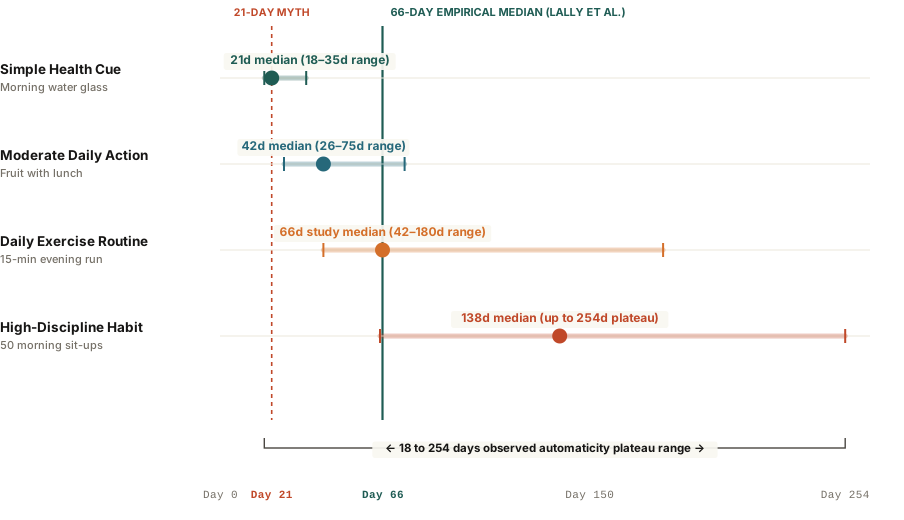
In 2009, Dr. Phillippa Lally and her research team at University College London published the first rigorous empirical study on habit acquisition in the European Journal of Social Psychology. The researchers tracked 96 participants who chose a new eating, drinking, or exercise behavior and logged their daily performance across 84 days using the Self-Report Habit Index (SRHI):
- The 66-Day Median: Across all participants and behaviors, the median time required to reach the automaticity plateau was 66 days.
- Task Complexity Determines Speed: Simple drinking habits (such as drinking a glass of water after breakfast) reached automaticity in as little as 18 to 20 days. Strenuous exercise routines (such as running 15 minutes before dinner) required an average of 84 to 90 days, with some participants taking up to 254 days.
- The Missed Day Finding: Crucially, the researchers demonstrated that missing an occasional day did not disrupt the long-term habit formation process. Consistency across the overall trend line proved far more decisive than unbroken daily streaks.
Habit Automaticity Timelines by Behavior Type
| Habit Category | Median Days | Observed Range | Cognitive Friction Level |
|---|---|---|---|
| Simple Cue & Swallow | 20 Days | 18 – 35 Days | Negligible (e.g., drinking water, taking morning vitamins) |
| Dietary Addition | 40 Days | 25 – 70 Days | Low to Moderate (e.g., eating an apple with lunch) |
| Moderate Physical Routine | 66 Days | 40 – 120 Days | Moderate to High (e.g., 20-minute daily brisk walk) |
| High-Discipline Workout | 90+ Days | 65 – 254 Days | Intense (e.g., morning strength training, gym sessions) |
How to Apply the 66-Day Curve to Your Routine
- Do not panic on day 25: Recognize that feeling resistance three or four weeks into a new gym routine is completely normal biology, not personal failure.
- Anchor to an existing physical cue: Attach the new behavior immediately after an established routine (e.g., “After I pour my morning coffee, I will write for 10 minutes”).
- Track repetitions without streak anxiety: Focus on recording moments and logging entries over time rather than stressing over broken streaks; discover low-friction habit logging tools in Timeli.