
How Long Does It Take to Refocus After a Slack or Email Interruption?
How Long Does It Take to Refocus After a Slack or Email Interruption?
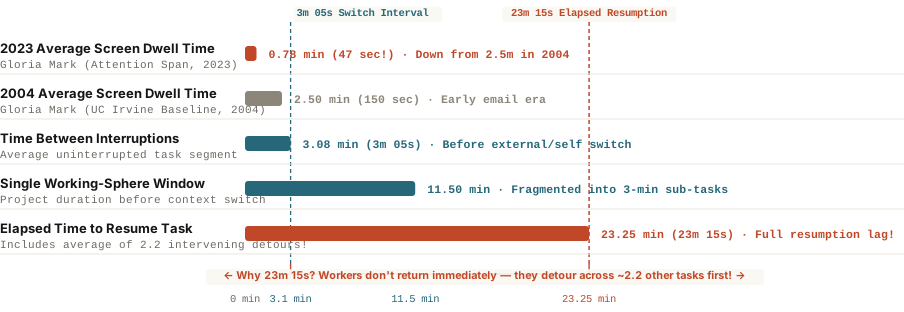
Empirical workplace shadowing at UC Irvine shows knowledge workers switch tasks every 3 minutes and 5 seconds—requiring an average of 23 minutes and 15 seconds to resume an interrupted project because a single ping triggers 2.2 intervening detours.
You are forty minutes deep into debugging a complex module or drafting a strategy memo when a Slack banner slides into the corner of your screen: "Quick question—do you have the Q3 link?" Answering takes twenty seconds. In your head, that interruption cost you twenty seconds.
When human-computer interaction researchers shadowed office workers with stopwatches and screen loggers at the University of California, Irvine, they measured a drastically different number: after an interruption, it took an average of 23 minutes and 15 seconds to return to the original task. That statistic—often cited as the "23-Minute Rule"—is one of the most famous numbers in productivity science, yet it is almost universally misunderstood. Understanding what UC Irvine Professor Gloria Mark actually measured (and why workers detour through 2.2 side tasks before returning) gives you a concrete blueprint for protecting deep work.
What '23 Minutes and 15 Seconds' Actually Means (And What It Doesn't)
In folk productivity blogs, the `23-minute` figure is often misquoted as a purely neurological timer—as if glancing at a text message paralyzes your prefrontal cortex for 23 minutes while you stare blankly at your monitor. As Gloria Mark explained in her foundational CHI 2005 / CHI 2008 papers and her 2006 Gallup workplace interview, the real mechanism is behavioral as well as cognitive:
- The 2.2 Intervening Task Detours: When workers were interrupted out of a "working sphere" (a cohesive project unit that averaged `11.5 minutes` before interruption), they almost never returned to the original document right after answering the ping. Instead, switching to Slack or email exposed them to new unread messages, calendar alerts, or browser tabs—causing them to perform an average of 2.2 intervening tasks before finally reopening the original file 23 minutes and 15 seconds later.
- The Collapse to 47-Second Screen Spans (2004–2023): In her 2023 book Attention Span, Mark documented that the average duration knowledge workers spend on a single screen before switching dropped from 2.5 minutes (`150 seconds`) in 2004 to 75 seconds in 2012, and down to just 47 seconds in recent workplace tracking—with roughly 50% of task switches self-initiated out of habit.
- Speed Compensation & Cortisol (CHI 2008): In Mark, Gudith, and Klocke's controlled experiment (The Cost of Interrupted Work: More Speed and Stress, CHI 2008), interrupted workers actually completed tasks faster per active minute to make up for lost time—but paid for that speed with significantly higher NASA-TLX mental workload, stress, frustration, and time-pressure scores.
A 20-second Slack reply rarely costs 20 seconds; it opens a side door into 2.2 other tasks that delay your return for 23 minutes.
Three Structural Rules to Stop the 23-Minute Detour Chain
Because the 23-minute penalty comes from **cascading sub-task detours** plus **attention residue** (rebuilding your mental variable state after returning), willpower alone does not solve it. Use three architectural safeguards:
- Batch All Messaging Into Scheduled 20-Minute Windows: Instead of leaving Slack and email open as an interrupt stream every `3 minutes`, close communication apps completely during 90-minute deep-work blocks and process messages in dedicated batch windows (for example, `11:00 AM` and `3:30 PM`).
- Write a 5-Word 'Breadcrumb Note' Before Switching: If an urgent interruption forces you to leave a task mid-thought, spend 5 seconds typing the exact next physical action at the cursor (e.g.,
// TODO next: fix null check line 142). That external breadcrumb cuts cognitive reload time in half when you return. - Eliminate Visual Inbox Temptation During Replies: When you must reply to a single message, use direct search or a focused thread window rather than opening the main unread inbox list where 2.2 detour tasks are waiting.
To structure your week around high-cognitive-load blocks and batched communication windows, you can Block uninterrupted deep-work windows in Timeli and track your real uninterrupted focus ratio.