
How Long Does It Take to Refocus After an Interruption? The 23-Minute Cost of Context Switching and Attention Residue
You are 30 minutes into debugging a tricky state transition or drafting a technical spec when a colleague pings you with a "quick 30-second question." You reply in under a minute and turn back to your editor—yet twenty minutes later, you have checked two email threads, glanced at a pull request, and still haven't reconstructed the mental model you held before the ping. When informatics professor Gloria Mark and her research team at the University of California, Irvine shadowed office workers with stopwatches and computer-logging telemetry to measure how long it actually takes to resume an interrupted task in the real world, the average wasn't two minutes or five minutes: it was 23 minutes and 15 seconds.
Reader outcome: You will learn what actually happens inside that 23-minute, 15-second recovery window, how attention residue (Sophie Leroy, 2009) degrades IQ and error rates when you switch mid-task, and how a 60-second "ready-to-resume" closure log lets you switch contexts without losing half your afternoon.
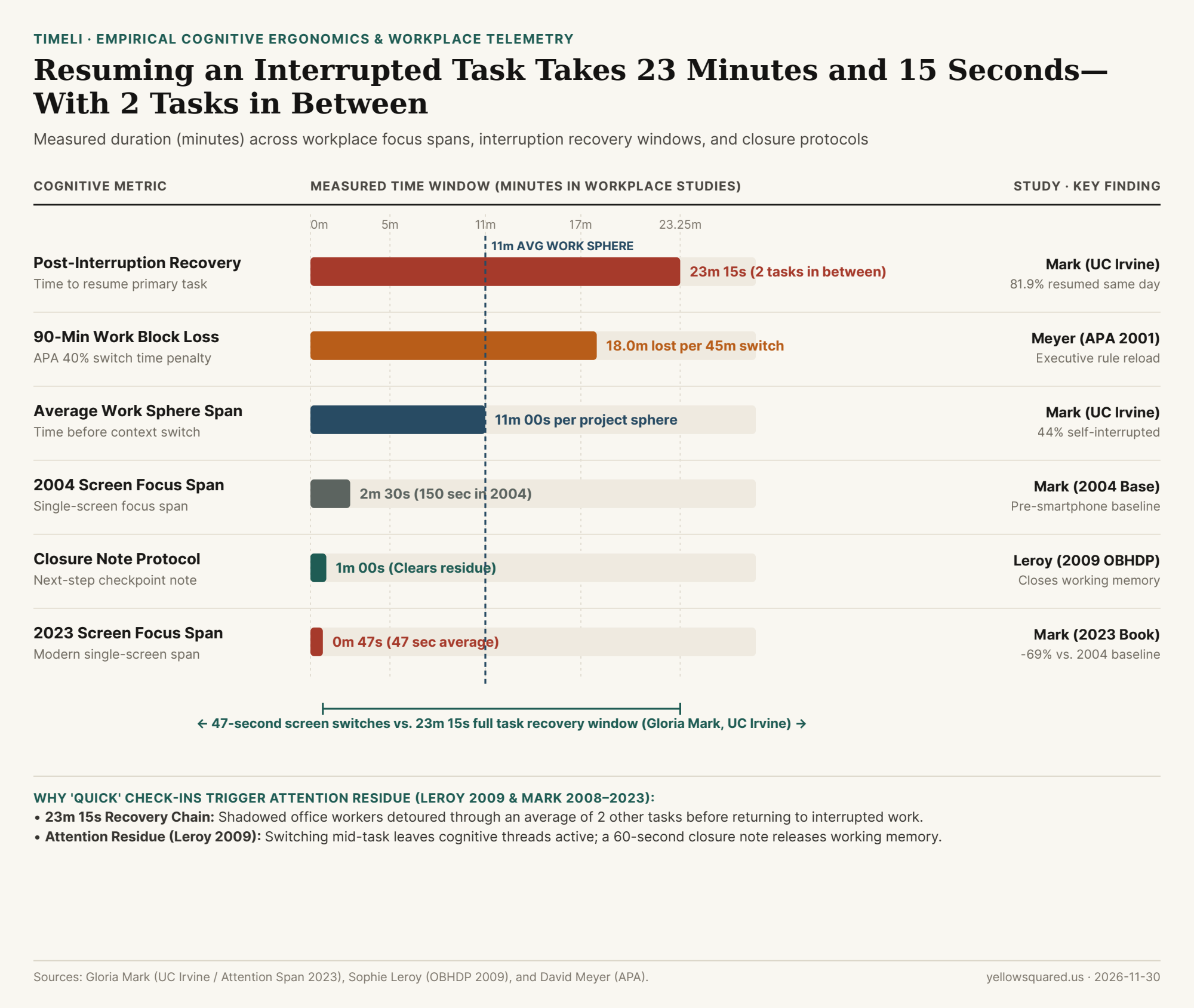
What Actually Happens Inside the 23-Minute, 15-Second Recovery Window?
A common misconception is that a human brain sits staring blankly at a monitor for 23 straight minutes after a Slack message. In reality, Gloria Mark's UC Irvine observational studies revealed a structural behavioral chain across office engineering and management teams:
- The 11-Minute "Work Sphere" Fragmentation: Mark grouped related tasks (such as reading a spec, editing a module, and checking a test log for the same feature) into "working spheres." On average, workers stayed inside a single working sphere for just
11 minutesbefore being interrupted or switching spheres. - Two Intervening Tasks Before Resumption: Once pulled out of a working sphere, workers did not bounce straight back. Instead, they completed an average of two other intervening tasks (answering a follow-up message, checking an inbox, or triaging a ticket) before returning to the original interrupted task
23 minutes and 15 secondslater (resuming it the same day81.9%of the time). - 44% of Interruptions Are Self-Initiated: Nearly half (
44%) of all context switches occurred without any external ping or colleague—triggered instead by an internal impulse to check email, news, or chat whenever cognitive friction rose on the primary task. Over two decades of follow-up tracking documented in Mark's book Attention Span (2023), the average continuous duration on a single screen fell 69%—from2 minutes and 30 seconds(150 seconds) in 2004 down to just47 seconds.
An interruption doesn't just cost the 30 seconds of the interruption itself; it breaks the working-memory seal, inviting two detour tasks that delay resumption by 23 minutes and 15 seconds.
Attention Residue (Leroy 2009) and the 40% Executive Control Penalty
Even when you force yourself to switch straight from Task A to Task B with zero detours, cognitive performance drops sharply. In experimental studies summarized by the American Psychological Association (APA), psychologist David Meyer demonstrated that shifting between tasks requires two distinct executive-control stages in the prefrontal cortex—goal shifting ("I want to do this now instead of that") and rule activation ("I'm turning off the rules for SQL queries and turning on the rules for prose editing")—which can consume up to 40% of a person's productive time.
In a landmark 2009 paper in Organizational Behavior and Human Decision Processes, researcher Sophie Leroy discovered why switching mid-task is so damaging: attention residue. When you leave Task A unfinished—especially under low-to-moderate time pressure—your brain does not cleanly garbage-collect Task A's variables. Instead, part of your working memory remains involuntarily tethered to the unresolved problem while you attempt to read or reason through Task B:
| Workplace Focus & Interruption Metric | Empirical Measurement | Time in Minutes | Primary Study / Researcher | Cognitive Mechanism & Operational Finding |
|---|---|---|---|---|
| Full Task Resumption After 1 Interruption | 23 min 15 sec |
23.25 min |
Gloria Mark (UC Irvine) | Workers average 2 intervening tasks before returning to original work |
| Executive Task-Switching Penalty | Up to 40% time loss |
18.00 min / 45m |
David Meyer (APA 2001) | Prefrontal goal-shifting and rule-activation latency on complex tasks |
| Uninterrupted Work Sphere Duration | 11 min 00 sec |
11.00 min |
Gloria Mark (UC Irvine) | Average time in one project sphere; 44% of switches self-initiated |
| 2004 Single-Screen Attention Span | 2 min 30 sec |
2.50 min |
Gloria Mark (2004 Baseline) | Continuous focus on one screen window before switching in 2004 |
| 2020–2023 Single-Screen Attention Span | 47 seconds |
0.78 min |
Gloria Mark (Attention Span, 2023) | 69% drop in continuous single-screen focus over two decades |
| Ready-to-Resume Closure Protocol | 60 seconds |
1.00 min |
Sophie Leroy (2009 OBHDP) | Externalizing next concrete step clears working-memory residue |
How a 60-Second 'Ready-to-Resume' Log Cuts Recovery Time by 80%
How do you defend against a 23-minute recovery tax when interruptions are unavoidable? Leroy's follow-up experiments showed that attention residue drops dramatically when your brain perceives either task completion or a concrete, trusted resumption plan. Before you switch windows to answer a colleague, join a meeting, or step away from your desk, take 60 seconds to record a one-line "ready-to-resume" breadcrumb:
- State the Exact File/Line & Failing Condition: Instead of leaving a vague mental note ("finish auth bug"), write or dictate the exact state: "In
token_refresh.dartline 142: reproduces 401 race when two requests fire within 50ms." - Write the Very First Physical Action for When You Return: End the note with an immediate verb: "Next step: wrap
_refreshFuturein a Completer lock and runauth_test.dart." - Batch Reactive Comms at Sphere Boundaries: Since working spheres naturally hit sub-goal boundaries every
35 to 50 minutes, defer non-urgent Slack and email checks to those natural stopping points rather than breaking mid-thought. To capture one-tap timestamped focus breadcrumbs and voice notes whenever you switch tasks, Log daily focus blocks and moments in Timeli.