
How Long Is a Billion Seconds vs. a Million Seconds?
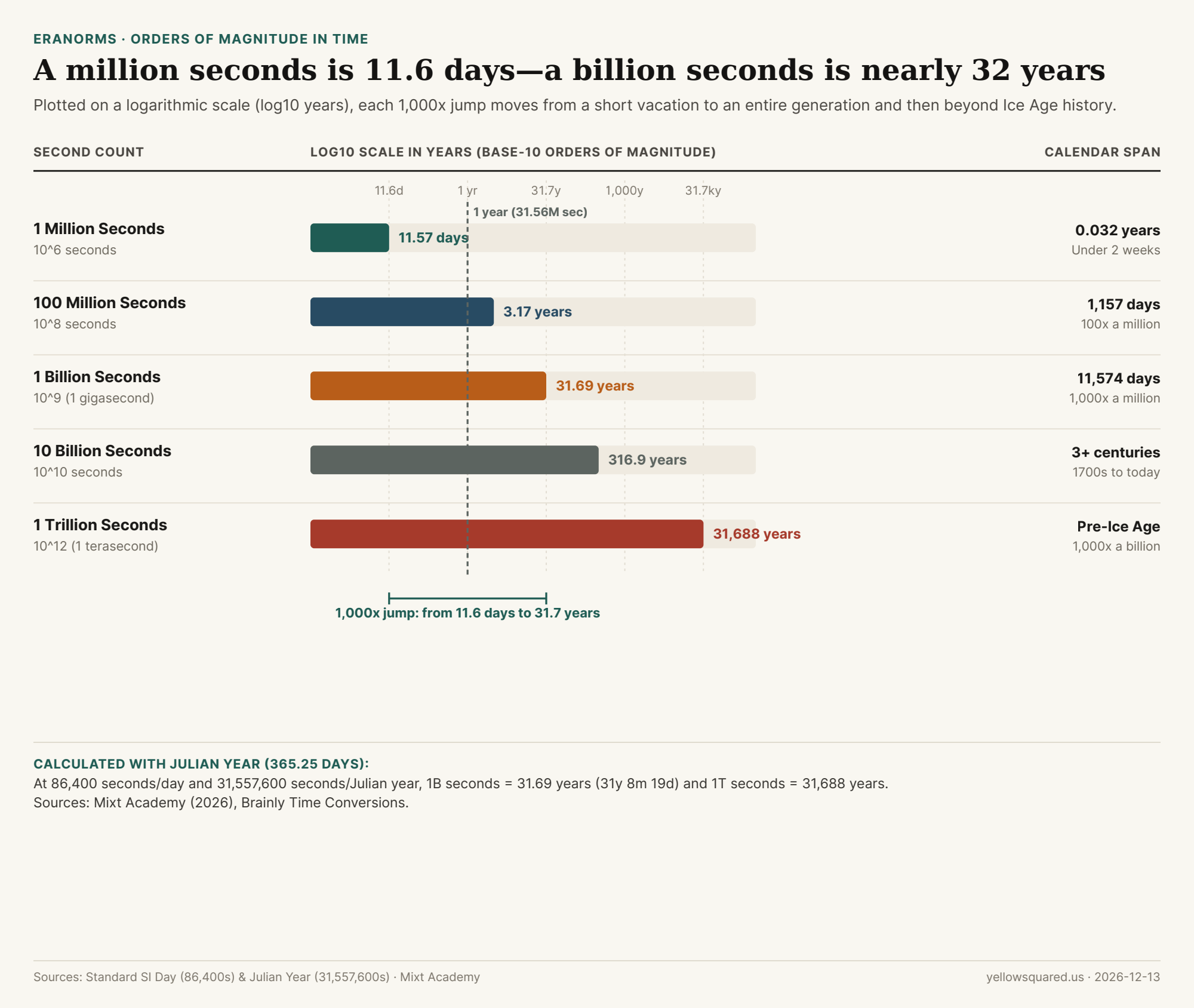
Human brains are notoriously bad at distinguishing between millions, billions, and trillions because the words rhyme and differ by a single starting letter. Converting those counts into elapsed seconds makes the scale gap immediately concrete: 1 million seconds passes in under two weeks, while 1 billion seconds spans nearly a third of a human lifetime.
The Exact Math Behind Millions, Billions, and Trillions
As shown in standard time-unit conversions and duration benchmarks, dividing by 86,400 seconds per day and 31,557,600 seconds per 365.25-day Julian year reveals how fast orders of magnitude explode:
| Seconds | Scientific Term | Calendar Equivalent | Historical Benchmark |
|---|---|---|---|
| 1,000,000 | 1 Megasecond (106) | 11.57 days | Less than a two-week vacation |
| 100,000,000 | 100 Megaseconds (108) | 3.17 years | Roughly a high school or college span |
| 1,000,000,000 | 1 Gigasecond (109) | 31.69 years | A full generation (1995 to 2026) |
| 1,000,000,000,000 | 1 Terasecond (1012) | 31,688 years | Back to the Upper Paleolithic Ice Age |
"One million seconds is 11.57 days. One billion seconds is 31.7 years. One trillion seconds is 31,688 years—older than recorded civilization."
To place decades, centuries, and deep-history eras side by side on an interactive scale, explore historical time spans in Eranorms.