
How Do Moon Phases Affect Milky Way Photography?
Even if you drive two hours to a pristine Bortle 2 dark-sky site—escaping the artificial light pollution that blocks the Milky Way for nearly 80% of Americans—a bright moon can still erase the galactic core. Moonlight acts like natural light pollution, scattering through the atmosphere and flattening faint dust lanes.
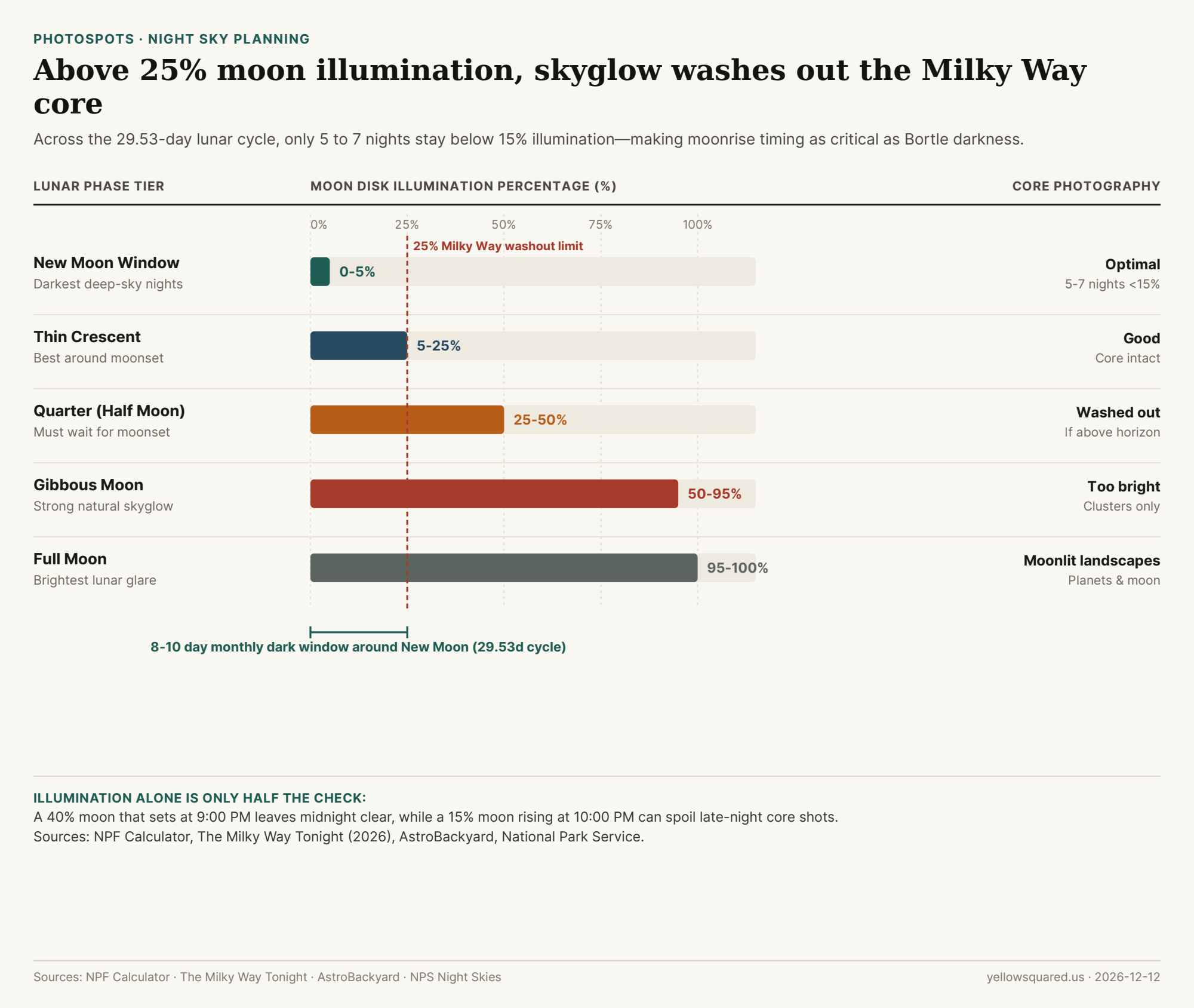
The 25% Illumination Rule—and Why Moonrise Time Matters
According to NPF Calculator's astrophotography calendar and The Milky Way Tonight, only 5 to 7 nights per month stay below 15% moon illumination (and 10–14 nights stay under 35%). Once a moon exceeds roughly 25% illumination while above the horizon, it washes out the delicate galactic core, and a 50% half moon makes it virtually invisible except at the highest, driest sites.
"What matters is not just the percentage but whether the moon is above the horizon during your specific viewing window. A 40% moon that sets at 9 PM is fine." — The Milky Way Tonight (2026)
What to Shoot During Brighter Phases
As AstroBackyard's moon phase guide notes, bright gibbous and full moons are not wasted nights: planetary imaging and moonlit mountain foregrounds thrive on natural moonlight, while deep-sky core shoots belong in the 8-to-10-day window centered on the New Moon.
Before packing your tripod for a dark-sky drive, scout Bortle skies and moon windows in PhotoSpots to pair low light pollution with a moonless horizon.