
How Much Time Do You Lose When Switching Between Tasks, and How Do Goal Shifting and Rule Activation Work?
When we bounce between writing code, answering a Slack message, and checking a spreadsheet, it feels as though our attention pivots instantaneously. Yet in August 2001, psychologists Joshua S. Rubinstein, David E. Meyer, and Jeffrey E. Evans published a landmark four-experiment study in the Journal of Experimental Psychology: Human Perception and Performance (full 2001 JEP:HPP paper PDF; PubMed PMID 11518143) proving that the human brain's executive control system cannot switch tasks in a single step. As summarized in the American Psychological Association (APA) research brief on multitasking switching costs and the APA Monitor on Psychology report, every context switch forces the prefrontal and parietal cortices through two distinct, time-consuming stages—Goal Shifting and Rule Activation—that slow task completion by 18% to over 55% per switch and can consume up to 40% of a person's productive workday.
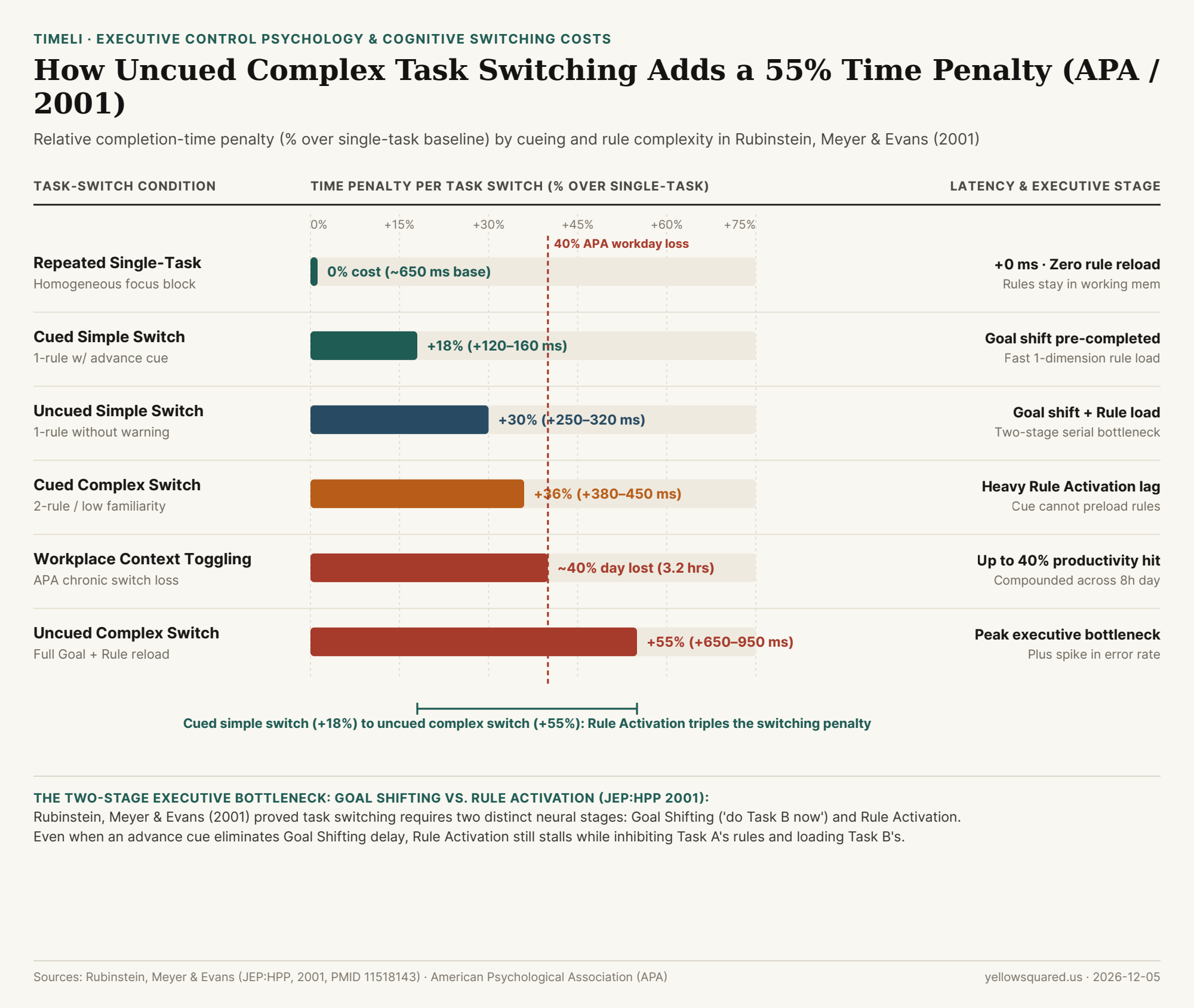
The Two-Stage Executive Control Model: Goal Shifting vs. Rule Activation
Prior to Rubinstein, Meyer, and Evans (2001), cognitive scientists debated whether "switching cost"—the extra time and higher error rate observed whenever a participant alternates between Task A (such as classifying geometric objects by shape) and Task B (classifying them by color or solving alternating math operations)—was merely passive decay from the previous trial or an active executive-control bottleneck. By independently manipulating advance task cues (telling participants which task was coming next before the stimulus appeared) and rule complexity (simple 1-dimension rules vs. complex 2-dimension conjunction or unfamiliar arithmetic rules), the authors isolated two separate neural stages:
- Stage 1 — Goal Shifting (Prefrontal Declarative Control): The executive decision to update working memory's current intention: "I want to perform Task B now instead of Task A." When participants are given an advance cue (sufficient preparation time before the next problem appears), Goal Shifting can be completed ahead of time, shrinking the switching penalty on simple tasks down to
~18%(+120 to +160 ms). - Stage 2 — Rule Activation (Posterior Parietal & Anterior Cingulate Procedural Reload): Even after your conscious goal has shifted to Task B, a second executive process must actively inhibit the procedural rules of Task A ("turn off the multiplication or shape-sorting rules") and load the procedural rules of Task B into procedural working memory. Crucially, Rubinstein, Meyer, and Evans discovered that Rule Activation cannot finish until the actual task stimulus arrives—and its time cost explodes as tasks become more complex or less familiar, surging from
+30%(+250 to +320 ms) on uncued simple switches to+55% or more(+650 to +950 ms) on uncued complex switches.
"Although switch costs may be relatively small—sometimes just a few tenths of a second per switch—they can add up to large amounts when people switch repeatedly back and forth between tasks, costing as much as 40 percent of someone's productive time." — American Psychological Association (APA)
Why Tenths of a Second in the Lab Compound Into 3.2 Lost Hours at Work
In a controlled laboratory card-sorting or arithmetic trial where a single problem takes 650 milliseconds, adding 350 to 900 milliseconds for Goal Shifting and Rule Activation already represents a 40% to 60%+ slowdown on every switched trial. In real-world software engineering, writing, and analytical workflows, the Rule Activation stage is vastly heavier than loading a geometric sorting rule:
- Working-Memory Rule Reloading in Deep Work: When you switch from debugging a state machine to replying to an email thread and then back to code, "Rule Activation" requires reconstructing variable invariants, call-stack context, and edge-case constraints in working memory.
- The 40% Workday Tax: As the APA's synthesis of Meyer and Rubinstein's findings emphasizes, chronic task-switching across an 8-hour workday consumes up to
40%of productive capacity—equivalent to losing3.2 hoursevery single day solely to executive-control reloading and error correction.
| Task-Switching Condition | Rule Complexity & Cueing | Time Penalty (%) | Added Switch Latency | Active Executive Control Stages |
|---|---|---|---|---|
| Repeated Single-Task | Single rule · Zero switching | 0% | 0 ms (~650 ms base) |
Task execution only; procedural rules remain active |
| Cued Simple Switch | 1-dimension rule · Advance cue | +18% | +120 to +160 ms |
Goal shifting completed pre-stimulus; fast rule load |
| Uncued Simple Switch | 1-dimension rule · No cue | +30% | +250 to +320 ms |
Serial Goal Shifting + simple Rule Activation |
| Cued Complex Switch | 2-dimension / unfamiliar · Cued | +36% | +380 to +450 ms |
Post-stimulus complex Rule Activation bottleneck |
| Workplace Context Toggling | Chronic daily task interleaving | ~40% | ~3.2 hrs / 8h day |
Compounded Goal Shifting + Rule Activation + errors |
| Uncued Complex Switch | 2-dimension / unfamiliar · No cue | +55% | +650 to +950 ms |
Full Goal Shifting + heavy Rule Activation reload |
How to Eliminate Rule-Activation Overhead in Your Daily Schedule
Rubinstein, Meyer, and Evans's data points directly to two practical defenses against cognitive switching loss: first, batch homogeneous tasks together (processing all messages or administrative reviews in a single contiguous window so your brain loads that rule set once instead of 30 times); second, use explicit transition cues (writing down a one-line next-step note before stepping away from a complex problem so Goal Shifting and Rule Activation have an external anchor when you return). Log daily focus blocks and moments in Timeli to spot fragmented context-switching windows and protect uninterrupted deep-work sessions.