
How Often Can You Get a Credit Card Welcome Bonus? Chase 24/48-Month, Citi, Capital One, and Amex Lifetime Rules
Sign-up bonuses are the fastest way to build a six-figure balance of transferable travel points — often yielding 60,000 to 175,000 points from a single minimum-spend window. Yet every major U.S. bank enforces strict anti-churning cooldown timers and family sequencing rules inside the fine print of its cardmember agreements. Apply two weeks before your cooldown clock expires — or open a flagship card before its mid-tier sibling — and the bank may approve your credit line while awarding you zero welcome bonus points.
As synthesized in Upgraded Points' Bank-by-Bank Credit Card Application Rules, NerdWallet's Guide to 48-Month Welcome Bonus Cooldowns, and The Points Guy's Repeat Welcome Bonus Eligibility Guide, bonus cooldown horizons split into three distinct tiers: 24 months, 48 months, and once per lifetime (~7+ years). To calculate the net dollar value of each card's welcome bonus and transfer partners before using a 5/24 slot, Compare credit card welcome bonuses and point values in Pointsuno.
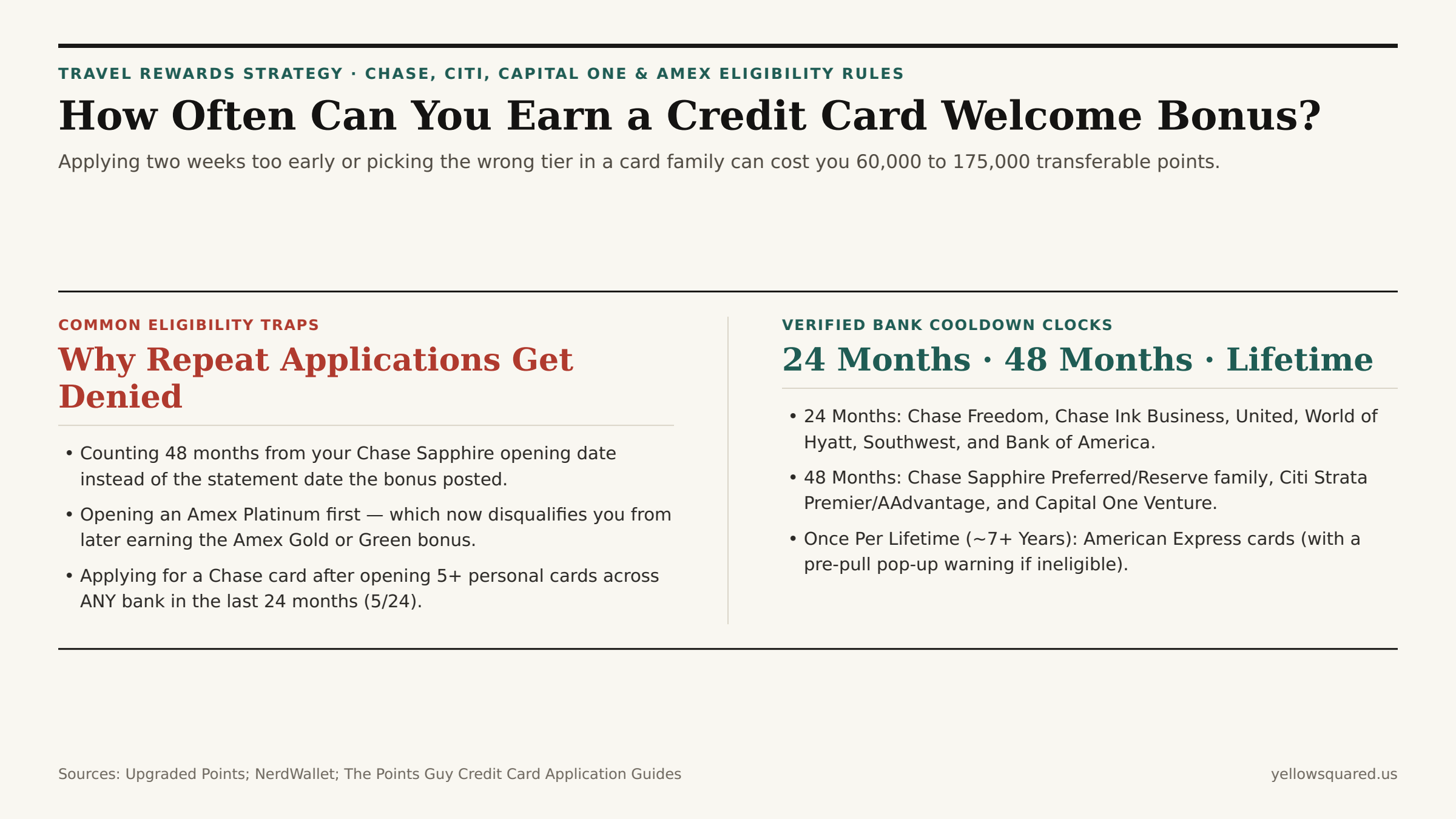
1. The 24-Month vs. 48-Month Clock: Why "Bonus Posted Date" Beats "Account Open Date"
The single most expensive calendar error in travel rewards is counting 24 or 48 months from the date you opened a credit card (the date shown on your credit report). Both Chase and Citibank explicitly start the cooldown timer on the date you last received the welcome bonus (which typically posts 2 to 3 months after account opening, once you complete the 3-month minimum spend):
- Chase's 24-Month Cooldown (Freedom, Ink Business, United, Southwest, World of Hyatt, Aeroplan, IHG, Marriott): You are eligible for a new welcome bonus on these cards as long as you do not currently hold the card and have not received a new cardmember bonus for it in the past 24 months (and remain under Chase's 5/24 rule — fewer than 5 new personal credit cards opened across all banks in the past 24 months). Even better, separate Chase Ink business flavors (
Ink Business Preferred,Ink Business Cash, andInk Business Unlimited) are treated as distinct products with independent clocks. - Chase's 48-Month Sapphire Family Rule (
Sapphire Preferred&Sapphire Reserve): You may only hold one Sapphire card at a time, and you must wait 48 full months from the statement date your last Sapphire bonus posted before applying for a new Sapphire welcome bonus. If you still hold your old Sapphire card after 48 months, product-change (downgrade) it to a no-annual-fee Chase Freedom card and wait 4–7 business days before submitting your new Sapphire application. - Citi's 48-Month Rule & Capital One's 48-Month Rule: As detailed in NerdWallet's Citi 48-Month Rule Breakdown and The Points Guy's AAdvantage Co-Brand Guide, Citibank (
Strata Premier,Citi / AAdvantage Platinum Select,AAdvantage Executive) and Capital One (Venture X,Venture) enforce a 48-month cooldown from the date a prior bonus was received on that product.
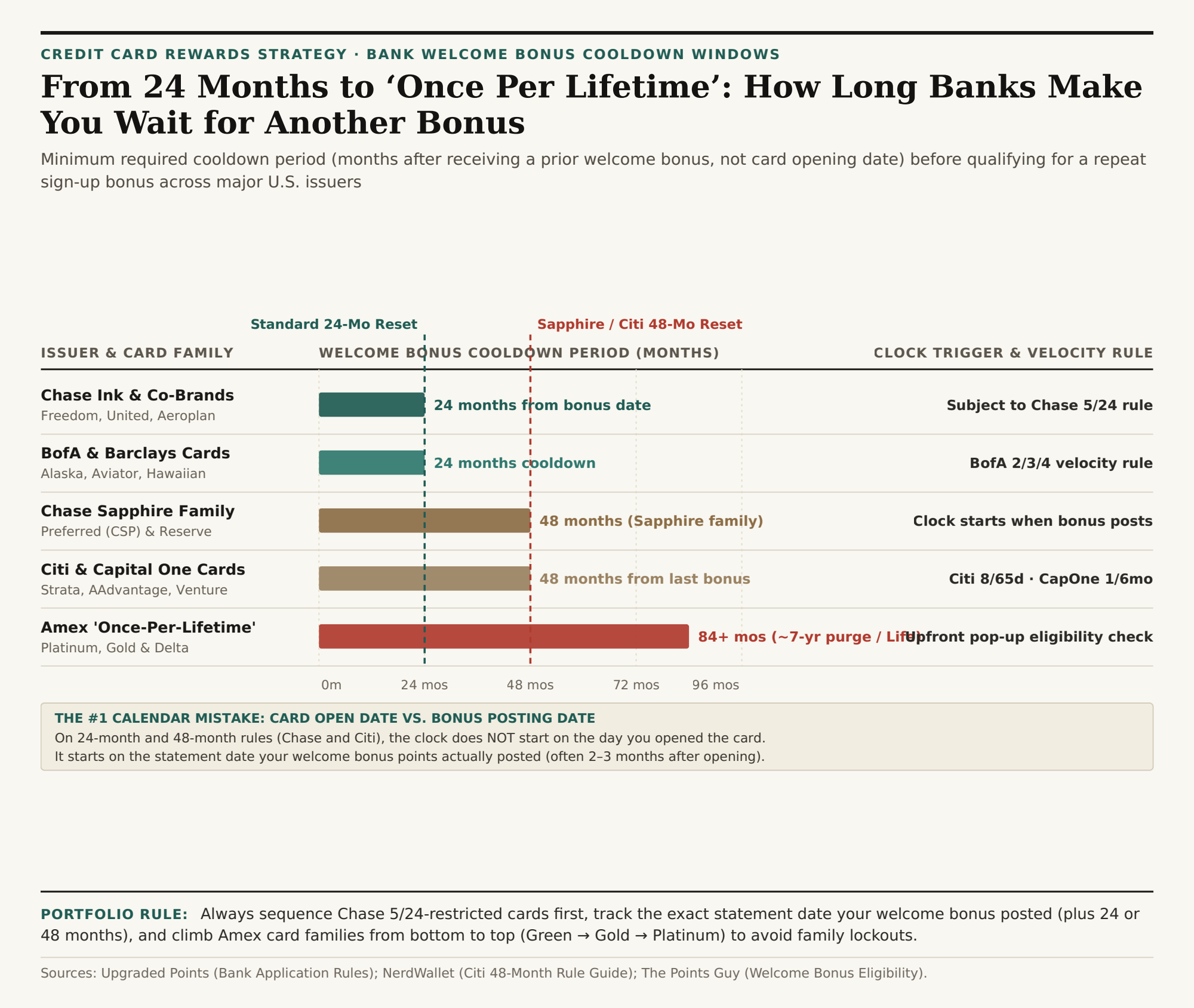
2. American Express's "Once-Per-Lifetime" Rule & Top-Down Family Lockouts
Unlike Chase and Citi, American Express includes standard offer language stating that its welcome bonus is unavailable if you "have or have had this Card." In practice, two structural rules govern Amex eligibility (Upgraded Points Bank Rules):
- The ~7-Year Internal Purge & Pre-Pull Pop-Up Warning: While Amex calls its restriction "once per lifetime," empirical data points show Amex's internal history typically purges closed accounts roughly 7 years (
84+ months) after account closure (and targeted "No Lifetime Language" / NLL offers bypass the rule entirely). Better yet, Amex runs an automated eligibility check before performing a hard credit inquiry and displays a pop-up window warning you if you are ineligible for the welcome bonus — allowing you to cancel the application with zero credit impact. - The Bottom-Up "Family Rule" Ladder (Green → Gold → Platinum): American Express now enforces upward family progression across its consumer Charge Cards (
Green,Gold,Platinum) and Delta SkyMiles co-branded cards (Gold,Platinum,Reserve). If you open the top-tier Amex Platinum Card first, the terms state you may become ineligible to later earn the welcome bonus on the Amex Gold or Amex Green. Always climb Amex families from the lowest tier upward (Green → Gold → Platinum).
"Always sequence your credit card roadmap in two dimensions: fill your first five personal slots with Chase 5/24-restricted cards, and climb American Express card families from the bottom tier up so a top-tier card never locks you out of mid-tier bonuses."
| Issuer & Card Group | Bonus Cooldown | Clock Start Trigger | Velocity Cap | Key Sequencing Rule |
|---|---|---|---|---|
| Chase Ink / Freedom / Co-Brands | 24 months | Statement date bonus posted | 5/24 (All banks) | Apply while under 5/24; Ink flavors are separate |
| Bank of America & Barclays | 24 months | Bonus / prior close window | BofA 2/3/4 rule | Alaska, Hawaiian & Aviator co-brand cards |
| Chase Sapphire Family (CSP/CSR) | 48 months | Date last Sapphire bonus posted | 5/24 + 1 Sapphire cap | Downgrade current Sapphire 1 week before applying |
| Citibank (Strata / AAdvantage) | 48 months | Date last bonus received | 1 per 8d, 2 per 65d | Personal and Business AAdvantage clocks are separate |
| Capital One (Venture / Venture X) | 48 months | Date last bonus received | 1 card per 6 months | Requires excellent credit profile with low recent inquiries |
| American Express (MR / Delta / Hilton) | Lifetime (~84+ mos) | Account closure + ~7 yr purge | 2 credit cards / 90d | Climb bottom-up (Green → Gold → Platinum); watch pop-up |
Auditing Your Bonus Cooldown Dates & Net Point Value
Before submitting any new application, check the exact statement PDF on which your prior welcome bonus posted, add 24 or 48 months plus a 15-day safety buffer, and verify your current 5/24 count. Compare credit card welcome bonuses and point values in Pointsuno to model which ecosystem delivers the highest net travel return, and download the bank welcome bonus cooldown CSV table.