
How the Sunny 16 and Looney 11 Rules Calculate Camera Exposure Without a Light Meter
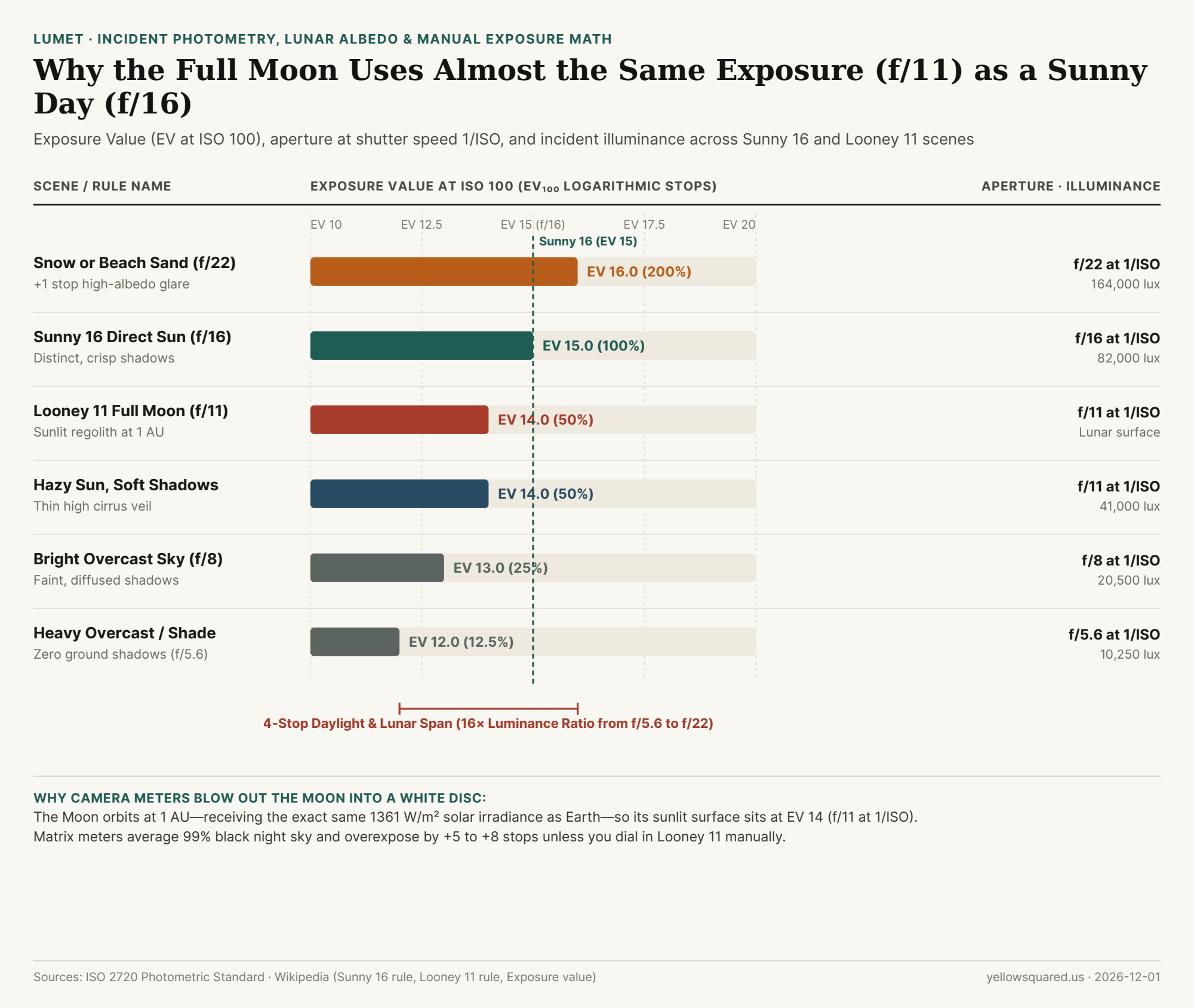
Every photographer who points a camera at the Full Moon in automatic exposure mode encounters the same surprise: instead of crisp craters and dark basalt maria, the camera captures a featureless, blown-out white blob. That happens because the camera's built-in reflective meter averages the 99% black night sky around the lunar disc and boosts exposure by +5 to +8 stops. In reality, the sunlit surface of the Moon is illuminated by the exact same midday Sun as Earth, sitting at Exposure Value 14 (EV 14 at ISO 100)—just one stop below the Sunny 16 rule (EV 15 at ISO 100) (Looney 11 rule - Wikipedia; Sunny 16 rule - Wikipedia).
Once you understand how logarithmic Exposure Values (EV) map to physical illuminance in lux, you can set accurate exposures on mechanical film cameras, manual prime lenses, or telephoto lunar rigs before taking a single test frame—and cross-check real-world ambient lux readings when you Measure ambient and studio lighting in Lumet.
The Photometric Math Behind EV 15 (Sunny 16)
In the international exposure system defined by ISO 2720, Exposure Value (EV) combines relative aperture (f-number N) and exposure time in seconds (t) into a base-2 logarithmic scale (Exposure value - Wikipedia):
EV = log₂(N² / t)
On a clear day with direct sunlight and distinct shadows, incident solar illuminance on Earth's surface reaches approximately 82,000 lux, which corresponds to EV 15 at ISO 100 (Exposure value - Wikipedia). Plugging N = 16 and t = 1/125 s into the formula yields log₂(256 × 125) = log₂(32,000) ≈ 14.97 EV, or EV 15. That relationship gives us the classic Sunny 16 mnemonic: in direct midday sun, set your aperture to f/16 and your shutter speed to the reciprocal of your ISO (1/100 s or 1/125 s at ISO 100; 1/400 s or 1/500 s at ISO 400) (Sunny 16 rule - Wikipedia).
Why the Looney 11 Rule Sits Exactly One Stop Wider (EV 14)
Why does a night-sky object require a daytime shutter speed? By the inverse-square law of electromagnetic radiation, solar irradiance depends only on an object's distance from the Sun—not on the distance from the object to your camera lens. Both Earth and the Moon orbit the Sun at an average distance of 1 Astronomical Unit (1 AU ≈ 149.6 million km), receiving the same 1,361 W/m² solar constant above the atmosphere.
While an average sunlit terrestrial landscape reflects roughly 18% of incident light ("middle gray"), the Moon's dusty basaltic regolith has a slightly darker average geometric albedo of roughly 12%, balanced in part by the opposition surge (retroreflection when the Moon is full) (Looney 11 rule - Wikipedia). As a result, the sunlit lunar surface requires just one stop more exposure than a sunny afternoon on Earth:
- Looney 11 Rule (Full Moon Surface, EV 14): Set aperture to f/11 and shutter speed to 1/ISO (e.g.,
f/11at1/100 sor1/125 sat ISO 100, orf/8at1/250 sfor sharper hand-held telephoto shots) (Looney 11 rule - Wikipedia). - Quarter Moon (+1 stop, EV 13): When the solar incidence angle becomes oblique along the lunar terminator, open one additional stop to f/8 at 1/ISO.
- Crescent Moon (+2 stops, EV 12): For thin crescents low above the twilight horizon, open two stops from Looney 11 to f/5.6 at 1/ISO.
"Photographing the Full Moon is not low-light photography—it is daylight photography of a sunlit rock 384,400 kilometers away."
Complete Sunny 16 & Looney 11 Exposure Reference Table (EV 16 to EV 12)
Each 1.0 EV step down from EV 16 halves the physical illuminance in lux and opens the lens aperture by one full f-stop at a constant 1/ISO shutter speed (Sunny 16 rule - Wikipedia; Exposure value - Wikipedia):
| Lighting Condition / Scene | Rule Name | Aperture at 1/ISO | EV at ISO 100 | Incident Illuminance | Shadow & Surface Cue |
|---|---|---|---|---|---|
| 1. Snow or White Beach Sand | Snowy / Sandy f/22 |
f/22 |
16.0 EV |
164,000 lux (200%) |
High-albedo glare; hard black shadows |
| 2. Direct Midday Sunlight | Sunny 16 Baseline | f/16 |
15.0 EV |
82,000 lux (100%) |
Clear sky; crisp, distinct shadow edges |
| 3. Full Moon Surface (Night) | Looney 11 Rule | f/11 |
14.0 EV |
41,000 lux eq (50%) |
Sunlit lunar regolith at 1 AU (~12% albedo) |
| 4. Hazy Sun / Thin High Clouds | Slight Overcast f/11 |
f/11 |
14.0 EV |
41,000 lux (50%) |
Soft, diffused shadow edges |
| 5. Bright Overcast Daylight | Overcast f/8 |
f/8 |
13.0 EV |
20,500 lux (25%) |
Faint shadows under bright cloud deck |
| 6. Heavy Overcast / Open Shade | Shady f/5.6 |
f/5.6 |
12.0 EV |
10,250 lux (12.5%) |
Zero ground shadows; open north shade |
Reciprocity Equivalents for Portrait and Telephoto Shooting
You never have to shoot at f/16 to use the Sunny 16 rule. By the law of exposure reciprocity, every full-stop wider aperture (from f/16 → f/11 → f/8 → f/5.6 → f/4 → f/2.8 → f/2) doubles the required shutter speed. In EV 15 direct sunlight at ISO 100, f/16 at 1/125 s delivers the exact same sensor exposure as f/8 at 1/500 s, f/4 at 1/2000 s, or f/2 at 1/8000 s. To verify real-time incident illuminance and exposure reciprocity on location before shooting film or digital portraits, Measure ambient and studio lighting in Lumet.