
How to Avoid Airline Fuel Surcharges on Award Flights
Airline "carrier-imposed surcharges" (coded as YQ and YR on ticket receipts) can add $900 to $1,050 in out-of-pocket cash to an award ticket that was supposed to be booked entirely with miles. However, you can legally avoid or slash these fees to under $60 by booking Star Alliance partner flights through loyalty programs that strictly ban fuel surcharges — specifically Air Canada Aeroplan and United MileagePlus — rather than booking through programs like British Airways Executive Club or Virgin Atlantic Flying Club that pass full carrier fees directly to members.
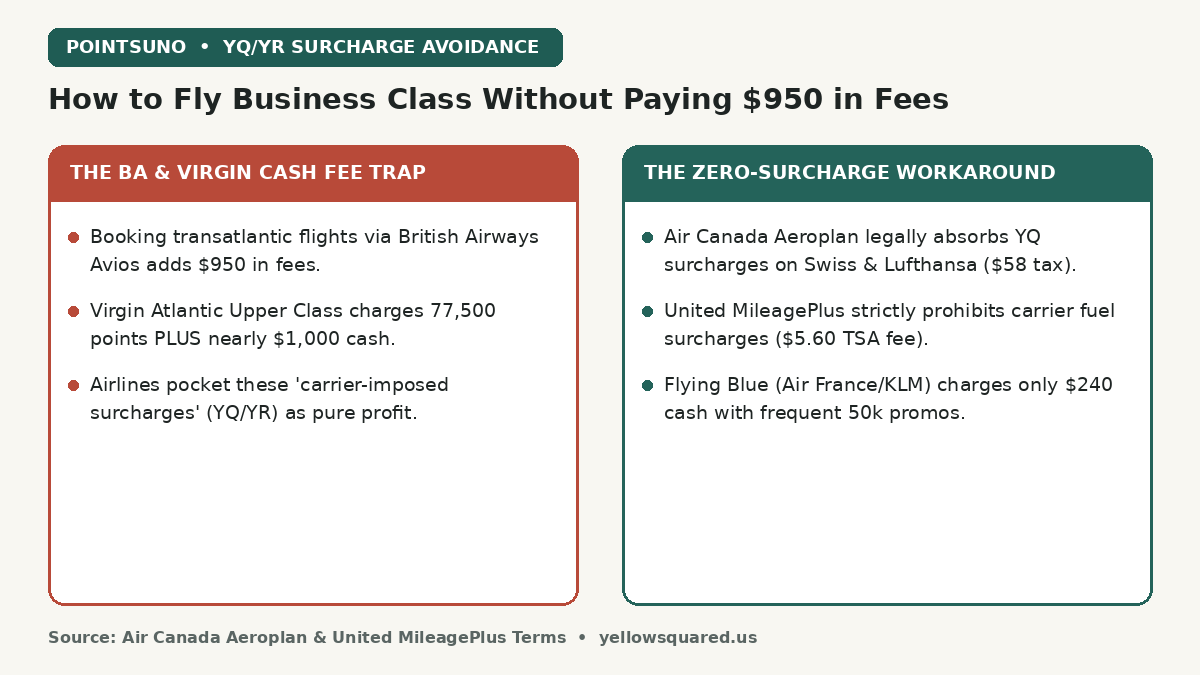
There are few ruder awakenings in points and miles than earning 80,000 credit card points, transferring them to an airline partner to book a dream business class flight to London or Frankfurt, and reaching the final checkout screen only to see a cash requirement of $985.40 alongside your points balance. While genuine government departure taxes are unavoidable, massive fuel surcharges are completely optional if you route through the right booking currency.
A carrier-imposed fee (YQ/YR) is not an airport tax — it is an airline cash surcharge that only certain frequent flyer programs force you to pay.
The Anatomy of an Award Ticket: Government Taxes vs. YQ Fees
When you redeem miles for an airline seat, your cash bill consists of two separate components:
- Genuine Government & Airport Taxes: These are non-negotiable statutory fees collected on behalf of civil aviation authorities. For flights departing the United States, this includes the $5.60 TSA September 11th Security Fee per one-way segment. For flights departing the United Kingdom, it includes the UK Air Passenger Duty (APD), which charges £202 (roughly $260) for long-haul premium cabins. Every airline must collect these taxes regardless of booking method.
- Carrier-Imposed Surcharges (YQ / YR): Originally invented during the 1970s and 2000s oil crises as temporary "fuel surcharges," international carriers (notably British Airways, Virgin Atlantic, Lufthansa, Swiss, and Austrian Airlines) retained these fees as permanent profit centers. On a one-way business class ticket across the Atlantic, YQ surcharges alone range from $650 to $850.
Which Loyalty Programs Ban Surcharges on Partner Flights?
The crucial secret of airline alliances (Star Alliance, oneworld, and SkyTeam) is that the loyalty program you use to book determines whether carrier surcharges are passed through to you, not the airline operating the plane:
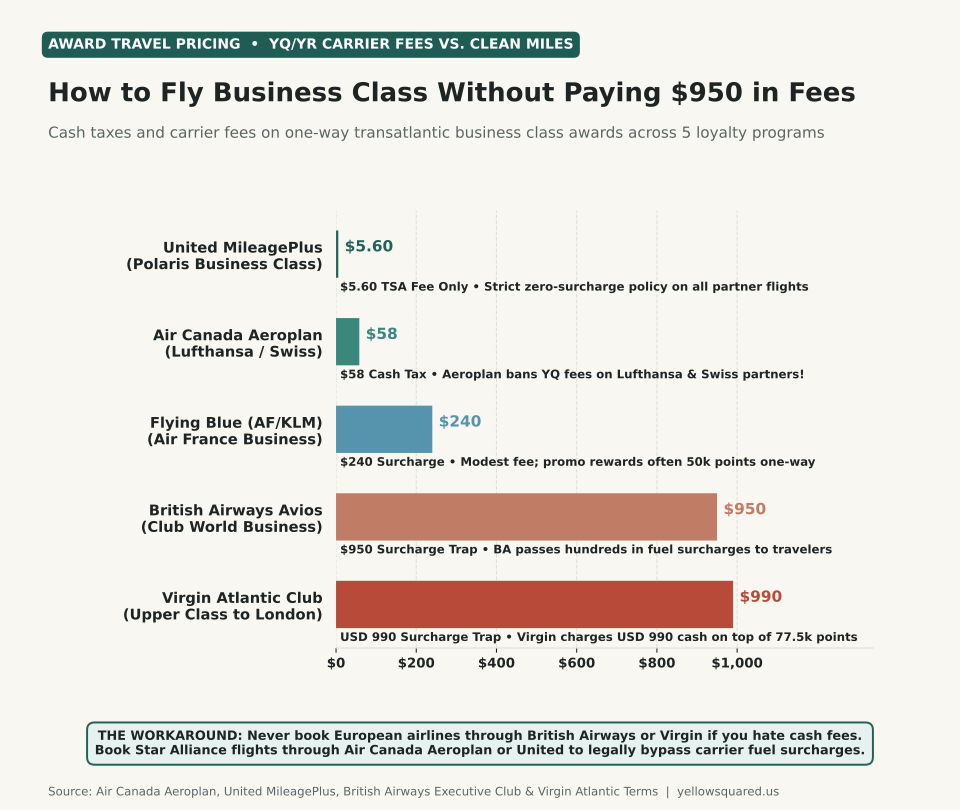
| Frequent Flyer Program | Alliance | Carrier Surcharge (YQ/YR) Policy | Typical Cash Fee to Europe (One-Way Biz) |
|---|---|---|---|
| United Airlines MileagePlus | Star Alliance | Banned: Never passes YQ fees on any partner flight | $5.60 (U.S. departure) |
| Air Canada Aeroplan | Star Alliance | Banned: Absorbs all partner YQ fees (charges $39 CAD booking fee) | $58 to $80 (CAD/USD taxes) |
| Avianca LifeMiles | Star Alliance | Banned: Zero fuel surcharges on all partner redemptions | $25 to $45 (taxes only) |
| Flying Blue (Air France / KLM) | SkyTeam | Moderate: Capped internal surcharges on Air France/KLM metal | $220 to $260 |
| British Airways Executive Club | oneworld | Full Pass-Through: Collects maximum commercial YQ fees | $950 to $1,050 |
| Virgin Atlantic Flying Club | SkyTeam | Full Pass-Through: Extreme cash surcharges on Upper Class | $950 to $1,020 |
The 3 Rules for Booking Surcharge-Free Flights
- Rule 1 — Book Lufthansa & Swiss via Aeroplan instead of Miles & More: If you want to fly Lufthansa First Class or Swiss Business Class, never book through Lufthansa's own Miles & More program (which charges $900+ in fees). Booking that identical seat through Air Canada Aeroplan charges just 70,000 to 100,000 points and roughly $58 in cash.
- Rule 2 — Fly out of departure-tax-friendly countries on the return: If you are visiting Europe, flying home out of London Heathrow triggers the $260 UK Air Passenger Duty. Taking the Eurostar train to Paris, Amsterdam, or Dublin before flying home cuts government taxes by more than half.
- Rule 3 — Compare net value before transferring points: Paying 60,000 points + $240 cash with Flying Blue is often far better than spending 88,000 United miles to save $234 in cash. Use the Pointsuno award valuation calculator to model the break-even math across airline programs before transferring your credit card points.