
How to Keep Celery Crisp in the Fridge for 4 Weeks
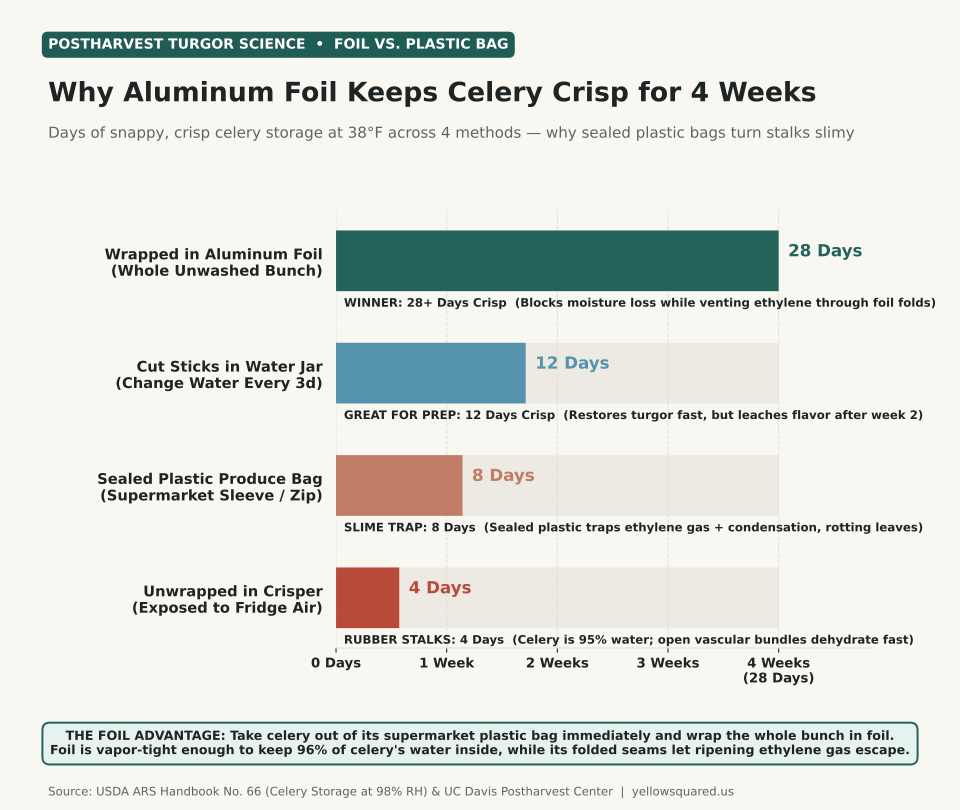
To keep fresh celery crisp and snappy in the refrigerator for up to four weeks, remove it from its supermarket plastic sleeve and wrap the whole unwashed bunch snugly in aluminum foil. While leaving celery unwrapped dehydrates its stalks into limp rubber in four days and sealed plastic bags trap ethylene gas that rots the leaves in a week, aluminum foil locks in 96 percent of the stalk's internal water pressure (turgor) while allowing ripening ethylene gas to vent through the folded seams.
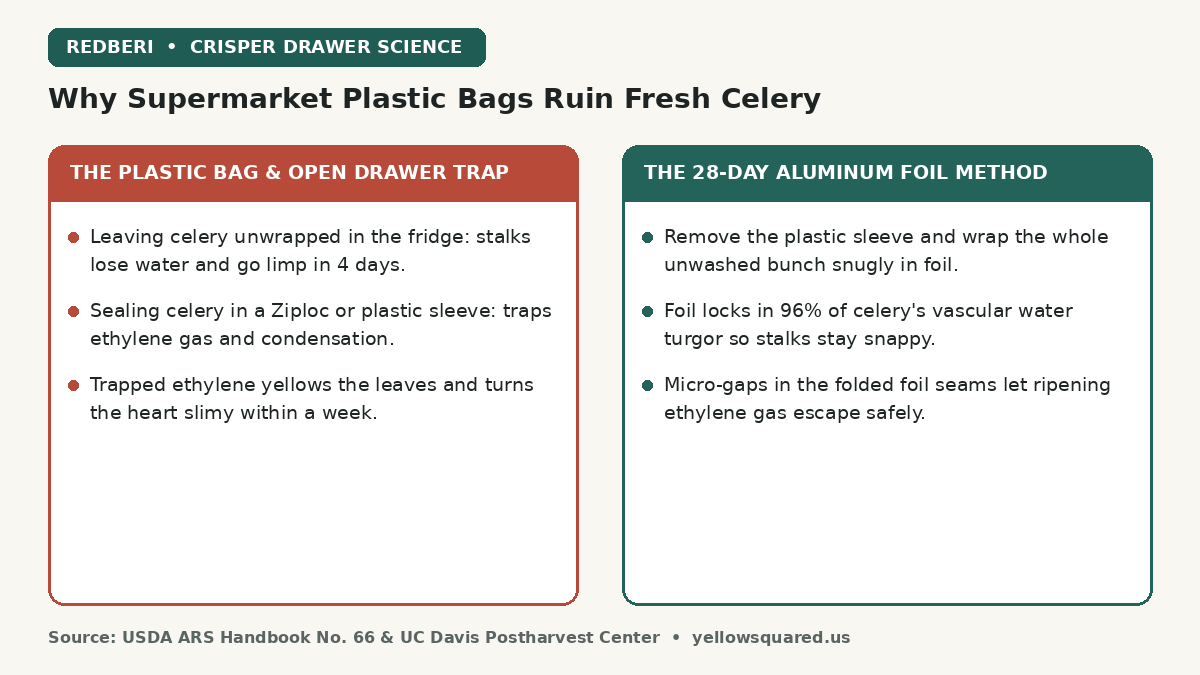
Celery is one of the most frequently wasted vegetables in home kitchens: a recipe calls for two diced ribs of celery for a soup base, leaving the remaining ten ribs forgotten in the crisper drawer. Five days later, the entire bunch bends like a garden hose or smells sour inside its plastic sleeve. Understanding the vascular anatomy of a celery petiole explains why foil outperforms both open air and sealed Ziploc bags.
A celery stalk is 95 percent water held under hydraulic pressure; keeping it crisp requires blocking water vapor loss without trapping ethylene gas.
The Two Enemies of Crisp Celery: Transpiration Loss and Trapped Ethylene
Botanically, a "stalk" or rib of celery (Apium graveolens) is not a woody stem — it is a fleshy leaf petiole engineered to transport water from the root crown to the transpiring leaves at the top. According to postharvest storage standards in USDA ARS Handbook No. 66, celery requires one of the highest humidity levels of any produce item: 98 to 100 percent relative humidity at 32°F to 36°F.
When you bring celery home to a standard refrigerator (where the compressor coil dries ambient cabinet air down to 35 to 50 percent relative humidity), two opposite failure modes occur depending on how you store it:
- The Unwrapped Dehydration Failure (4 Days): Left exposed in the crisper drawer or in an open-top supermarket sleeve, water evaporates rapidly out of the cut vascular bundles (xylem) and leaf pores (stomata). Once a celery petiole loses just 5 to 8 percent of its water weight, internal cellular turgor pressure collapses, collenchyma strings slacken, and the stalk becomes limp and rubbery.
- The Sealed Plastic Bag Slime Failure (7 to 8 Days): Sealing celery inside an airtight Ziploc bag stops water loss, but traps two things: liquid condensation droplets and ethylene gas — the natural plant hormone we also track in countertop fruit ripening. Celery is highly sensitive to ethylene; trapped gas triggers chlorophyll breakdown (blanching the green stalks yellow), accelerates pithiness (hollow, spongy centers), and encourages bacterial soft rot (Erwinia carotovora) on the wet inner leaves.
Why Aluminum Foil Is the Ideal Semi-Vented Barrier
Wrapping a whole, unwashed head of celery in a single sheet of standard aluminum foil solves both problems simultaneously:
- Vapor barrier (96%+ moisture retention): Foil is completely impermeable to water vapor across its surface, creating a microclimate above 95 percent humidity around the stalks without clinging wetly to the leaves the way thin plastic film does.
- Passive gas venting through crimped seams: Because crimped foil folds are not hermetically heat-sealed, small diffusive air gaps along the ends allow low-molecular-weight ethylene gas (C2H4) and respiration carbon dioxide to escape slowly into the crisper drawer.
Comparison of 4 Celery Storage Methods
| Storage Method | Crisp Shelf Life | Moisture Retention | Best Use Case & Trade-Off |
|---|---|---|---|
| Whole Bunch Wrapped in Aluminum Foil | 28+ Days | 96% | Best Overall: Keep root base attached; unpeel foil, snap off ribs as needed, and re-crimp. |
| Cut Sticks Submerged in Glass Water Jar | 10 – 14 Days | 99% | Best for Grab-and-Go Snacking: Change water every 3 days; soaking past 2 weeks leaches flavor. |
| Damp Paper Towel Inside Partially Open Bag | 10 – 12 Days | 90% | Good Backup: Paper towel buffers condensation, but requires re-dampening every 4 days. |
| Sealed Plastic Bag / Unwrapped Crisper | 4 – 8 Days | 76% – 94% | Avoid: Unwrapped stalks wilt in 4 days; sealed plastic rots inner leaves in 8 days. |
How to Revive Limp Celery in 30 Minutes
If you find limp, bendable celery in the back of your crisper (provided it is not slimy or discolored), you can restore its crunch through osmotic turgor recovery: slice 1/4 inch off the dry bottom root callous to reopen the clogged xylem vessels, cut the ribs into sticks, and submerge them in a bowl of ice water for 30 minutes. Because the pure water in the bowl has a higher water potential than the solute-rich cells inside the dehydrated celery, water rushes back across the cell membranes via osmosis, re-pressurizing the vacuoles until the stalks snap cleanly again.
To check seasonal harvest calendars, ethylene compatibility, and storage guides across fresh produce, Open Redberi in your browser.