
Why Do Cucumbers Get Slimy in the Fridge? How to Keep Them Crisp
Why Do Cucumbers Get Slimy in the Fridge? How to Keep Them Crisp
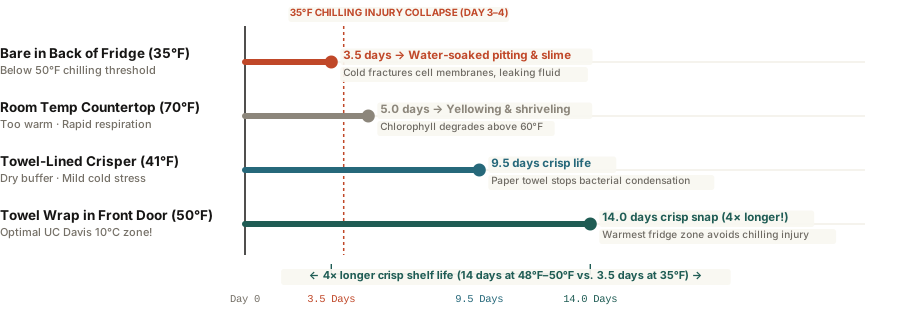
Cucumbers are warm-season subtropical fruits that suffer cellular chilling injury below 50°F (10°C); wrapping unwashed cucumbers in a dry paper towel and storing them in the warmer front fridge door (46°F–50°F) prevents slimy pitting for 14 days.
Almost every home cook has experienced the cucumber paradox: leave a fresh cucumber on the kitchen counter and it turns yellow and shriveled within five days, yet tuck it into the back of the refrigerator crisper drawer (`34°F–36°F`) and within four days its skin develops sunken, water-soaked pits coated in a slippery biofilm. Unlike hardy root vegetables such as carrots or parsnips that thrive right above freezing (`32°F`), cucumbers actively break down in standard refrigerator cold.
According to postharvest physiology research from the University of California, Davis, cucumbers (Cucumis sativus) are chilling-sensitive subtropical fruits whose optimal storage window sits at a surprisingly warm 50°F to 55°F (10°C to 12.5°C). Understanding how cold temperatures fracture cucumber cell membranes—and how to create a 48°F microclimate inside a normal kitchen refrigerator—lets you extend crisp cucumber shelf life from 3.5 days to two full weeks.
The Science of Chilling Injury Below 50°F (10°C)
Composed of roughly 95% water held inside thin-walled parenchyma cells, cucumbers evolved in warm South Asian climates. When a cucumber is held below 50°F (10°C) for more than 48 to 72 hours, the phospholipid bilayers inside its cell membranes undergo a physical phase transition from a flexible liquid-crystalline state into a rigid, cracked gel:
- Intracellular Leakage & Pitting: As the stiffened cell membranes fracture, water and dissolved sugars leak out of the vacuoles into the intercellular spaces. On the surface of the peel, collapsed cells form sunken dark dimples known as chilling pits.
- Secondary Bacterial Slime: Once sugar-rich cellular fluid leaks onto the skin—especially inside a sealed plastic produce bag where condensation droplets pool—cold-tolerant Pseudomonas and soft-rot bacteria rapidly colonize the wet pits, creating the characteristic slimy coating.
Slime on a refrigerated cucumber is rarely primary spoilage; it is the secondary consequence of 35°F chilling injury cracking the fruit's cell membranes.
The 14-Day Crisp Protocol: Paper Towel + Front Door
Because a kitchen counter (`70°F`) is too warm and the back of a refrigerator (`35°F`) is too cold, use these three steps to hit the postharvest sweet spot:
- Wrap Dry, Unwashed Cucumbers in a Paper Towel: Never wash cucumbers before storing them. Wrap each dry cucumber in a single sheet of paper towel (or a clean cotton dish towel) and slide it into a loosely closed zip-top bag. The paper towel acts as a humidity buffer—maintaining the 95% relative humidity needed to prevent shriveling while wicking away liquid condensation droplets before bacteria can bloom.
- Store in the Warmest Zone of the Fridge (Front Upper Shelf or Door): Heat rises and warm air enters every time you open the refrigerator door, making the front edge of the top shelf or the covered butter/door compartment (`46°F–50°F / 8°C–10°C`) up to 12°F warmer than the back bottom wall. Storing wrapped cucumbers in that warmer front zone quadruples their crisp lifespan to 14 days.
- Quarantine Away from Ethylene Producers: Cucumbers are extremely sensitive to ethylene gas (`>1 ppm` triggers rapid chlorophyll degradation and yellowing). Never store them in the same drawer as apples, bananas, avocados, melons, or ripening tomatoes.
To check exact chilling-injury temperature floors and ethylene compatibility pairs across all your fruits and vegetables, you can Explore storage benchmarks in Redberi before organizing your fridge.