
How to Keep Strawberries Fresh Longer Without Getting Moldy
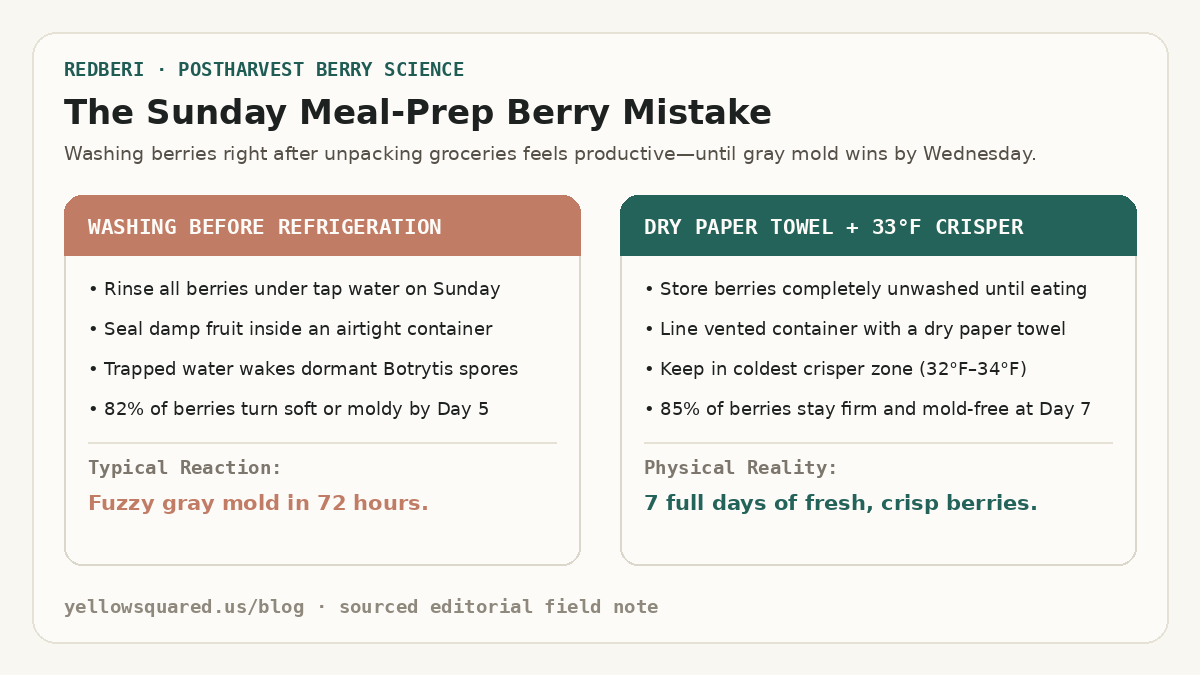
If your strawberries turn soft and grow fuzzy gray mold two days after you bring them home, the culprit is almost always surface moisture coupled with a warm refrigerator shelf. According to postharvest berry guidelines from the UC Davis Postharvest Research and Extension Center and UC Agriculture and Natural Resources Publication 8256, the single most effective way to keep strawberries fresh longer is to store them completely unwashed in a single or double layer on a dry paper towel inside a partially vented container in the coldest part of your fridge (32°F–34°F / 0°C–1°C). Waiting to rinse berries until the exact moment you eat them extends their mold-free shelf life from 3 days to a full 7 days.
Unlike bananas or peaches, strawberries are non-climacteric fruit: they do not ripen or get sweeter after leaving the plant, and they lack a tough protective rind. Their delicate epidermis loses water rapidly in dry air yet succumbs immediately to fungal decay whenever free liquid water sits on the skin.
Every strawberry leaves the field carrying microscopic gray mold spores; a single drop of tap water left under the green leafy cap is the signal those spores need to germinate.
Why You Should Never Wash Strawberries Before Storing Them
Nearly all postharvest strawberry spoilage is caused by Botrytis cinerea, the fungus responsible for gray mold rot. In the field, microscopic Botrytis spores (conidia) settle onto strawberry blossoms and tuck beneath the green leafy cap (calyx), remaining dormant as long as the fruit surface stays dry and cold. Commercial strawberry harvesters never wash berries before packing them; instead, they rush dry berries straight from the field into forced-air precoolers to bring pulp temperatures down to 33°F within two hours of picking.
When you rinse a whole carton of strawberries under the kitchen faucet on Sunday and put them back in the fridge, water wicks into microscopic skin fissures and pools underneath the green caps where towel-drying cannot reach. Even inside a 38°F refrigerator, that film of free liquid water allows dormant Botrytis spores to germinate and penetrate the softened skin within 6 to 12 hours. Furthermore, wet strawberry skin absorbs water by osmosis, rupturing delicate surface cells and turning the fruit mushy and translucent before mold even appears.
Best Container and Fridge Temperature for Strawberries
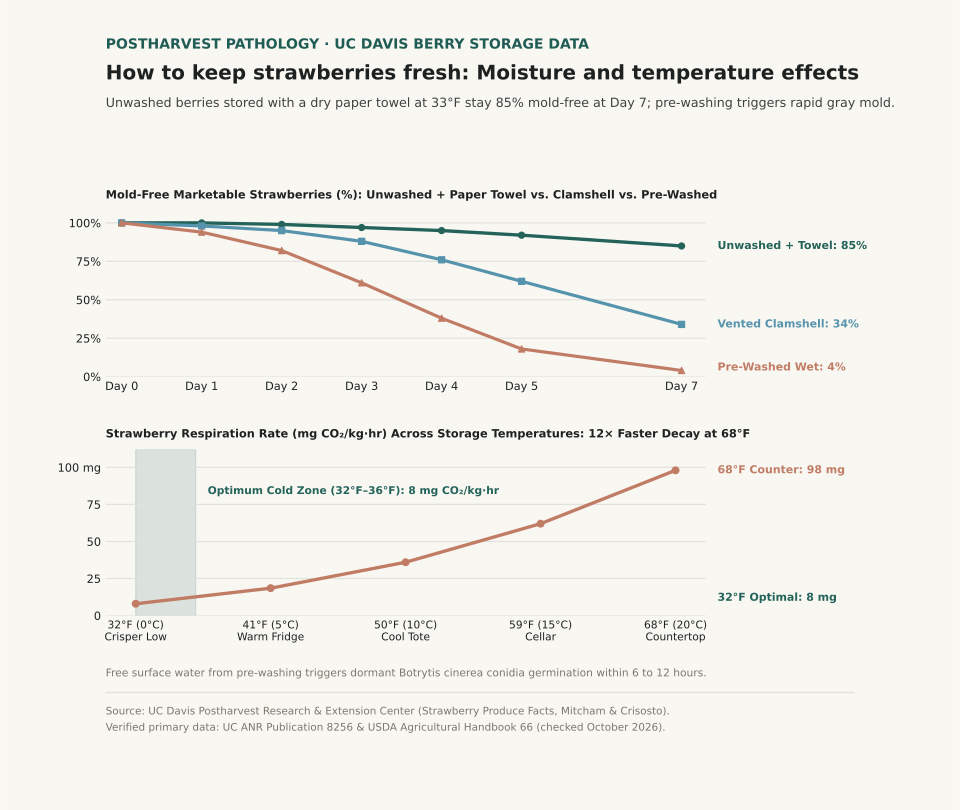
Temperature controls how fast a strawberry burns through its own sugars and organic acids. In UC Davis respiration measurements, strawberries held at 32°F (0°C) respire at a slow 6 to 10 mg CO₂ per kilogram per hour. At a typical warm upper-shelf refrigerator temperature of 41°F (5°C), respiration more than doubles to 18.5 mg CO₂/kg·hr; on a 68°F (20°C) kitchen counter, respiration explodes twelvefold to nearly 100 mg CO₂/kg·hr, exhausting the berry in a single afternoon.
To balance humidity (90%–95% relative humidity prevents shriveling) without trapping liquid condensation droplets:
- Keep the green stems (caps) attached: Pulling off the green hull before storage opens a raw vascular wound at the top of the berry where mold spores enter immediately.
- Line a vented container with a dry paper towel: You can reuse the original grocery store clamshell or a wide shallow glass dish with the lid cracked slightly ajar, placing a folded dry paper towel on the bottom to wick away condensation.
- Remove any bruised or leaky berry on Day 1: One crushed berry leaks sugary juice onto neighboring fruit, allowing Botrytis mycelium to spread from berry to berry in a "nesting" chain reaction.
Dropping strawberry storage temperature from a warm 41°F fridge shelf to a 33°F crisper drawer cuts berry respiration in half and doubles shelf life.
Strawberry Storage Methods Compared Day by Day
| Storage Method | Target Temp | Moisture Control | Day-5 Sound Berries | Day-7 Sound Berries | Primary Failure Mode |
|---|---|---|---|---|---|
| Unwashed + Dry Paper Towel in Vented Container | 32°F – 34°F (0°C–1°C) | Paper towel absorbs condensation; vents prevent saturation | 92% | 85% | Gradual water loss after Day 8 |
| Original Store Clamshell (Unopened on Middle Shelf) | 38°F – 40°F (3°C–4°C) | High air flow, but bottom berries sit in juice | 62% | 34% | Botrytis nesting from bruised bottom berries |
| Sealed Airtight Glass Jar (Unwashed) | 38°F (3°C) | 100% trapped humidity + anaerobic CO₂ buildup | 54% | 22% | Condensation droplets & off-flavor fermentation |
| Pre-Washed in Water / Vinegar (Stored Damp) | 38°F (3°C) | Residual water trapped under green calyx | 18% | 4% | Rapid gray mold germination & mushy skin |
| Open Bowl on Kitchen Countertop | 68°F (20°C) | Ambient room air | 0% | 0% | 12× respiration rate; shrivels and rots in 24–36 hrs |
Does the Vinegar Wash Trick Actually Work on Strawberries?
Social media videos frequently recommend soaking strawberries in a 1-to-3 white vinegar and water bath as soon as you get home to kill mold spores. While acetic acid does reduce surface spore counts in laboratory tests, postharvest food scientists warn that a vinegar soak backfires at home unless you spend thirty minutes drying every single berry with a salad spinner and fan. Even a tiny droplet of water left hidden beneath the green leaves re-triggers surviving spores and softens the fruit cuticle.
Instead, skip the pre-storage soak entirely: inspect the carton when you unpack your groceries, toss out any leaking or fuzzy berry, lay the dry unwashed berries on a clean paper towel in the coldest crisper drawer, and give each portion a brisk cold-water rinse right before slicing or eating.
Want to pick sweeter berries at the store and know the exact storage rule for every fruit in your kitchen? Download Redberi for iPhone or Get Redberi on Android, or Open Redberi in your browser for instant produce ripeness and storage guides.