
What Causes Sunbeams? How to Photograph Crepuscular Rays
What Causes Sunbeams? How to Photograph Crepuscular Rays
Crepuscular rays appear when low-angle sunlight (between 3° and 15° solar elevation) passes through broken cumulus clouds or forest canopies and scatters off atmospheric aerosols via Tyndall and Mie scattering.
Few natural lighting phenomena command attention like visible shafts of sunlight—colloquially called sunbeams, god rays, or Jacob's Ladder—streaming through a gap in storm clouds or slicing across a misty redwood forest. In meteorological optics, these volumetric beams are known as crepuscular rays (from the Latin crepusculum, meaning twilight), because they appear most frequently during the low-angle hours just after sunrise and just before sunset.
While spotting sunbeams often feels like luck, their appearance is governed by three predictable physical variables: solar elevation angle, aerosol particle size, and shadow occlusion geometry. Understanding how these three factors interact lets you forecast volumetric light conditions and expose them cleanly without blowing out your highlights.
The Physics: Linear Perspective and Forward Mie Scattering
When you look at sunbeams fanning out from behind a cloud, the rays appear to diverge at steep angles like spokes on a wheel. In reality, because the sun sits 93 million miles (150 million kilometers) away, every shaft of sunlight entering Earth's atmosphere is virtually parallel. Their apparent divergence is pure linear perspective—the exact same optical illusion that makes parallel railroad tracks appear to meet at the horizon. Occasionally, on clear evenings, those parallel shafts continue across the entire sky vault and appear to converge again on the opposite eastern horizon as anticrepuscular rays.
For a sunbeam to become visible in mid-air, two conditions must occur simultaneously:
- Shadow Lanes (Occlusion): Broken stratocumulus clouds, jagged mountain ridges, or dense tree trunks must block sections of the sun's disk, carving alternating corridors of bright light and dark shadow.
- Forward Mie Scattering: Clean nitrogen and oxygen molecules (Rayleigh scattering) are too small to make distinct shafts pop at short distances. Visible beams require larger suspended aerosols—water micro-droplets, morning mist, sea spray, dust, or campfire smoke (1 to 10 micrometers in diameter)—which exhibit intense forward Mie scattering, deflecting sunlight brightly when you shoot within 15° to 30° of the sun's direction.
Sunbeams are not made of light alone; they are sculpted by the dark shadow corridors carved between clouds and tree trunks.
Camera Settings: Why You Must Underexpose by -1.0 EV
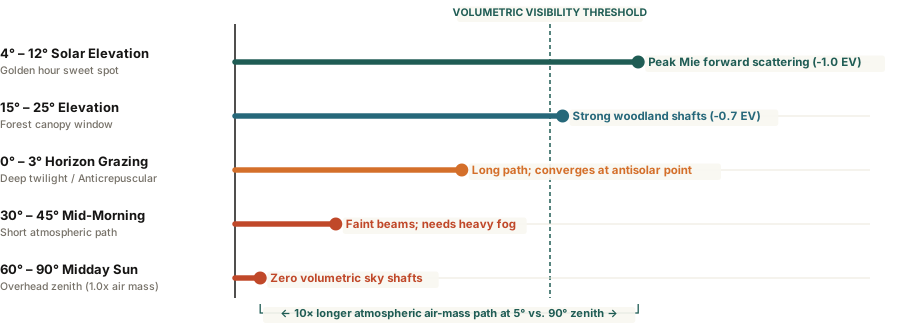
The optimal window for open-sky crepuscular rays occurs when the sun sits between 4° and 12° above the horizon (where the atmospheric path length is 5 to 11 times longer than at midday). Inside dense forests, where tree canopies provide overhead occlusion, the window extends to 15°–25° solar elevation.
- Dial in -0.7 to -1.3 EV Exposure Compensation: Standard camera matrix metering sees the dark shadow corridors and automatically boosts exposure, turning the scene into a washed-out gray haze. Underexposing by one full stop preserves the deep dark shadows that give the bright shafts their 3D contrast.
- Stop Down to f/8–f/11: Using a mid-range aperture keeps both foreground foliage and distant cloud edges crisp while preventing lens flare washout.
To check exact solar elevation angles and golden-hour azimuth windows before heading out to shoot, you can Track lighting ephemeris in PhotoSpots to time your arrival when sunbeams hit peak contrast.