
How to Store Whole and Cut Bell Peppers So They Don't Get Slimy
How to Store Whole and Cut Bell Peppers So They Don't Get Slimy
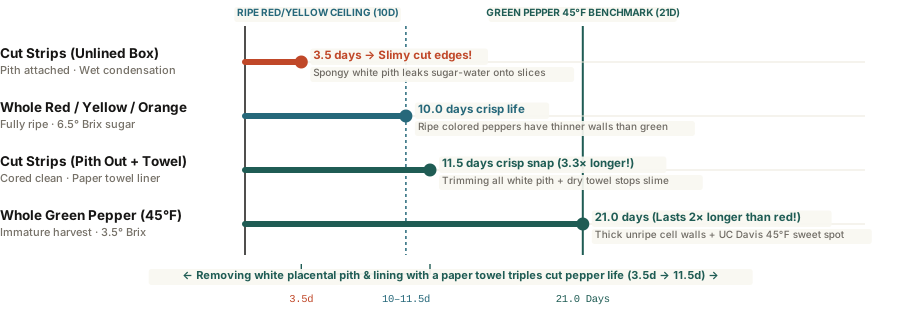
Because red, yellow, and orange bell peppers are fully ripe (twice the sugar and thinner cell walls than unripe green peppers), they spoil twice as fast—while sliced strips turn slimy in 3.5 days unless the spongy white placental pith is removed.
Buy a tricolor three-pack of red, yellow, and orange bell peppers alongside a couple of green bell peppers, place them in your refrigerator crisper drawer, and watch what happens ten days later: the green peppers are still rock-hard and glossy, while the red and yellow peppers have developed wrinkled tips and soft, sunken spots. Even worse, if you slice a bell pepper in half—or chop strips ahead of time for fajitas and salads—the cut edges turn slippery and slimy within 72 to 96 hours.
Understanding two aspects of postharvest pepper botany—the physiological difference between unripe green peppers and ripe colored peppers, and the moisture-trapping anatomy of the inner white pith—lets you keep sliced strips crisp for 11+ days and whole peppers firm for up to 3 weeks.
Why Green Bell Peppers Last Twice as Long as Red, Yellow, and Orange
Green, yellow, orange, and red bell peppers come from the exact same plant species (Capsicum annuum)—the primary difference is ripeness at harvest:
- Green Bell Peppers (Immature Fruit — 21 Days): Harvested before ripening begins, green peppers have thick, rigid pectin-rich cell walls and low soluble sugar content (`~3.5° Brix`). Because decay fungi and bacteria have less free sugar to feed on and tougher cell walls to penetrate, whole green peppers stay crisp for 2 to 3 full weeks.
- Red, Yellow & Orange Peppers (Fully Ripe — 7 to 10 Days): Left on the vine until chlorophyll breaks down and carotenoids (`capsanthin` and `lutein`) develop, colored peppers contain nearly double the sugar (`6.0°–7.5° Brix`) and up to 1.5 times more Vitamin C—but natural ripening enzymes (`polygalacturonase`) have already partially softened their cell walls, cutting their remaining refrigerator life in half.
According to postharvest research from the University of California, Davis, whole bell peppers are also sensitive to chilling injury below 45°F (7.5°C): storing them in the freezing-cold back wall of a 34°F refrigerator for more than two weeks causes surface pitting and black Alternaria rot around the green stem calyx.
The spongy white ribs inside a bell pepper are a moisture sponge; leaving them attached to cut slices guarantees slimy strips in four days.
The 11-Day Protocol for Sliced Bell Peppers
Why do cut bell peppers turn slimy so much faster than whole ones? The outer skin of a bell pepper is sealed by a thick, waterproof waxy cuticle, whereas the interior seed cavity is lined with unprotected parenchyma tissue and spongy white placental ribs (pith). When you slice a pepper and leave remnants of that spongy white pith or stem attached inside a sealed container, cellular fluid weeps from the cut vascular bundles and pools against the wet pith, feeding Pseudomonas soft-rot bacteria.
- Excise 100% of the Stem, Seeds, and White Pith: When prepping half-peppers or fajita strips, lay the pepper flat and slice away every trace of the spongy white inner ribs so only smooth, dense outer wall (`pericarp`) remains.
- Store Skin-Side Down on a Dry Paper Towel: Line the bottom of an airtight glass or BPA-free container with a dry paper towel, arrange the trimmed strips inside, and place a second dry paper towel on top before sealing the lid. Replacing the damp towel every 4 days keeps sliced bell peppers snapping crisp for 11 to 12 days.
- Eat Colored Peppers First: Always rotate your crisper drawer by ripeness—use red, orange, and yellow peppers in the first week, and save green peppers for weeks two and three.
To check optimal temperature zones, chilling thresholds, and prep-ahead shelf life across all your produce, you can Explore storage benchmarks in Redberi before unpacking your groceries.