
How to Store Fresh Bread So It Doesn't Get Moldy or Stale
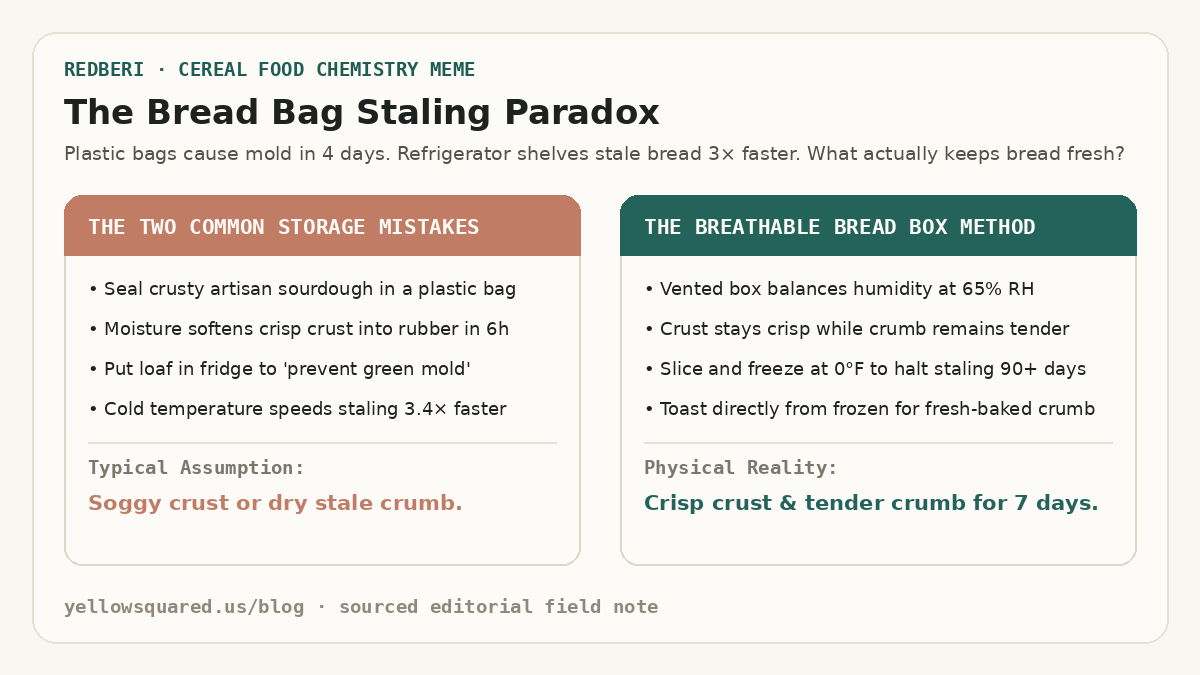
When you bring home a gorgeous loaf of fresh artisan sourdough or crusty French bread from the bakery, your instinct is usually to protect it: either by sealing it tightly inside a plastic grocery bag or putting it on a refrigerator shelf. Within twenty-four hours, both methods ruin the bread. The plastic bag turns the crackly crust into a soft, leathery rubber skin and grows green mold within four days. The refrigerator preserves the loaf from mold, but turns the soft, tender crumb into a dry, crumbly, stale brick three times faster than if left on the kitchen counter.
According to cereal food chemistry research from AACC International (Cereal Foods World) and food storage studies in the Journal of Agricultural and Food Chemistry, bread staling is not caused by moisture evaporating into the air. Staling is caused by a biochemical process called starch retrogradation—and understanding how retrogradation behaves across temperatures is the key to keeping your bread fresh for days or months.
Putting bread in the refrigerator doesn't keep it fresh; cold temperatures act as a biochemical catalyst that crystallizes starch molecules three times faster than room temperature.
The Science of Staling: Why Bread Goes Stale in the Refrigerator
When dough bakes in an oven, wheat starch granules absorb water and heat, swelling until their crystalline structure breaks down into an amorphous, jelly-like gel. This process—starch gelatinization—is what gives fresh-baked bread its soft, tender, pillowy crumb.
The moment bread leaves the oven and cools, that amorphous starch gel begins to revert. Starch molecules (specifically amylose and amylopectin) realign and recrystallize into a rigid, organized lattice. As the starch recrystallizes, it pushes water molecules out of the starch gel and into the surrounding gluten protein network. The crumb turns firm, chalky, and dry—even though the total moisture content of the loaf hasn't changed at all.
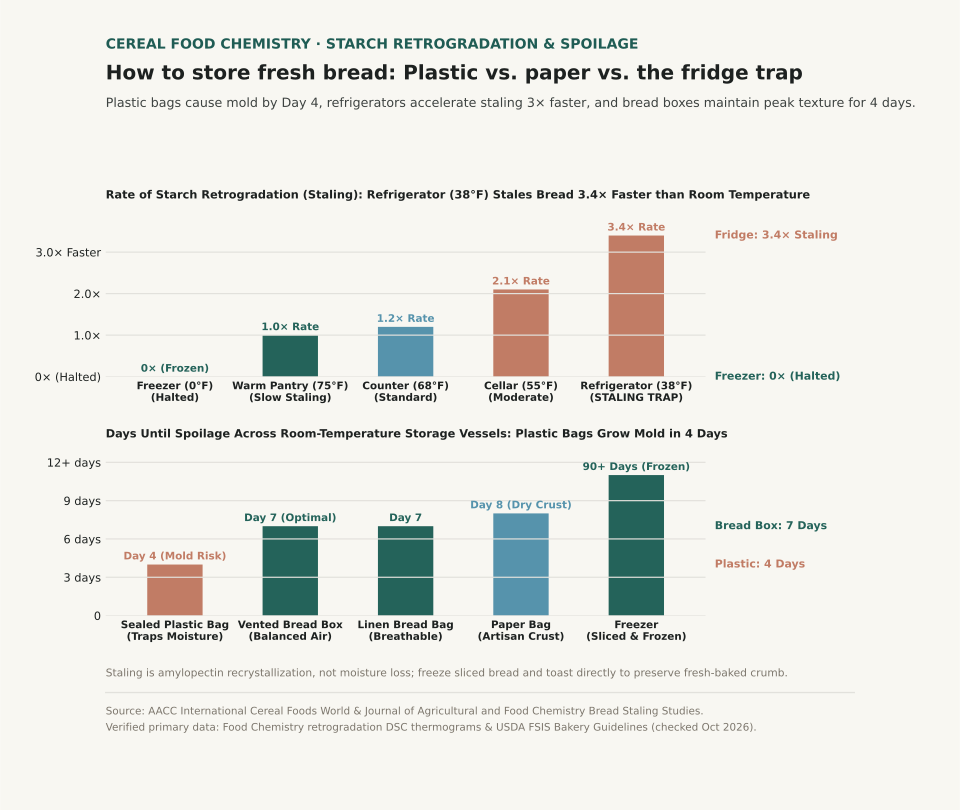
Food scientists have mapped this retrogradation curve using differential scanning calorimetry (DSC). The rate of starch crystallization reaches its absolute maximum at 38°F to 40°F (3°C to 5°C)—the exact temperature of your home refrigerator. Storing bread in the fridge accelerates staling by 340% compared to leaving it on the kitchen counter.
Why Airtight Plastic Bags Ruin Artisan Bread
If the refrigerator is out, why not seal the loaf in an airtight Ziploc or plastic produce bag on the counter? Plastic bags work well for commercial sandwich bread (which contains chemical emulsifiers, mono- and diglycerides, and calcium propionate mold inhibitors), but plastic destroys fresh bakery loaves:
- Loss of Crust Crispness: A freshly baked artisan loaf has a crisp, caramelized crust with roughly 12% moisture surrounding a soft crumb with 45% moisture. Inside a sealed plastic bag, water evaporates from the crumb and gets trapped against the crust, raising surface humidity to 90%+ within six hours. The crackly crust turns into soft, soggy, chew-resistant leather.
- Accelerated Mold Germination: That trapped film of moisture creates the ideal greenhouse environment for airborne mold spores (Penicillium and Rhizopus). In laboratory tests, bread sealed in plastic at 70°F develops visible fuzzy mold colonies within 4 days.
Plastic bags trap humidity to keep the crumb soft, but sacrifice the crust and create a bacterial breeding ground by Day 4.
Storage Methods Compared: Plastic vs. Paper vs. Bread Box vs. Freezer
| Storage Method | Internal Humidity | Crust Texture | Crumb Quality at Day 3 | Days to Visible Mold | Best Use Case |
|---|---|---|---|---|---|
| Vented Wooden Bread Box | Balanced (~65% RH) | Crisp & crackly | 78% soft; slow retrogradation | 6 to 8 days | Optimal balance for fresh artisan loaves (Days 1–5) |
| Brown Paper Bag / Linen Bag | Breathable (~45% RH) | Maximum crackly crunch | 62% soft; dries after Day 3 | 7 to 9 days | Best for same-day baguette or sourdough (Days 1–2) |
| Sealed Airtight Plastic Bag | Trapped (~92% RH) | Soft, rubbery, limp | 88% soft crumb, but ruined crust | 3 to 4 days | Commercial sandwich bread with preservatives only |
| Refrigerator Shelf (38°F) | Dry cold air | Tough, leathery skin | 24% soft (3.4× maximum staling) | 12 to 14 days | Never recommended; ruins bread crumb and texture |
| Sliced & Frozen in Freezer (0°F) | Frozen solid | Restores perfectly in toaster | 95% fresh-baked crumb restored | 90+ days | Long-term storage; toast slices directly from frozen |
The 2-Rule Strategy for Fresh Bakery Bread
To enjoy bakery-fresh bread every day without wasting half a loaf:
- For the first 48 to 72 hours, use a breathable bread box or paper bag: Keep the cut side of the loaf resting face-down on a wooden cutting board inside a bread box or loose paper bag at room temperature (68°F–72°F). The crust stays crackly and the crumb stays soft.
- After Day 3, slice the remaining loaf and freeze it: Slice the leftover bread, place the slices in a freezer zip-top bag with parchment paper separating them, and freeze at 0°F (−18°C). Freezing halts starch retrogradation completely. When you want a slice, pop it straight into the toaster or oven—the intense heat reverses retrogradation and re-gelatinizes the starch, delivering instant fresh-baked texture.
Want to check the storage guidelines and shelf-life indicators for all your baked goods, produce, and pantry staples? Download Redberi for iPhone or Get Redberi on Android, or Open Redberi in your browser for instant kitchen storage and produce guides.