
How to Store Fresh Ginger Root So It Doesn't Shrivel or Mold
How to Store Fresh Ginger Root So It Doesn't Shrivel or Mold
Ginger is an underground stem (rhizome) protected by a cork periderm; letting cut scars dry for 2 hours and wrapping unpeeled ginger in a paper towel inside a zip-top bag keeps it crisp for 5 weeks—or 6 months in the freezer.
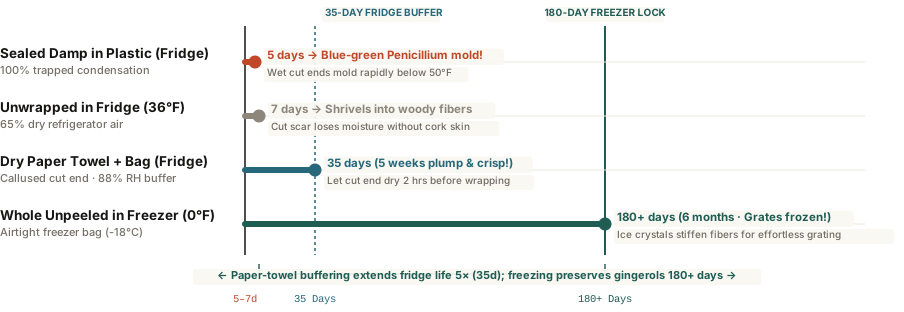
Almost every recipe for stir-fries, curries, or marinades calls for "a 1-inch knob of fresh ginger," leaving you with the remaining 80% of the hand to store in the refrigerator. Toss that leftover piece unwrapped into the crisper drawer, and within a week the cut end shrivels into dry, woody strings. Seal it immediately inside a tight plastic produce bag while the cut surface is still damp, and within five days fuzzy blue-green Penicillium mold colonizes the scar.
Understanding the botanical anatomy of a ginger rhizome—and a counterintuitive freezer technique used by professional prep kitchens—lets you keep fresh ginger plump in the fridge for over a month or grateable from frozen for half a year.
Rhizome Anatomy: Cork Periderm and Wound Suberization
Botanically, culinary ginger (Zingiber officinale) is not a root at all—it is a horizontal underground stem called a rhizome. Its tan, papery outer skin is a multi-layered cork periderm coated in suberin (a natural waxy biopolymer) that protects the water-rich interior parenchyma cells from soil fungi and dehydration. According to postharvest benchmarks from the University of California, Davis, and the University of Hawaii, mature ginger rhizomes are tropical organs that store best commercially at 55°F (12.5°C–15°C) and 85% to 90% relative humidity.
When you slice across a thick lobe of ginger with a chef's knife and immediately seal the damp piece inside a cold (`36°F`) plastic bag, two things go wrong: cold temperatures slow down the rhizome's natural wound-healing process (suberization), and moisture weeping from the severed vascular bundles pools inside the bag, creating a perfect incubator for mold spores.
Never slice straight across the thickest part of a ginger hand; snap off a side knob at its narrow branching joint and let the tiny scar air-dry for two hours before storing.
The 5-Week Fridge Protocol vs. The 6-Month Freezer Trick
- For 35 Days of Plump Fridge Storage (Dry Scar + Paper Towel Buffer): Snap off the knob you need at a narrow joint rather than cutting a wide wound. Leave the remaining unpeeled ginger on the kitchen counter for 2 hours so the small scar dries into a protective callus. Then wrap the unpeeled ginger in a dry paper towel and seal it inside a zip-top bag (pressing out excess air) in the crisper drawer. The paper towel buffers humidity around `88% RH` without allowing liquid droplets to touch the cut end.
- For 180+ Days of Zero-Waste Storage (Freeze Whole & Grate Frozen): If you use ginger primarily for grating or mincing into cooked dishes, skip the crisper drawer entirely. Place whole, unwashed, unpeeled ginger hands inside an airtight freezer bag at 0°F (`-18°C`). Freezing locks in 98% of pungent `6-gingerol` essential oils for over six months. Best of all, ice crystals stiffen the tough cellulose fibers—meaning you can pull rock-hard ginger straight from the freezer, rub it across a Microplane grater (thin papery skin and all, or scrape the skin off with a spoon first), and watch it fall into a fluffy, fiber-free snow in ten seconds before tossing the knob right back into the freezer.
To check optimal humidity buffers, wound-curing rules, and chilling-injury thresholds across all your roots, rhizomes, and aromatics, you can Explore storage benchmarks in Redberi anytime.