
How to Store Fresh Ginger Root So It Stays Firm for 2 Months (Not Shriveled or Moldy)
How to Store Fresh Ginger Root So It Stays Firm for 2 Months (Not Shriveled or Moldy)
Every home cook knows the frustration of buying a plump, fragrant hand of fresh ginger root (Zingiber officinale) solely to grate one teaspoon into a stir-fry—only to find the leftover piece three weeks later either shriveled into a fibrous, woody mummy on the counter or covered in fuzzy blue-white mold at the bottom of the fridge drawer. Why is fresh ginger so finicky compared to carrots or potatoes? According to postharvest horticulture research on ginger rhizomes and the UN Food and Agriculture Organization (FAO) storage manual, ginger is a tropical underground stem caught between a narrow humidity window and a 12°C (54°F) chilling injury floor.
1. The Three Postharvest Enemies of Ginger: Shriveling, Sprouting, and Chilling Mold
As documented by postharvest physiologists Robert Paull and Nancy Chen in commercial ginger storage trials, storing ginger successfully requires navigating three biological thresholds:
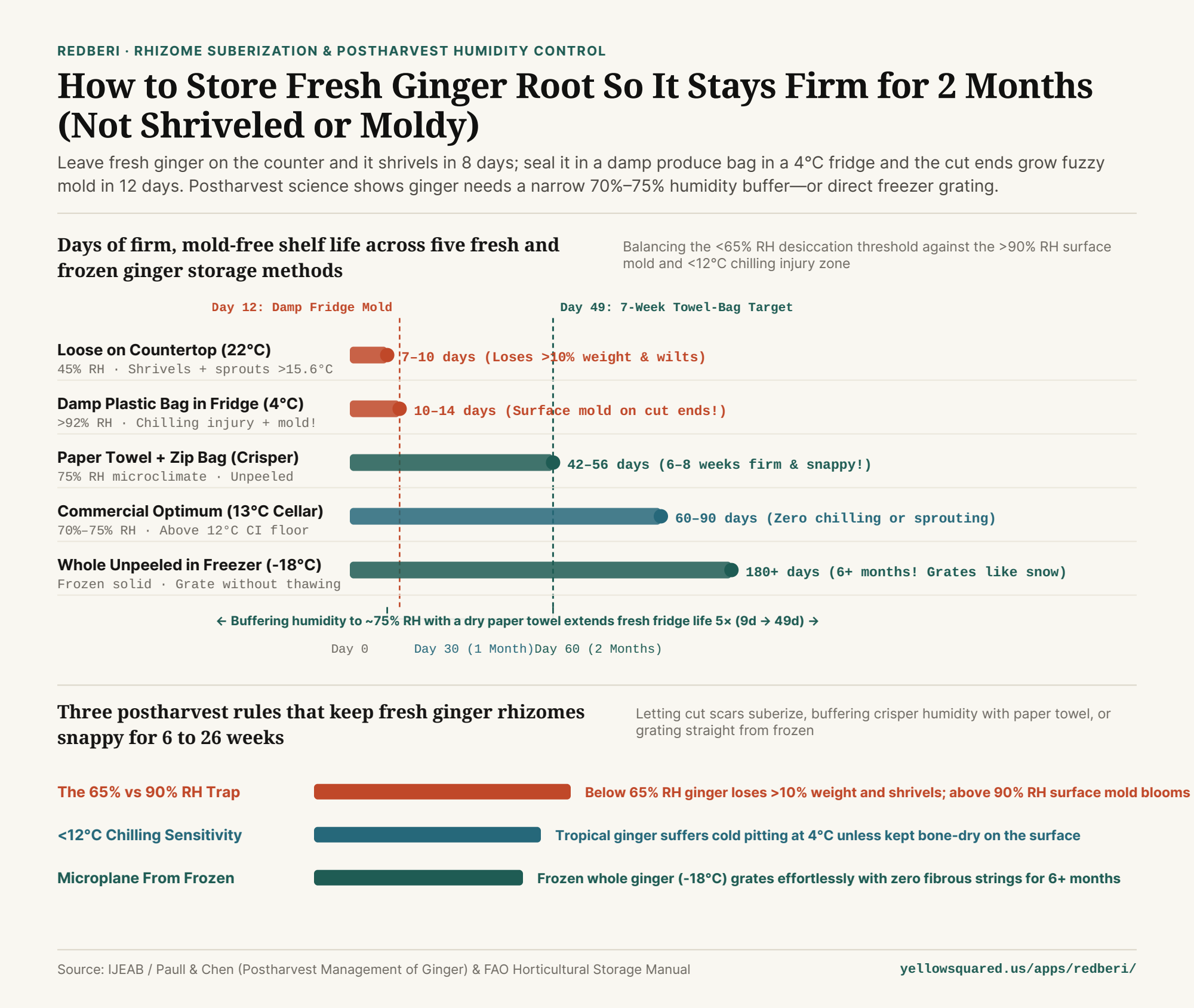
- Desiccation below 65% Relative Humidity: Once a ginger rhizome loses more than 10% of its harvest weight to water vapor transpiration, its epidermis wrinkles and the internal parenchyma turns woody and fibrous. In a typical kitchen (`45% RH`), a cut knob crosses that 10% loss mark in just 7 to 10 days.
- Sprouting above 15.6°C (60°F): Held at warm room temperature, ginger breaks dormancy and begins sprouting pale nodes within a few weeks.
- Chilling Injury below 12°C (54°F) + Surface Mold above 90% RH: Because ginger is a tropical crop (optimum commercial storage is
12°C–14°Cat70%–75% RH), a standard4°C (39°F)home refrigerator slowly induces chilling injury—weakening cell walls. If you toss freshly cut, wet ginger into a sealed plastic produce bag (`>90% RH`), condensation pools on the raw cut surface and breeds surface mold within 10 to 14 days.
"Ginger hates both extremes: below 65% humidity it loses 10% of its weight and shrivels into wood; above 90% humidity in a cold 4°C fridge, its raw cut ends bloom with surface mold."
2. The 2-Month Crisper Method vs. the 6-Month Frozen Microplane Trick
To keep fresh ginger firm and snappy in a standard refrigerator for 6 to 8 weeks (42–56 days), you need to create a 70%–75% relative humidity microclimate that keeps the skin dry while halting evaporation:
- Never peel before storing—and let cut scars suberize: Whenever you break or slice a knob off a larger ginger hand, leave the remaining piece on the counter for 1 to 2 hours before putting it back in the fridge. That brief air-drying lets the wet cut surface form a dry, protective barrier (suberization) that blocks mold spores.
- Wrap in a dry paper towel inside a zip-top bag: Wrap the unpeeled ginger tightly in a dry paper towel, press the air out of a resealable freezer bag, and store it in the crisper drawer. The outer bag blocks dry refrigerator air, while the paper towel absorbs excess moisture so surface humidity never crosses the
90% RHmold threshold. - Or freeze whole unpeeled knobs at
-18°C (0°F)for 6+ months: If you only use ginger once or twice a week for cooked dishes, skip the fridge entirely and place whole, unpeeled ginger hands in a freezer bag. When a recipe calls for grated ginger, pull the rock-hard frozen root out, run it across a fine microplane grater (skin and all—the papery peel vanishes into fine snow while freezing snaps the tough fibrous strings), and pop the root straight back into the freezer in 30 seconds.
3. Fresh & Frozen Ginger Storage Comparison Table
Compare temperature, humidity, shelf life, and primary spoilage mechanisms across all five ginger storage methods below (available in how-to-store-fresh-ginger-root-so-it-doesnt-mold-or-shrivel.csv):
| Storage Method | Temp & Humidity | Firm Shelf Life | Primary Disorder | Cut-End Prep | Best Culinary Use |
|---|---|---|---|---|---|
| Loose on Countertop | 22°C (72°F) · 45% RH | 7 to 10 days | >10% weight loss + sprouting | Keep skin intact | Use within 1 week |
| Damp Bag in Fridge | 4°C (39°F) · >92% RH | 10 to 14 days (Molds!) | Chilling injury + surface mold | Wet cut scar rots | Avoid completely |
| Paper Towel + Zip Bag | 5°C–7°C · ~75% RH | 42 to 56 days (6–8 wks) | Towel prevents >90% RH mold | Air-dry cut scar 1–2h | Best everyday fresh method |
| 13°C Wine/Root Cellar | 12°C–14°C · 70%–75% RH | 60 to 90 days | Zero chilling injury (>12°C) | Cured suberized skin | Commercial / cellar optimum |
| Whole in Freezer Bag | -18°C (0°F) Frozen | 180+ days (6+ months) | Softens only if fully thawed | Freeze whole unpeeled | Grate frozen on microplane! |
4. Look Up Chilling-Injury Thresholds for Tropical Produce in Redberi
What about the viral tip of submerging peeled ginger in a jar of dry sherry or vodka in the fridge? While alcohol prevents mold, 40%-ABV spirits leach volatile gingerols out of the root within two weeks, leaving the ginger tasting muted and boozy. Stick to the dry-towel crisper bag for raw slicing and the freezer for grating—and Explore storage benchmarks in Redberi to check exact temperature and humidity targets for garlic, turmeric, herbs, and tropical produce.
Verified Primary Sources
- International Journal of Environment, Agriculture and Biotechnology (IJEAB / Paull & Chen) — Postharvest Management and Value Addition of Ginger (Zingiber officinale): Curing, 12°C–14°C Storage & 70%–75% RH Benchmarks (Retrieved 2026-10-31).
- Food and Agriculture Organization of the United Nations (FAO) — Manual for the Preparation and Sale of Fruits and Vegetables — Chapter 6: Storage Temperature & Chilling Injury (Retrieved 2026-10-31).