
How to Store Lemons and Limes So They Stay Juicy for 4 Weeks (Not Hard)
How to Store Lemons and Limes So They Stay Juicy for 4 Weeks (Not Hard)
A ceramic bowl of bright yellow lemons and emerald Persian limes looks great on a kitchen island—right up until Day 6, when you try to squeeze one into a vinaigrette and discover the rind has hardened into an unyielding wooden sphere. Surprisingly, a hardened lemon usually still has juice trapped inside its inner segments; you just can't compress the peel to get it out. According to the UC Davis Postharvest Research and Extension Center, citrus hardening is driven by peel transpiration across a steep vapor-pressure deficit when fruit sits in dry 40%–50% indoor air.
1. The Postharvest Physics of Peel Desiccation and Chilling Injury
As detailed in postharvest citrus physiology research, a lemon or lime is structurally divided into two moisture reservoirs: the inner juice vesicles (sacs) and the outer pericarp (the colored flavedo plus the spongy white albedo). Water moves out of the fruit exclusively through microscopic pores in the outer peel.
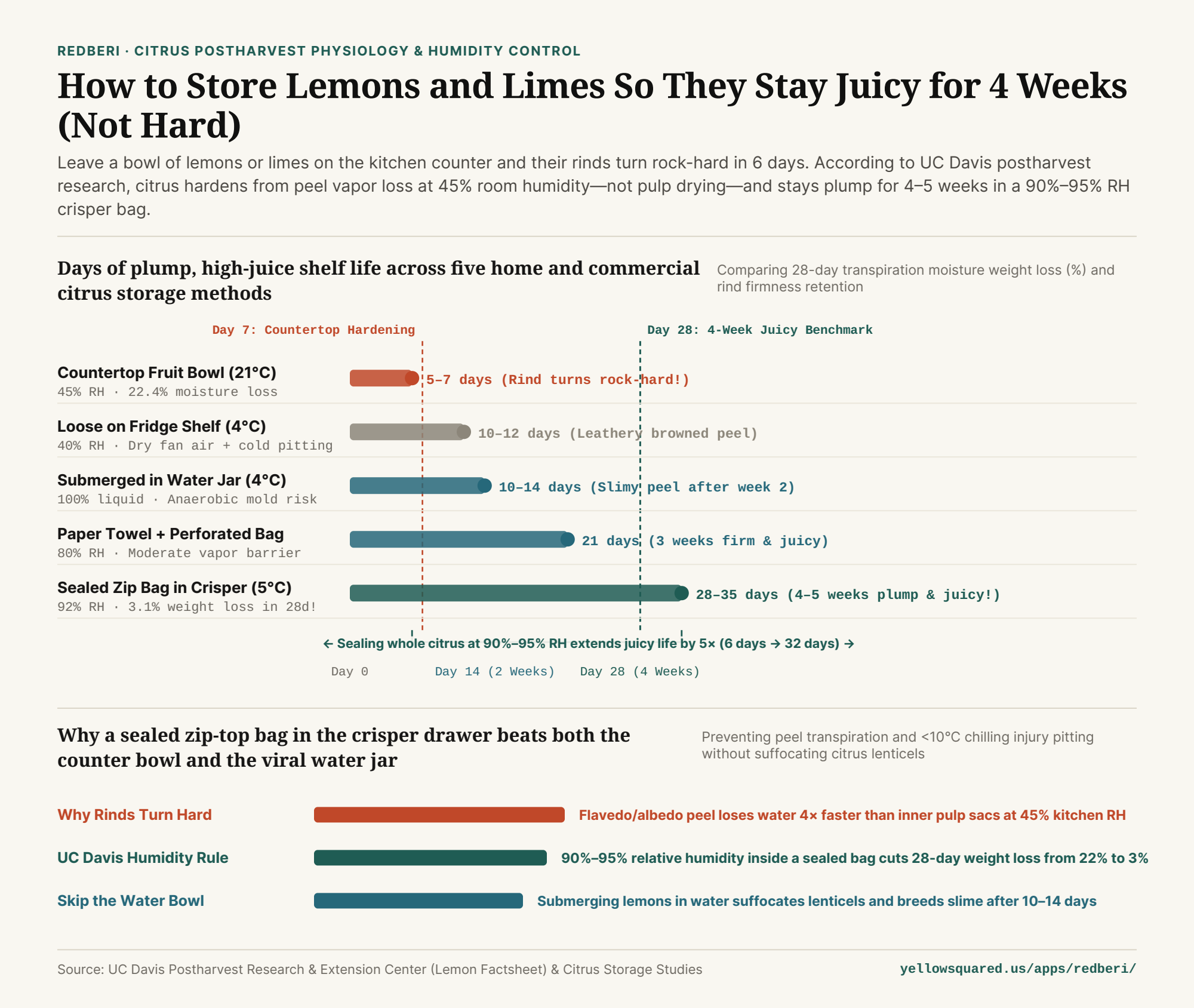
When whole lemons or limes sit in a 21°C (70°F) kitchen at 45% relative humidity, water evaporates out of the peel four times faster than moisture can migrate outward from the inner juice sacs. Once total fruit weight drops by 8% to 10%, the spongy white albedo collapses into a dense, leathery crust. Worse, tossing loose lemons onto an open refrigerator shelf (4°C / 39°F) blasts them with dry evaporator-fan air while triggering chilling injury—sunken brown rind pitting that develops when citrus is exposed to temperatures below 10°C (50°F) without a high-humidity buffer.
"Raising relative humidity from 45% (countertop) to 92% (sealed crisper bag) slashes 28-day citrus moisture weight loss from 22.4% down to 3.1%—extending squeezable shelf life from 6 days to 32 days."
2. Why the Sealed Crisper Bag Beats the Viral Water Bowl Hack
A popular social media tip claims you should submerge whole lemons in a glass jar of water inside the fridge. While liquid water prevents evaporation for the first 10 days, citrus fruits are living, respiring organs that exchange oxygen and carbon dioxide through their peel. Submerging them in water creates an anaerobic surface environment that waterlogs the oil glands and invites slimy Penicillium mold after 10 to 14 days.
Instead, replicate the UC Davis 85%–95% relative humidity standard inside your refrigerator's crisper drawer:
- Do not wash before storing: Commercial citrus carries a microscopic food-grade carnauba or shellac wax coating that slows moisture loss; scrubbing it off before storage accelerates shriveling. Wash right before zesting or cutting.
- Seal inside a zip-top bag with one dry paper towel: Place whole, dry lemons and limes in a resealable freezer bag alongside a single folded paper towel. The fruit's natural respiration raises internal bag humidity to 90%–95% RH (which also suppresses cold-pitting below
10°C), while the paper towel wicks away liquid droplets so mold spores cannot germinate. - Store in the high-humidity crisper drawer: Set the drawer vent to closed (high humidity). At
4°C–6°Cand92% RH, whole lemons and limes lose only3.1%of their weight over 28 days and stay plump and easy to juice for 4 to 5 full weeks.
3. Citrus Storage Methods & 28-Day Weight Loss Table
Compare 28-day transpiration weight loss, rind firmness window, and primary spoilage mechanisms across all five storage methods below (available in how-to-store-lemons-and-limes-so-they-stay-juicy-for-4-weeks.csv):
| Storage Method | Temp & Relative Humidity | 28-Day Weight Loss | Juicy Shelf Life | Primary Spoilage Mechanism | Best Culinary Window |
|---|---|---|---|---|---|
| Countertop Fruit Bowl | 21°C (70°F) · 45% RH | 22.4% (Desiccated) | 5 to 7 days | Rapid peel vapor loss into dry air | Use within 5 days |
| Loose on Fridge Shelf | 4°C (39°F) · 40% RH | 16.8% + cold pitting | 10 to 12 days | Dry evaporator air + <10°C pitting | 1 to 1.5 weeks |
| Submerged in Water Jar | 4°C (39°F) · 100% liquid | 0.0% (Waterlogged) | 10 to 14 days | Anaerobic peel breakdown & slime | Short-term only; change water every 2d |
| UC Davis Packhouse Room | 10°C–13°C · 85%–95% RH | 2.8% | 42 to 84 days | Zero chilling injury + low VPD | Commercial storage benchmark |
| Sealed Zip Bag in Crisper | 4°C–6°C · 90%–95% RH | 3.1% (Plump!) | 28 to 35 days | High-RH microclimate halts drying | Best home method (4–5 weeks) |
4. Check Produce Humidity & Temperature Benchmarks in Redberi
Wait to zest your lemons until right before you juice them—once the outer flavedo is grated off, a naked lemon loses moisture 6 times faster and hardens within 48 hours even inside the fridge. To look up exact temperature, ethylene sensitivity, and crisper-drawer humidity targets for every fruit and vegetable in your kitchen, Explore storage benchmarks in Redberi.
Verified Primary Sources
- UC Davis Postharvest Research and Extension Center — Lemon Produce Factsheet: Optimum Storage Temperature (10°C–13°C) & Relative Humidity (85%–95%) (Retrieved 2026-10-31).
- ResearchGate / Postharvest Citrus Physiology — Postharvest Technologies of Fresh Citrus Fruit: Advances and Recent Developments for Loss Reduction during Handling and Storage (Retrieved 2026-10-31).