
Why Does an Airline Have Award Seats on a Connecting Flight When the Nonstop Leg Is Sold Out?
Why Does an Airline Have Award Seats on a Connecting Flight When the Nonstop Leg Is Sold Out?
Suppose you want to book a lie-flat Business Class award from Chicago (ORD) to Frankfurt (FRA) using partner miles. You search the nonstop flight—say, Flight 431—and the calendar shows zero saver seats (or a sky-high 210,000-mile dynamic price). Five minutes later, you search Chicago to Barcelona (ORD → FRA → BCN) on the exact same date. Suddenly, the airline offers 4 saver Business Class seats for 70,000 miles—putting you on the very same Flight 431 across the Atlantic that just claimed to be sold out. Welcome to Married Segment Control (MSC) and Origin & Destination (O&D) revenue management.
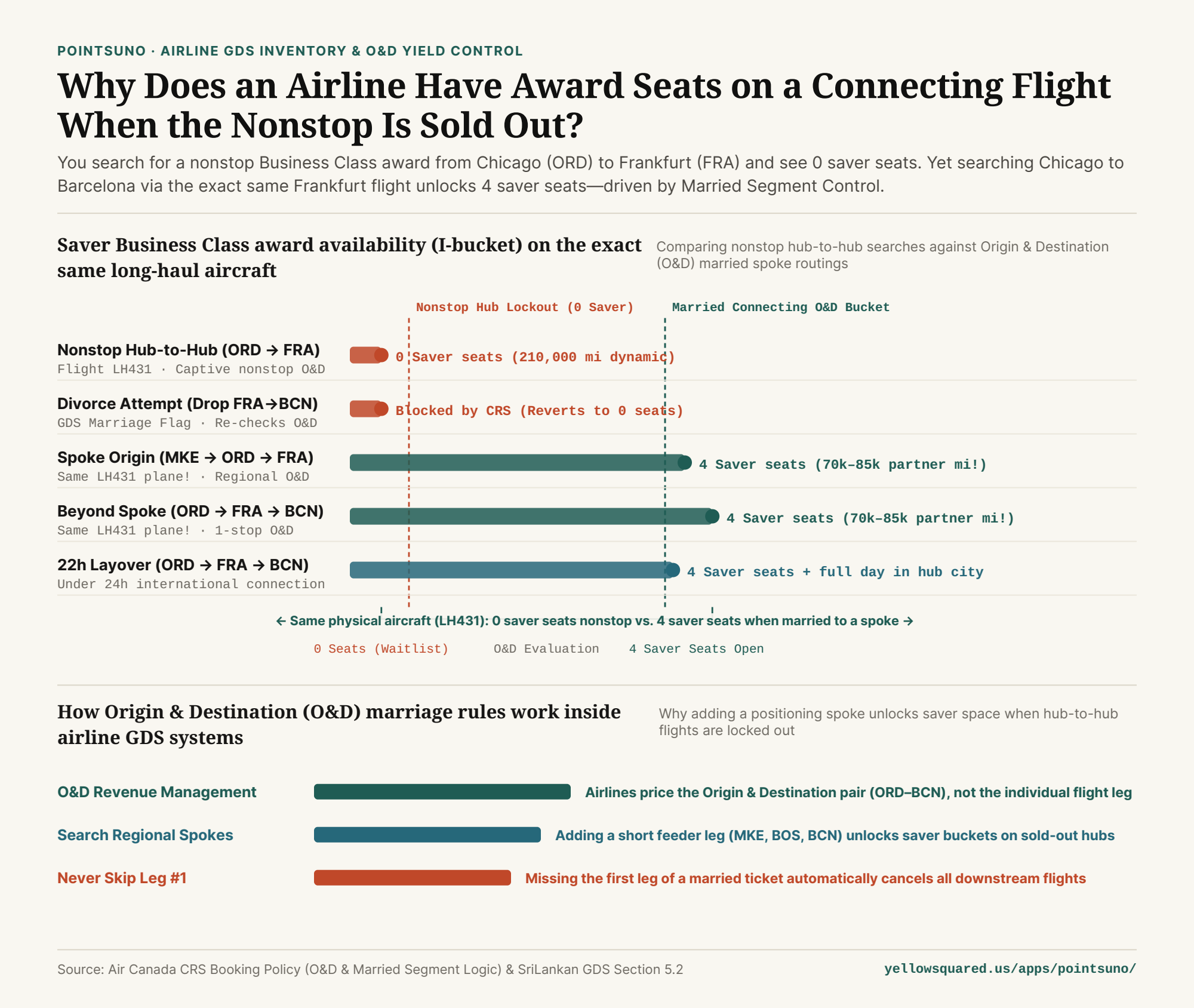
I bucket) on the exact same long-haul aircraft across five Origin & Destination (O&D) search structures. Reproducible dataset: married-segment-logic-airline-award-flights-explained.csv.1. How Origin & Destination (O&D) Inventory Control Works
Decades ago, airline reservation systems managed seat inventory flight-by-flight: if Flight 431 had 4 seats left in the I (Business Saver Award) bucket, anyone could book those 4 seats regardless of where they started or ended their trip. Modern Computerized Reservation Systems (CRS) and Global Distribution Systems (GDS) no longer work that way.
As documented in Air Canada's CRS Booking and Ticketing Policy and Section 5.2 of standard IATA GDS booking rules, airlines allocate inventory based on the passenger's complete Origin and Destination (O&D) and Point of Commencement (POC):
- Nonstop Hub-to-Hub O&D (Captive High Yield): On a nonstop hub route like
ORD → FRAorJFK → DOH, the operating airline enjoys a nonstop monopoly or duopoly. Because corporate accounts happily pay $5,000+ in cash for nonstop speed, the revenue management algorithm restricts saver award inventory on the standaloneORD–FRAO&D to0 seats. - Connecting Spoke-to-Spoke O&D (Competitive 1-Stop Yield): On a connecting route like
Milwaukee (MKE) → ORD → FRAorORD → FRA → Barcelona (BCN), the passenger has to make a stop—meaning the airline is competing against half a dozen other one-stop European carriers. To fill seats without cannibalizing nonstop cash fares, the algorithm opens2 to 4 saver award seatsexclusively when Flight 431 is "married" to a feeder segment.
"Airlines don't price the physical seat on the airplane; they price the Origin-and-Destination journey. Adding a short spoke segment changes the O&D bucket from a captive nonstop monopoly to a competitive one-stop market."
2. Why You Can't Just 'Divorce' Married Segments After Booking
Once travelers discover married segment availability, their first instinct is to book ORD → FRA → BCN for 70,000 miles and then call customer service to drop the short FRA → BCN leg. In a modern GDS, those two segments carry an electronic married segment indicator. If an agent tries to cancel FRA → BCN alone, the reservation system forces a complete re-check of standalone ORD → FRA availability—which immediately returns 0 saver seats.
Instead of trying to break a married ticket (or no-showing the first leg, which triggers an automatic cancellation of your entire itinerary), use two legitimate search strategies: search from nearby regional spoke airports within a 1–2 hour drive or train ride, or book a legal 22-to-23-hour connection at the hub city (since international layovers under 24 hours are priced as part of the single connecting O&D).
3. Married Segment O&D Award Availability Table
Compare how an airline's CRS evaluates five different booking requests on the exact same long-haul aircraft (available in married-segment-logic-airline-award-flights-explained.csv):
| Search Structure | Example Routing | CRS / GDS Evaluation | Saver Business Bucket | Revenue Management Logic | Can You Drop a Leg? |
|---|---|---|---|---|---|
| Nonstop Hub O&D | ORD → FRA | High-yield nonstop O&D | 0 seats (Waitlist) | Protects cash nonstop demand | N/A (Single flight) |
| Spoke Origin O&D | MKE → ORD → FRA | Regional 1-stop O&D | 2–4 Saver seats | Competes with 1-stop rivals | No — skipping Leg 1 voids ticket |
| Beyond Spoke O&D | ORD → FRA → BCN | Leisure 1-stop O&D | 2–4 Saver seats | Fills secondary spoke capacity | Forfeits checked bags & return |
| Call-In 'Divorce' | Drop FRA → BCN leg | Triggers marriage flag | Blocked by CRS | Prohibits O&D circumvention | Re-prices at 0 saver seats |
| 22-Hour Hub Layover | ORD → FRA (22h) → BCN | Valid <24h connection | 2–4 Saver seats | Counts as transfer, not stopover | Legal full day in hub city |
4. Compare Partner Transfer Ratios Before Booking in Pointsuno
Because different airline loyalty programs apply different marriage rules and fuel surcharges to the exact same flight—for instance, booking a Star Alliance married O&D via Air Canada Aeroplan versus Avianca LifeMiles or United MileagePlus—checking transfer ratios across your credit card points is essential before moving points. Compare transfer ratios in Pointsuno to calculate the lowest-point path for your next international redemption.
Verified Primary Sources
- Air Canada Connex — CRS Booking and Ticketing Policy: Origin & Destination (O&D) and Married Segment Logic (Retrieved 2026-10-31).
- SriLankan Airlines / IATA GDS Rules — Global Distribution System (GDS) Booking Policy Section 5.2: Married Segment Control (Retrieved 2026-10-31).