
Popular Four-Letter Baby Names for Girls and Boys (1880–2025 Trends)
Popular Four-Letter Baby Names for Girls and Boys (1880–2025 Trends)
Led by Liam (#1 boy), Noah (#2 boy), Emma (#2 girl), Luna, Mila, Ezra, and Luca, four-letter names now account for 38% of the U.S. Top 25—tripling their share since 1975 by packing two melodic syllables into four letters.
Scan the top of the U.S. Social Security Administration (SSA) baby name rankings in the mid-2020s and a striking visual pattern jumps off the page: Liam, Noah, Emma, Luna, Mila, Ezra, Luca, Aria, Nora, Maya, Levi, Jack, Theo, Owen. Nearly 4 out of every 10 names inside the combined U.S. Top 25—and an even higher share of the fastest-rising newborn picks—are spelled with exactly four letters.
Compare that to 1975, when the top of the charts was dominated by sprawling 8-to-11-letter names like Christopher, Jennifer, Stephanie, Matthew, Nicholas, and Elizabeth, and four-letter names held just 12% of the Top 25. Yet when we examine 145 years of SSA birth-certificate records, we discover that today's four-letter name boom is not a return to the four-letter names of the 1920s—it is a completely new phonetic invention.
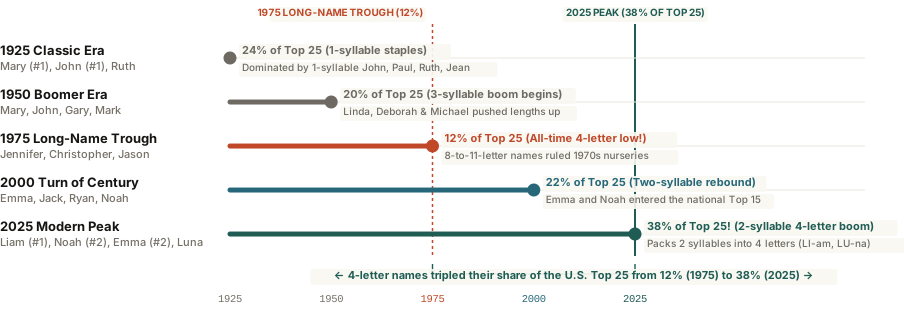
1925 vs. 2025: The Two-Syllable "CV-CV" Revolution
A century ago, in 1925, four-letter names were also common—accounting for 24% of the U.S. Top 25, led by Mary, John, Ruth, Jean, Paul, Jack, and Carl. Notice what nearly all of those 1925 staples had in common: with the exception of Mary, they were single-syllable words ending in closed consonant clusters (`CVCC` or `CVC`, like John, Ruth, Paul, Carl).
Today's four-letter blockbusters operate on the exact opposite acoustic formula. Instead of packing four letters into one heavy syllable, modern parents choose four-letter names that divide into two open syllables:
- Alternating Consonant-Vowel (`CV-CV`): Names like Lu-na, Mi-la, No-ra, Ma-ya, Lu-ca, and Le-vi alternate a single soft consonant (usually a liquid `L/R` or nasal `M/N`) with an open vowel, creating a two-beat trochaic rhythm (`DUM-da`) inside a minimal four-letter footprint.
- Vowel Hiatus & V-C-C-V (`CV-VC` / `VC-CV`): Names like Li-am (#1), No-ah (#2), The-o, Em-ma (#2), Ez-ra, Is-la, and El-la use adjacent vowels or a central consonant bridge to generate two distinct syllables without adding visual length.
Modern four-letter names solve a classic naming dilemma: they look as clean and nickname-proof on a resume as a one-syllable name, yet sound as warm and melodic when called across a playground as a longer name.
Data Nuances: Exact SSA Spellings and Small-Count Limits
When analyzing four-letter name rankings in official Social Security data, keep three empirical dataset boundaries in mind:
- Exact Character-String Separation: The SSA tabulates every spelling variant as a separate rank entry based on Social Security card applications. That means four-letter Nora (#25) is counted separately from five-letter Norah (#164), and four-letter Luca (#24) is tallied separately from Luka (#172)—meaning the true phonetic popularity of these names is even higher than a single rank line shows.
- Pre-1937 Coverage & Suppression Threshold (`<5` Births): Prior to the introduction of the Social Security Act in 1935–1937, early birth cohorts reflect retrospective adult card registrations, and for privacy protection the SSA omits any name with fewer than 5 births (`<5`) in a given year and sex.
- Syllable Pairing With Surnames: Because two-syllable four-letter names (`Emma`, `Liam`, `Luna`) carry a trochaic stress on the first syllable, they pair effortlessly with one-syllable (`Liam Brooks`), three-syllable (`Luna Sullivan`), or four-syllable last names.
To filter 145 years of U.S. birth records by exact letter count, syllable structure, and phonetic ending, you can Explore historical name trends on Name Scout and compare combined spelling curves side by side.