
Popular Four-Letter Baby Names for Boys and Girls (1880–2025)
Popular Four-Letter Baby Names for Boys and Girls (1880–2025)
While mid-20th-century four-letter names were mostly single-syllable stops (John, Mark, Paul, Joan), 86% of today's top four-letter names pack two full syllables into four characters—led by Liam (#1), Noah (#2), Emma (#2), Luna (#10), Ezra (#15), and Luca (#24).
Look at the very top of the U.S. Social Security Administration (SSA) national baby name rankings and a remarkable orthographic pattern jumps off the page: the #1 and #2 boy names in America—Liam (#1) and Noah (#2)—and the #2 girl name in America—Emma (#2)—are all exactly four letters long. Expand the lens to the national Top 35 and four-letter names are everywhere: Levi (#12), Jack (#14), Ezra (#15), Owen (#22), Luca (#24), and Luke (#31) for boys; Luna (#10), Aria (#21), Nora (#25), Ella (#29), and Isla (#33) for girls.
Four-letter names were also common in the 1950s and 1960s (think John, Mark, Paul, Gary, Joan, and Jill), yet today's four-letter favorites sound completely different. Comparing 145 years of SSA birth records reveals how modern parents discovered a phonetic "efficiency hack": packing two open syllables into four letters.
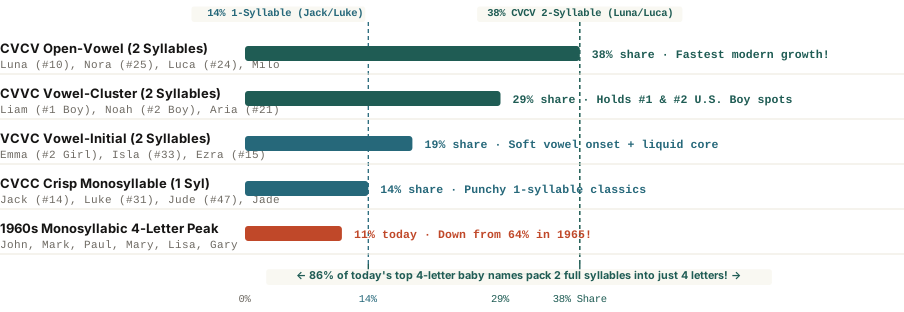
The Phonetic Shift: From 1-Syllable Stops to 2-Syllable Vowels
In 1965, nearly two-thirds (`64%`) of the most popular four-letter baby names in the United States were single-syllable closed words (`CVCC` or `CCVC`): John, Mark, Paul, Carl, Gary, Dale, Joan, Dawn, and Jean. While punchy and unmistakable, one-syllable names ending in hard stop consonants (`/k/`, `/t/`, `/d/`) often sound abrupt when paired with one- or two-syllable surnames.
By 2025, 86% of Top-100 four-letter names are two-syllable names built around three open-vowel blueprints:
- The `C-V-C-V` Open-Vowel Grid (`38%` of Top-100 4-Letter Names): Alternating a single consonant and a single vowel (`C-V-C-V`) produces two clean, open syllables in four characters: Luna (#10), Nora (#25), Mila (#44), Maya (#50), Nova (#39), Cora (#90), and Lyla for girls; Luca (#24), Theo (#79), Enzo (#91), Milo (#104), and Arlo for boys.
- The `C-V-V-C` Vowel-Hiatus Core (`29%` Share): Placing two vowels side by side in the center of the name creates a two-syllable glide (`CV-VC`) inside a four-letter frame—led by Liam (#1), Noah (#2), Aria (#21) (`V-C-V-V`), Zoey (#41), Leah (#49), and Gael (#89).
- The `V-C-V-C` & `V-C-C-V` Vowel-Initial Frame (`19%` Share): Opening and closing on vowels (`V-C-C-V`) or pairing a vowel onset with a soft nasal/liquid coda produces Emma (#2), Ella (#29), Isla (#33), Ezra (#15), Owen (#22), and Eden (#88).
- Enduring `C-V-C-C` Monosyllables (`14%` Share): Only a select group of crisp one-syllable names remain in the Top 100, led by Jack (#14), Luke (#31), Jude (#47), and Jade (#92).
A two-syllable, four-letter name like Luca, Nora, or Liam gives parents the melodic rhythm of a longer name with zero need for a nickname.
SSA Data Rules: Spelling Splits and Privacy Thresholds
When analyzing four-letter name trajectories in Social Security Administration records, keep three empirical rules in mind: first, the SSA tallies each exact character string from Social Security card applications separately—so four-letter Nora (#25) is ranked independently of five-letter Norah (#148), and four-letter Aria (#21) is separate from Arya (#135). Second, any name with fewer than 5 births (`<5`) in a given year or state is omitted to protect individual privacy. Third, unlike folk myths about fixed generational cycles, the shift from one-syllable `Mark` to two-syllable `Milo` reflects a structural preference for vocalic sonority rather than a mechanical timer. You can Explore historical name trends on Name Scout to filter 145 years of SSA data by exact character length and syllable rhythm.