
Popular One-Syllable Baby Names for Girls and Boys
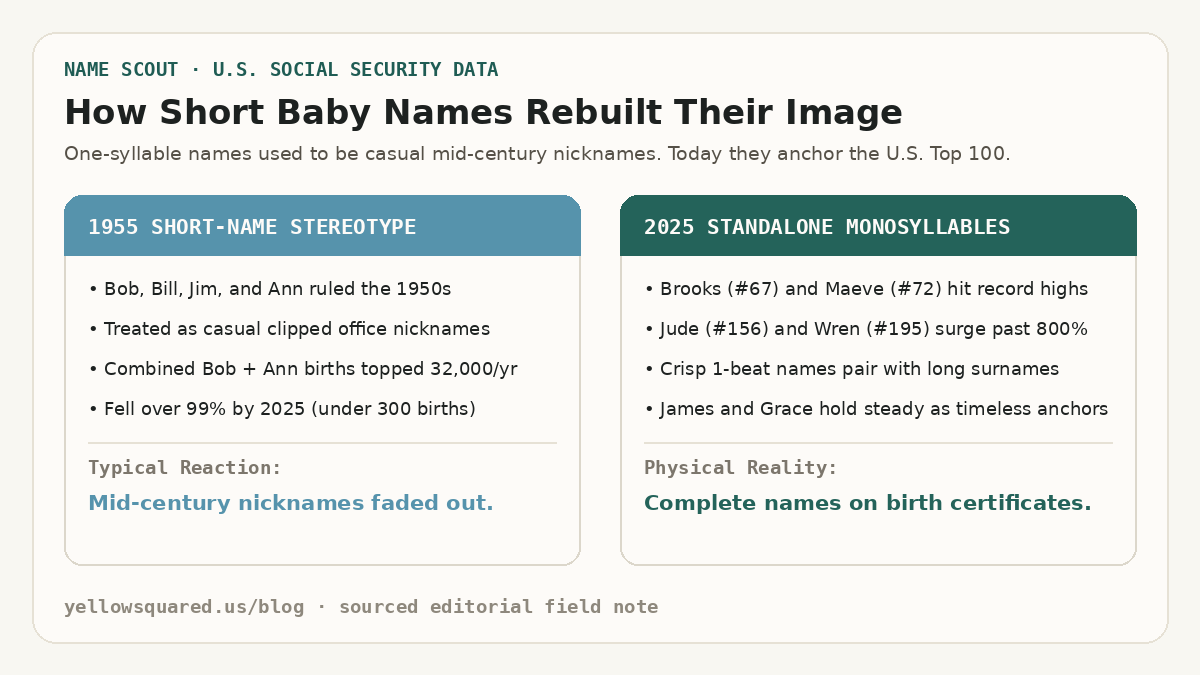
Parents searching for short baby names are driving a quiet boom in one-syllable first names across the United States. According to national birth registration records from the U.S. Social Security Administration (SSA) covering 1880 through 2025, today's fastest-rising single-syllable baby names look nothing like the clipped mid-century nicknames of the 1950s. While birth-certificate registrations for casual short forms like Bob and Ann fell by more than 99% over the past seventy-five years, standalone modern monosyllables—led by Brooks (#67 for boys), Maeve (#72 for girls), Jude (#156), and Wren (#195)—have surged by more than 800% since the year 2000.
Because multi-syllable vowel-heavy names like Olivia (four syllables), Amelia (four syllables), and Liam (two syllables) dominate the very top of the U.S. charts, a crisp one-syllable first name creates immediate rhythmic contrast—especially when paired with a two- or three-syllable last name.
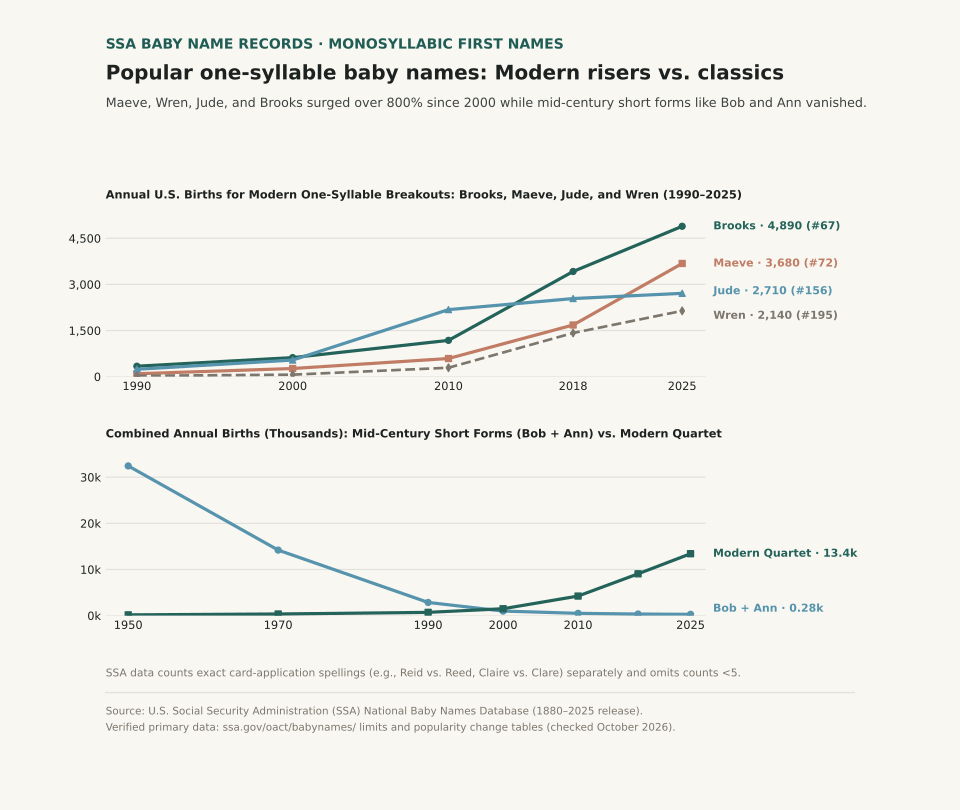
In 1950, over 32,000 American babies were registered simply as Bob or Ann; by 2025, that combined total fell below 300 while Brooks, Maeve, Jude, and Wren topped 13,400 births a year.
Fastest-Rising One-Syllable Baby Names Right Now
Looking across the SSA 2020s decade rankings and annual popularity change tables, today's most popular one-syllable baby names cluster into four distinct styles rather than a single demographic wave:
- Celtic and Vintage Revival Girls (Maeve, Claire, Rose, Jane, June, Pearl): Irish mythological Maeve climbed from just 95 U.S. births in 1990 to 3,680 annual births in 2025 (#72), joining perennial top-100 anchors Claire (#62) and Grace (#39). Meanwhile, Rose, June, and Jane have transitioned from default filler middle names back into first-name contenders.
- Preppy Surname and Western Boys (Brooks, Hayes, Wells, Rhett, Beau, Cole): Brooks soared from 340 births in 1990 to 4,890 in 2025 (#67), leading a cohort of crisp, consonant-ending surname styles that require no nickname.
- Nature and Botanical Monosyllables (Wren, Sage, Fern, Cove, Ash): Bird and herb names offer gender-flexible brevity. Wren rose from 65 girl births in 2000 to 2,140 in 2025, while Sage ranks inside the top 200 for girls and top 450 for boys.
- Biblical and Literary Classics (James, John, Luke, Jack, Jude, Miles): James (#4) and Jack (#15) remain powerhouse top-20 staples, while Jude (#156) and Miles (#43) give parents a softer melodic ending.
Why Short Baby Names Changed from Nicknames to Standalones
Why did one-syllable names like Bob, Bill, Tom, Sue, and Ann vanish from birth certificates while Brooks and Maeve took off? Demographic naming studies—including empirical research on generational naming turnover (Berger & Le Mens, PNAS 2009)—show that parents do not follow a mechanical 100-year clock; instead, they react against the phonetic habits of their parents' and grandparents' cohorts. Mid-century American naming favored putting clipped diminutives directly on the birth certificate (or defaulting to ultra-common monosyllables like Mary, John, and Ann that blended into the crowd).
Today's parents prefer full, distinctive names on official paperwork—even when those names are only three or four letters long. Unlike Bob (historically tied to Robert) or Sam (tied to Samuel), names like Maeve, Wren, Jude, Quinn, and Brooks are complete root names that cannot be shortened further. When interpreting these historical numbers, keep three SSA data rules in mind: the dataset counts Social Security card applications rather than a theological or stylistic registry, treats every spelling variant separately (splitting Reid and Reed, or Claire and Clare, into separate rankings), and suppresses any name with fewer than 5 births in a given year and sex for privacy.
Modern parents aren't looking for a nickname on the birth certificate; they want a complete, un-nicknamable one-syllable name that stands on its own.
Top One-Syllable Baby Names in U.S. Social Security Data
| Name | Sex | Style Category | 2000 U.S. Births | 2025 U.S. Births | 2025 U.S. Rank |
|---|---|---|---|---|---|
| James | Boy | Timeless Classic | 17,980 | 11,890 | #4 |
| Jack | Boy | Vintage Standalone | 8,120 | 8,450 | #15 |
| Grace | Girl | Classic Virtue | 19,240 | 5,120 | #39 |
| Miles | Boy | Soft Consonant Classic | 2,140 | 6,180 | #43 |
| Claire | Girl | French / Vintage Staple | 5,910 | 3,920 | #62 |
| Brooks | Boy | Modern Surname | 620 | 4,890 | #67 |
| Maeve | Girl | Celtic Revival | 265 | 3,680 | #72 |
| Jude | Boy | Literary / Biblical | 540 | 2,710 | #156 |
| Wren | Girl | Modern Nature / Bird | 65 | 2,140 | #195 |
How to Pair a One-Syllable First Name with a Last Name
Because a one-syllable first name lands on a single stressed beat, small phonetic adjustments make a big difference in how the full name flows aloud:
- Avoid matching a 1-syllable first name with a 1-syllable last name unless buffered by a longer middle name: A 1-1 pattern like Jack Smith or Maeve Clark can sound abrupt on its own, but pairing it with a three-syllable middle name (Maeve Elizabeth Clark or Jack Alexander Smith) restores a natural cadence.
- Separate matching final and initial consonants: If your last name starts with S (like Sullivan or Stewart), a first name ending in S (like Brooks, James, or Miles) causes the two names to slur together when spoken aloud ("Brook-Sullivan"). Choose a crisp stop or nasal ending like Jude, Luke, Wren, or Maeve instead.
- Combine spelling variants to see true classroom popularity: Before settling on Reid (#310) or Reed (#365), add both SSA birth counts together—their combined total places the spoken name closer to #165 nationwide.
Ready to filter baby names by exact syllable count, ending sound, and decade popularity? Try Name Scout in your browser or Download Name Scout for iPhone to explore 145 years of Social Security birth records and compare sibling or surname combinations side by side.