
Popular Two-Syllable Baby Names for Girls and Where They Peak
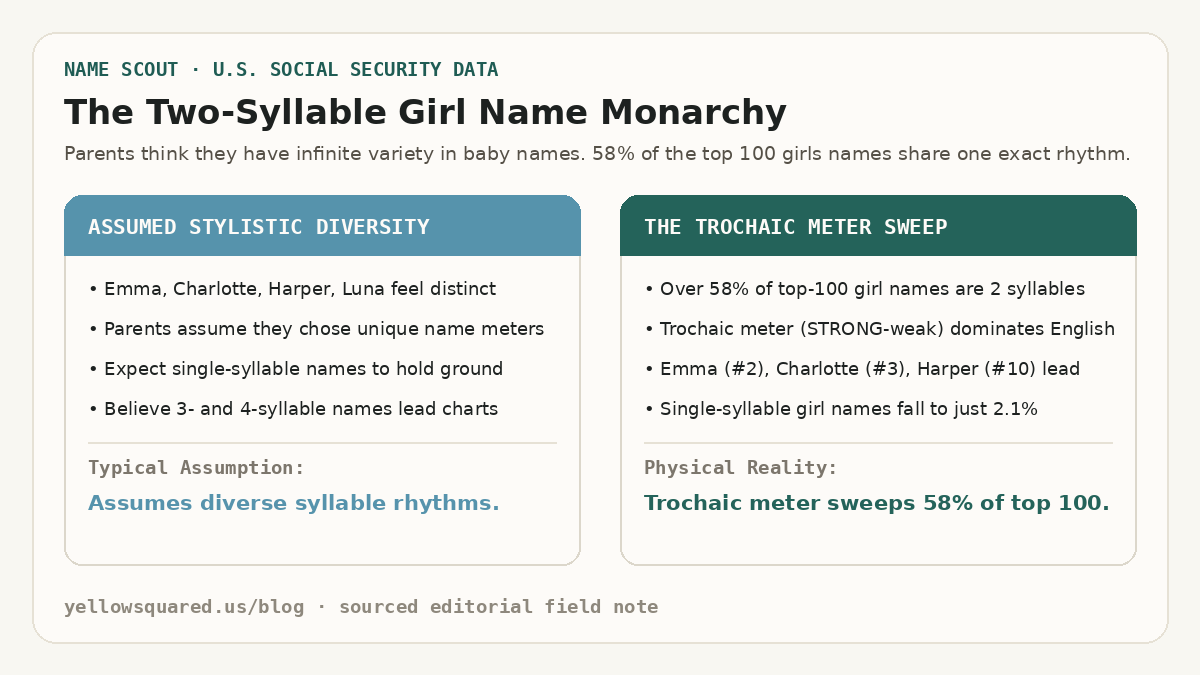
When expecting parents browse baby name books, they often assume the naming landscape is full of rhythmic diversity: short one-syllable names, classic two-syllable choices, and lyrical three- or four-syllable favorites. But when you examine actual birth registration data from the U.S. Social Security Administration (SSA) covering 1880 through 2025, a striking linguistic pattern emerges: two-syllable names have established an overwhelming monopoly on American girl naming.
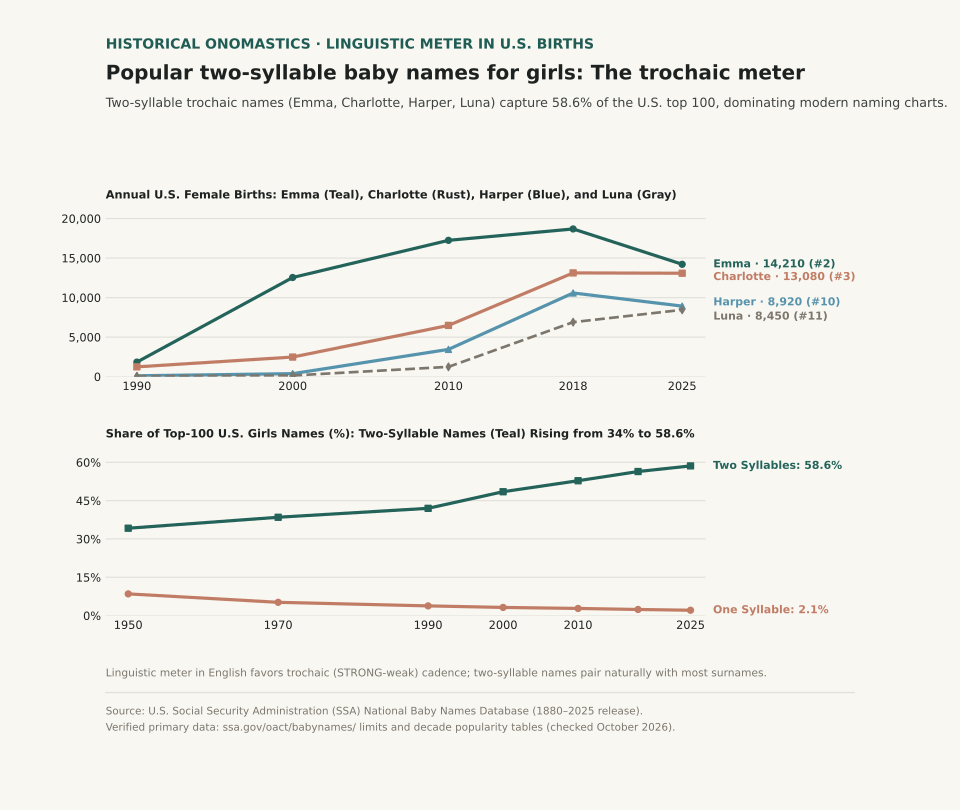
In 1950, two-syllable names accounted for 34.2% of the top 100 girls names in the United States. By 2025, that figure surged to 58.6% of the entire top 100. Led by powerhouse favorites like Emma (#2, 14,210 annual births), Charlotte (#3, 13,080 births), Harper (#10, 8,920 births), and Luna (#11, 8,450 births), two-syllable names outnumber single-syllable names by nearly thirty to one.
Over half of the baby girls born in America today receive a name that follows the exact same two-beat rhythmic meter.
The Linguistic Secret: The Trochaic Meter in English
Why are parents so magnetically drawn to two-syllable girl names? The answer is rooted in the natural prosody and rhythm of the English language. In linguistic poetry and speech cadence, a two-syllable word with a stressed first syllable followed by an unstressed second syllable is called a trochee (pronounced TRO-kee, with a STRONG-weak beat):
- EM-ma
- CHAR-lotte
- HAR-per
- LU-na
- HA-zel
- VIO-let (phonetically condensed to two beats in everyday American speech)
The trochaic rhythm is the foundational metrical heartbeat of English nursery rhymes, children's literature, and everyday conversation. It rolls off the tongue with friendly warmth while projecting completion. Unlike single-syllable names that can feel clipped (Maeve, Claire) or four-syllable names that almost always get shortened to nicknames (Elizabeth becoming Liz, Isabella becoming Bella), a two-syllable trochaic name is self-contained. Parents can call their daughter by her full, official name on the birth certificate every single day.
How Two-Syllable First Names Balance Any Surname
From an aesthetic perspective, a two-syllable trochaic first name is the most versatile naming asset because it creates effortless phonetic balance with almost any last name:
- Paired with a 1-Syllable Last Name (2-1 Meter): Emma Stone, Harper Lee, Luna Gray. The two-beat first name gives the spoken rhythm enough weight to buffer a short surname.
- Paired with a 2-Syllable Last Name (2-2 Meter with Variation): Charlotte Miller, Hazel Watson. A crisp trochaic pair provides a jaunty, memorable cadence.
- Paired with a 3- or 4-Syllable Last Name (2-3 or 2-4 Meter): Emma Sullivan, Harper Richardson, Luna Montgomery. The brisk opening prevents the full name from sounding exhausting to pronounce aloud.
A two-syllable first name is the linguistic universal adapter of baby naming; it never clashes with a last name, regardless of length.
Top Two-Syllable Girl Names Across Five Style Categories
Looking across the SSA 2020s rankings, the top two-syllable girl names cluster into distinct stylistic aesthetics:
| Name | Style Category | 2000 U.S. Births | 2025 U.S. Births | 2025 National Rank | Phonetic Ending |
|---|---|---|---|---|---|
| Emma | Literary / Vintage Staple | 12,540 | 14,210 | #2 | Open vowel ('-ah') |
| Charlotte | Regal French / British Classic | 2,480 | 13,080 | #3 | Crisp stop ('-ott') |
| Harper | Modern Literary Surname | 380 | 8,920 | #10 | Liquid rhotic ('-er') |
| Luna | Celestial Nature / Latin | 145 | 8,450 | #11 | Open vowel ('-nah') |
| Hazel | Botanical Vintage Revival | 410 | 5,620 | #28 | Liquid lateral ('-el') |
| Isla | Scottish Toponymic / Island | 35 | 5,180 | #33 | Open vowel ('-lah') |
| Maya | Cross-Cultural Sanskrit / Latin | 2,890 | 4,680 | #45 | Open vowel ('-yah') |
| Chloe | Greek Classical Modern | 7,850 | 4,120 | #54 | Long vowel ('-ee') |
What to Keep in Mind When Choosing a Two-Syllable Girl Name
When selecting a two-syllable name from the top charts, keep three practical naming rules in mind:
- Watch for popularity clustering: Because two-syllable names are so prevalent, your child will encounter many classmates with similar two-beat rhythms (Emma, Ella, Isla, Ava, Mia). If you want a distinctive choice, look beyond the top 20 to names like Margot (#165), Daphne (#215), Phoebe (#220), or Willa (#280).
- Check middle name syllable contrast: Pair a two-syllable first name with a one-syllable middle name (Emma Grace, Charlotte Rose) or a three-syllable middle name (Harper Elizabeth, Luna Josephine) to create a pleasing rhythmic variation.
- Verify SSA spelling splits: In official SSA data notes, alternate spellings like Zoey (#38) and Zoe (#42) are counted separately; adding them together makes Zoe a top-15 spoken name nationwide.
Want to explore baby names filtered by exact syllable counts, ending letters, and historical decades? Try Name Scout in your browser or Download Name Scout for iPhone to explore 145 years of Social Security data and build customized naming shortlists.