
Positioning Flights for Award Travel: Cost-Benefit Math, Risk Buffers, and Misconnect Liability
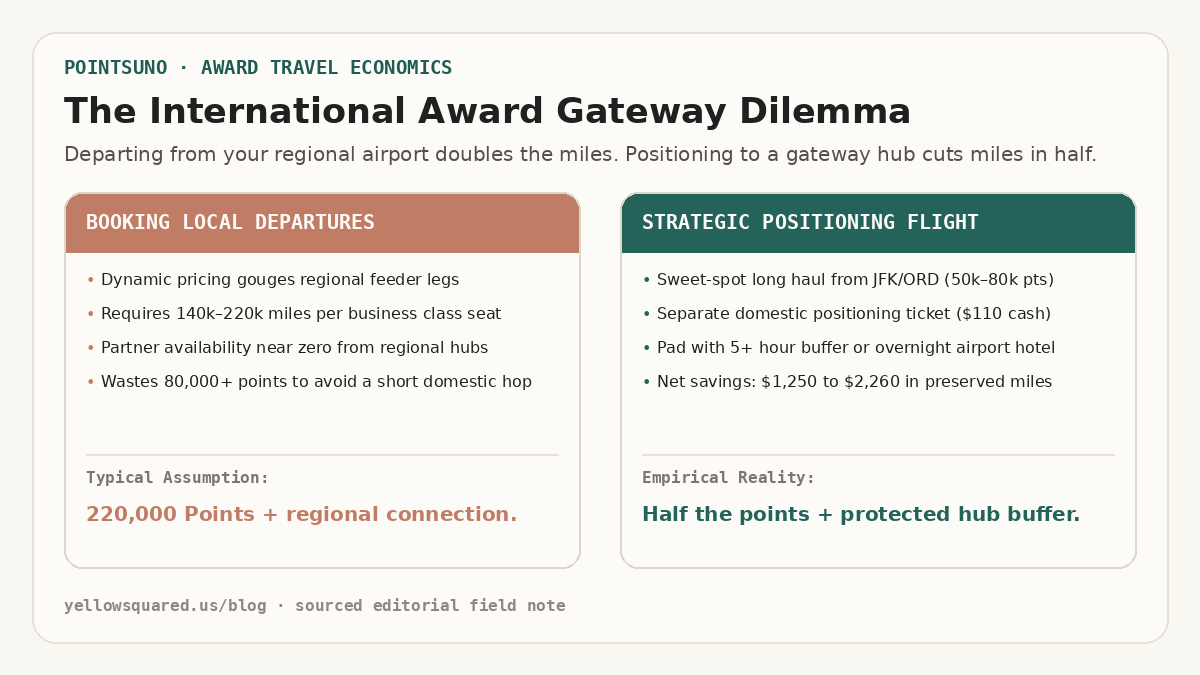
Award travelers living outside primary gateway hubs like New York (JFK), Chicago (ORD), or San Francisco (SFO) face a chronic dilemma: redeeming miles directly from regional airports often requires double the mileage or yields zero partner availability. According to consumer ticketing guidelines from the U.S. Department of Transportation (DOT) and interline baggage rules under IATA Resolution 766, booking a separate domestic flight to reach an international departure point—known as a 'positioning flight'—transforms a single journey into two legally independent contracts of carriage. When executed with disciplined mathematical buffers, positioning unlocks redemptions like 50,000-mile transatlantic business class on Air France or 80,000-mile transpacific first class on ANA. When travelers fail to account for cash buffer expenses and misconnect liability, a delayed regional flight can forfeit the entire long-haul ticket.
To determine whether a positioning flight is worth booking, award travelers must evaluate two interrelated factors: the net cents-per-point (CPP) value preserved after subtracting all cash repositioning expenses, and the operational risk profile of separate airline tickets.
A positioning flight only creates true economic value if the points saved exceed the combined cash cost of domestic airfare, checked luggage fees, and hotel buffer insurance.
The Mathematical Breakeven of Repositioning
Major US airline loyalty programs (Delta SkyMiles, United MileagePlus, American AAdvantage) apply dynamic award pricing on domestic feeder segments. When booking international business class from secondary cities such as Raleigh (RDU), Indianapolis (IND), Austin (AUS), or Kansas City (MCI), the loyalty program prices the entire itinerary dynamically if partner saver space is missing on the domestic leg. A seat from Indianapolis to Tokyo on United routinely prices at 220,000 miles one-way.
Conversely, partner programs with fixed or distance-based award charts—such as ANA Mileage Club or Virgin Atlantic Flying Club—offer Chicago (ORD) to Tokyo (HND) for 80,000 miles in first class or 50,000 miles to London in business class. Because partner airlines cannot book domestic feeder legs when saver inventory is blocked, the traveler buys a separate ticket from Indianapolis to Chicago.
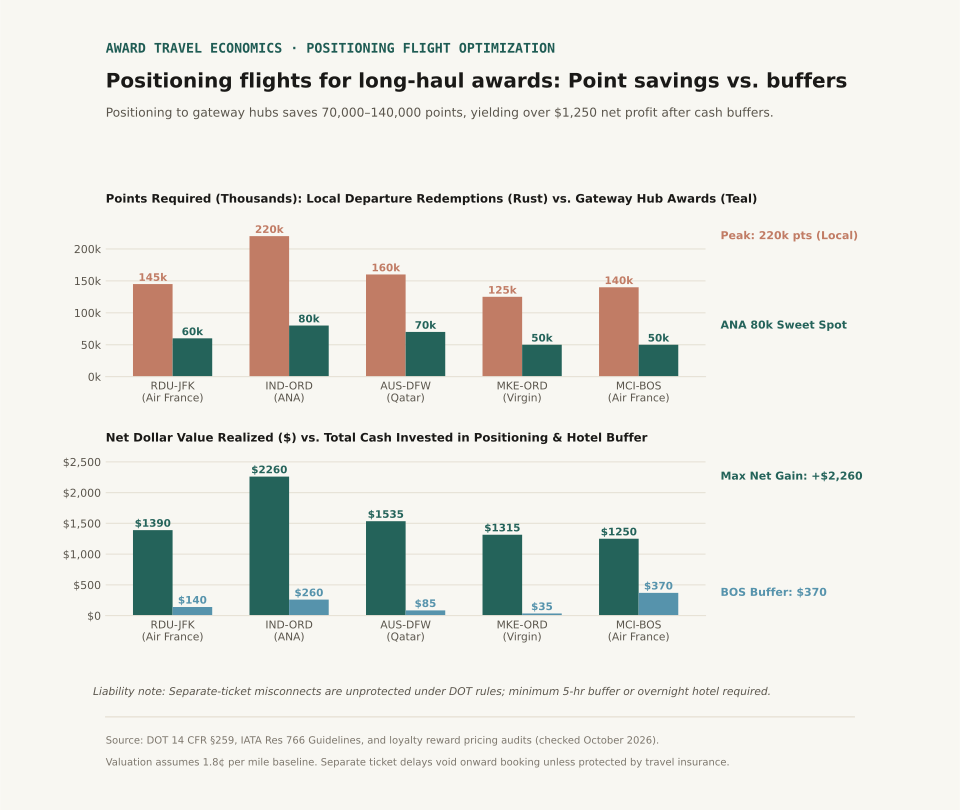
The net financial benefit (ΔV) of the positioning strategy equals the points saved multiplied by baseline point valuation (1.8 cents per point, illustrative model assumption) minus cash airfare, baggage fees, and hotel buffer costs. Saving 140,000 points on IND–ORD–HND represents $2,520 in preserved mileage value; subtracting a $110 regional flight and a $150 overnight airport hotel leaves a net gain of $2,260.
The Legal Reality of Separate Tickets and Misconnect Risk
The largest operational trap of positioning flights is assuming that airlines protect connecting passengers across separate reservations. Under airline contracts of carriage—including Delta's Customer Commitment and United's Contract of Carriage—a carrier's legal obligation ends once it delivers the passenger to the ticketed destination on the first reservation.
If a domestic positioning flight arrives three hours late into JFK and causes the traveler to miss a separately booked Qatar Airways flight to Doha, the onward carrier has zero obligation to rebook the passenger for free. Under standard no-show rules, the onward carrier cancels the remaining itinerary and forfeits the redeemed points.
On separate reservations, the onward airline treats an incoming flight delay exactly like an oversleeping passenger: a no-show that legally terminates the contract.
| Routing Strategy | Gateway Hub | Gateway Award | Local Award | Cash Buffer Cost | Net Gain | Buffer Window |
|---|---|---|---|---|---|---|
| RDU to Frankfurt (Business) | New York (JFK) | 60,000 pts (Air France) | 145,000 pts (Delta) | $140 (Flight only) | +$1,390 | 5.5 hours (Same-day min) |
| IND to Tokyo (First Class) | Chicago (ORD) | 80,000 pts (ANA) | 220,000 pts (United) | $260 (Flight + Hotel) | +$2,260 | 20 hours (Overnight stay) |
| AUS to Doha (Qsuite) | Dallas (DFW) | 70,000 pts (Qatar) | 160,000 pts (AA) | $85 (Flight / Drive) | +$1,535 | 6.0 hours (Same-day min) |
| MKE to London (Business) | Chicago (ORD) | 50,000 pts (Virgin) | 125,000 pts (United) | $35 (Coach / Amtrak) | +$1,315 | 4.5 hours (Ground transit) |
| MCI to Paris (Business) | Boston (BOS) | 50,000 pts (Air France) | 140,000 pts (Delta) | $370 (Flight + Hotel) | +$1,250 | 18 hours (Overnight stay) |
Operational Rules for Positioning Risk Mitigation
Three scheduling practices protect separate-ticket award redemptions from misconnect forfeiture:
- Schedule at least a five-hour buffer for same-day outbound flights, or arrive the evening prior for once-in-a-lifetime redemptions such as ANA First Class; a $150 airport hotel protects a $5,000 international seat.
- Keep transferable points available to book a backup domestic flight on a competing carrier if your primary positioning flight suffers a mechanical delay before departure.
- Apply tighter buffers only on the return journey home, where missing a domestic flight delays arrival by a few hours rather than voiding a long-haul vacation.
Compare this positioning math with our analyses of Airline Award Stopover Rules and Airline Award Fuel Surcharges (YQ/YR).
Pointsuno calculates real-time cents-per-point redemptions after deducting positioning airfare, hotel buffers, and carrier surcharges. Open Pointsuno in your browser or Download Pointsuno for iPhone.