
Should You Store Coffee Beans in the Fridge or Freezer? Why Fridge Condensation Ruins Roasted Beans
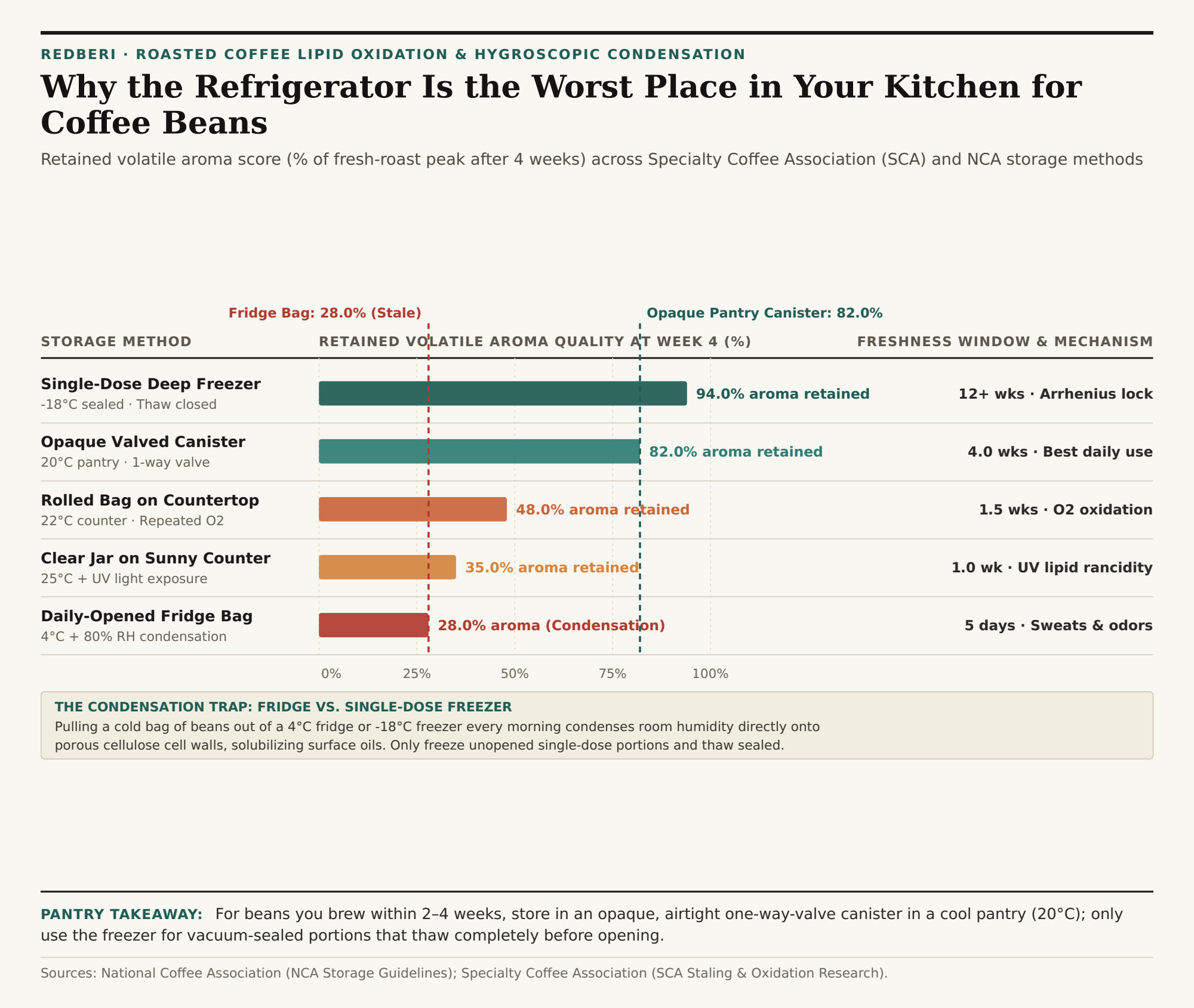
Walk into a kitchen and find a half-used bag of whole-bean coffee sitting on the refrigerator shelf, and you are looking at a textbook collision of food chemistry and psychrometrics. According to storage guidelines synthesized from the National Coffee Association (NCA) and Specialty Coffee Association (SCA) in Mainline Roastery's Technical Guide to Storing Roasted Coffee Beans and Eager Beaver Roasters' Coffee Lipid Oxidation Analysis, placing an everyday bag of coffee inside a 4°C (39°F) refrigerator degrades volatile aroma compounds faster than leaving it in a dark pantry — dropping 4-week aromatic retention to just 28.0% compared to 82.0% in an opaque airtight pantry canister.
Yet the same thermodynamic laws explain why world-class specialty cafes store unopened reserve beans in a -18°C (0°F) deep freezer with 94.0% aroma retention over 12+ weeks. The difference comes down to a single physical rule: whether humid room air ever touches a cold bean. To track roast dates, degassing windows, and freezer inventory across your kitchen, Track pantry and freezer staples in Redberi.
Why Daily Refrigerator Use Ruins Roasted Coffee Beans
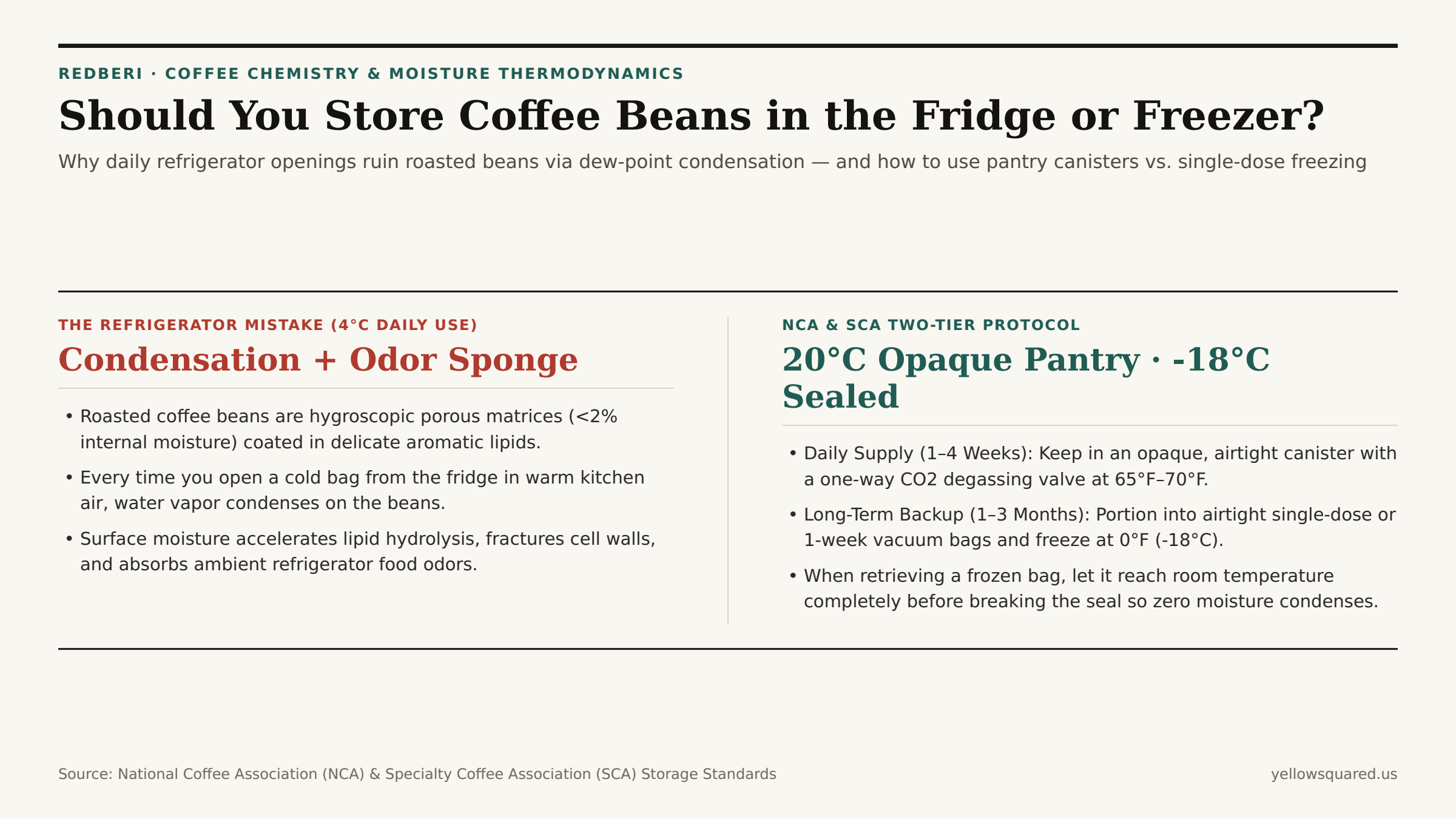
Green coffee beans enter the roaster at roughly 10% to 12% internal water content. During the 200°C+ Maillard and pyrolysis reactions of roasting, nearly all free water flashes into steam, leaving finished roasted beans with less than 1.5% to 2.0% moisture inside a honeycomb-like cellulose matrix coated in 10% to 16% coffee lipids (oils) and over 800 volatile aromatic compounds (thiols, furans, pyrazines, and aldehydes).
When you keep your active bag of beans in a 4°C (39°F) kitchen refrigerator and pull it out every morning to scoop 18 grams for your grinder, three destructive mechanisms occur simultaneously:
- Dew-Point Surface Condensation: A 39°F bean is well below the dew point of a typical 70°F, 50%-humidity kitchen (which has a dew point near 50°F). The moment you open the bag, microscopic water droplets condense directly onto the cold bean surface.
- Lipid Hydrolysis and Volatile Stripping: That condensed surface water dissolves water-soluble flavor compounds and accelerates the hydrolysis and oxidation of surface coffee oils, turning bright fruit and chocolate notes into flat, papery, cardboard-like off-flavors within 5 to 7 days.
- Activated-Carbon Odor Adsorption: Because roasted coffee's dry microporous cellulose structure acts identically to activated charcoal, an unsealed bag in the fridge acts as a chemical sponge for volatile sulfur and amine compounds from nearby onions, garlic, and leftovers.
How to Use Opaque Pantry Canisters vs. Single-Dose Deep Freezing
As both NCA / SCA storage standards and coffee oxidation studies confirm, protecting coffee requires matching your storage method to your consumption timeline:
- For Beans Consumed Within 1 to 4 Weeks (Opaque Valved Canister at 20°C): Keep your daily coffee in an opaque, airtight canister (or its original foil-lined roaster bag with the air squeezed out and a one-way
CO2degassing valve) inside a dark pantry cupboard at65°F–70°F (18°C–21°C)away from oven or sunlight heat. Freshly roasted beans release carbon dioxide (CO2) for 7 to 14 days; a one-way valve letsCO2escape while blocking oxygen (O2, which makes up 21% of air) from oxidizing the lipids. - For Surplus Beans Stored 1 to 3 Months (Single-Dose or Weekly Vacuum Freezing at -18°C): By the Arrhenius equation, dropping temperature from
+20°Cto-18°C (0°F)slows the rate of bothCO2degassing and lipid oxidation by roughly 8x to 10x. Divide extra beans into airtight, zero-headspace portions (either single 18g dosing tubes or 1-week vacuum-sealed bags) and freeze them once. - The Golden Thaw Rule: When you remove a frozen bag from the freezer, never open the bag while the beans are still cold. Let the sealed bag sit on the counter for 1 to 2 hours until the beans reach room temperature so condensation forms on the outside of the plastic or glass rather than on the beans themselves.
"Never move the same bag of coffee back and forth between the freezer and the counter: freeze once in sealed portions, and let the container warm to room temperature before breaking the seal."
| Coffee Storage Method | Temp & Humidity | 4-Week Aroma Retention | Peak Flavor Window | Primary Degradation / Protection Mechanism |
|---|---|---|---|---|
| Single-Dose Deep Freezer | -18°C (0°F) · Sealed | 94.0% | 12.0+ weeks | Arrhenius thermal lock slows oxidation & CO2 loss ~8x |
| Opaque Valved Canister | 20°C (68°F) · 45% RH | 82.0% | 4.0 weeks | 1-way CO2 valve blocks O2 entry with zero condensation |
| Unsealed Bag on Counter | 22°C (72°F) · Ambient O2 | 48.0% | 1.5 weeks | Headspace oxygen oxidizes surface lipids |
| Clear Jar in Sunlight | 25°C (77°F) · UV Light | 35.0% | 1.0 week | UV photons catalyze free-radical lipid rancidity |
| Daily-Opened Fridge Bag | 4°C (39°F) · 80% RH | 28.0% | 0.7 weeks (5d) | Dew-point condensation & fridge odor adsorption |
Logging Roast Dates and Peak Degassing Windows
Because espresso extractions peak between Day 7 and Day 21 post-roast (after initial turbulent CO2 channeling subsides) while filter pour-overs peak between Day 4 and Day 28, tracking the roast date printed on each bag ensures you freeze surplus portions right at peak maturity. Track pantry and freezer staples in Redberi and download the coffee storage retention CSV dataset.