
Should You Store Natural Peanut Butter Upside Down or in the Fridge? The Science of Oil Separation
Open a fresh jar of two-ingredient natural peanut butter (roasted peanuts and salt) after it has sat on a grocery store shelf, and you are greeted by a half-inch pool of liquid amber peanut oil floating at the top and a rock-hard, dry clay-like plug of peanut solids packed at the bottom. To avoid splashing oil over the counter while stirring, thousands of home cooks follow a popular viral tip: store the jar upside down in the pantry. Yet food rheology and lipid storage studies show that leaving an already-opened jar upside down at room temperature causes oil to leak through the lid threads while doing nothing to stop re-separation or rancidity.
The chemistry behind why natural peanut butter separates — and why a one-time unopened inversion followed by upright refrigeration at 4°C (39°F) permanently locks the emulsion — is documented in the NIH / PMC Food Science Study on Stabilizer-Free Natural Peanut Butter Storage (10°C vs. 25°C and 35°C), the Canadian Food Inspection Agency (CFIA) Technical Fact Sheet on Oil Separation in Natural Nut Butters, and Elysium Agrico's Shelf-Life & Oxidation Synthesis. To track open-date timers and fridge vs. pantry storage windows across your nut butters and condiments, Track pantry and fridge shelf life in Redberi.
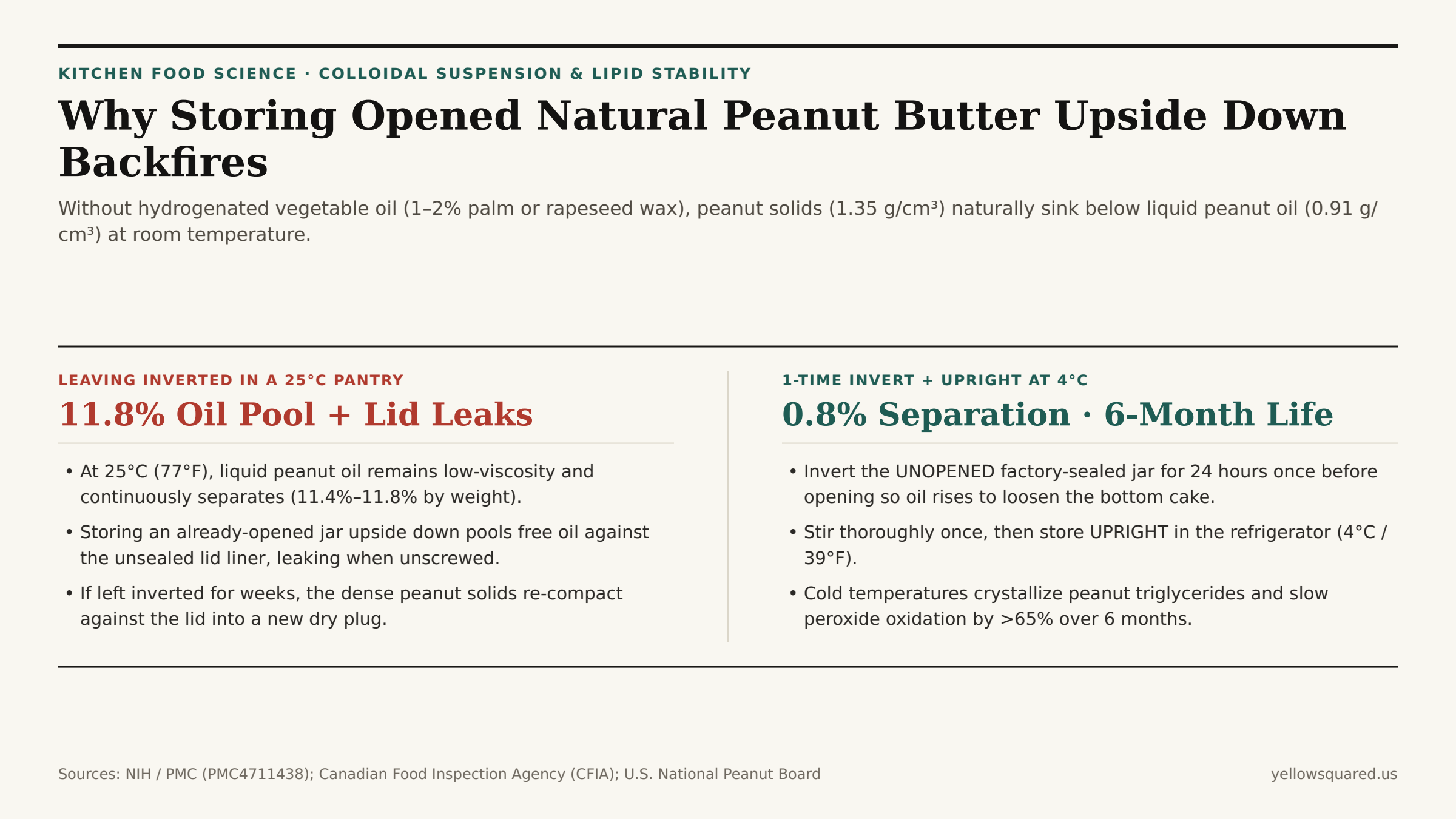
1. Stokes' Law: Why Density (1.35 vs. 0.91 g/cm³) Causes Room-Temperature Separation
Conventional supermarket peanut butter adds 1% to 2% fully hydrogenated vegetable oil (typically palm, cottonseed, or rapeseed oil) whose microscopic high-melting wax crystals form a three-dimensional scaffolding that traps liquid peanut oil at room temperature. True natural peanut butter contains only ground roasted peanuts (~50% oil by weight) and salt.
In a colloidal suspension without wax stabilizers, gravity governs particle settling via Stokes' Law:
- The Density Differential: Finely ground peanut protein and cell-wall fiber particles have a density of roughly
1.35 g/cm³, whereas liquid peanut oil has a density of0.91 g/cm³. Because the solid particles are 48% denser than the oil, gravity pulls the solids downward toward the bottom of the jar, displacing the lighter liquid oil upward. - Why Temperature Controls Settling Speed: In Stokes' Law, settling velocity is inversely proportional to the dynamic viscosity (η) of the liquid phase. In the NIH / PMC multi-temperature storage study (PMC4711438), stabilizer-free peanut butter stored at 25°C (77°F) and 35°C (95°F) suffered rapid gravitational oil separation (
11.4%to16.5%free oil by weight over 12 weeks) alongside rising peroxide oxidation values. By contrast, storage at 10°C (50°F) or inside a standard 4°C (39°F) refrigerator caused the monounsaturated and saturated triglycerides in peanut oil to partially crystallize, increasing viscosity so sharply that solid settling dropped below0.8%–2.1%.
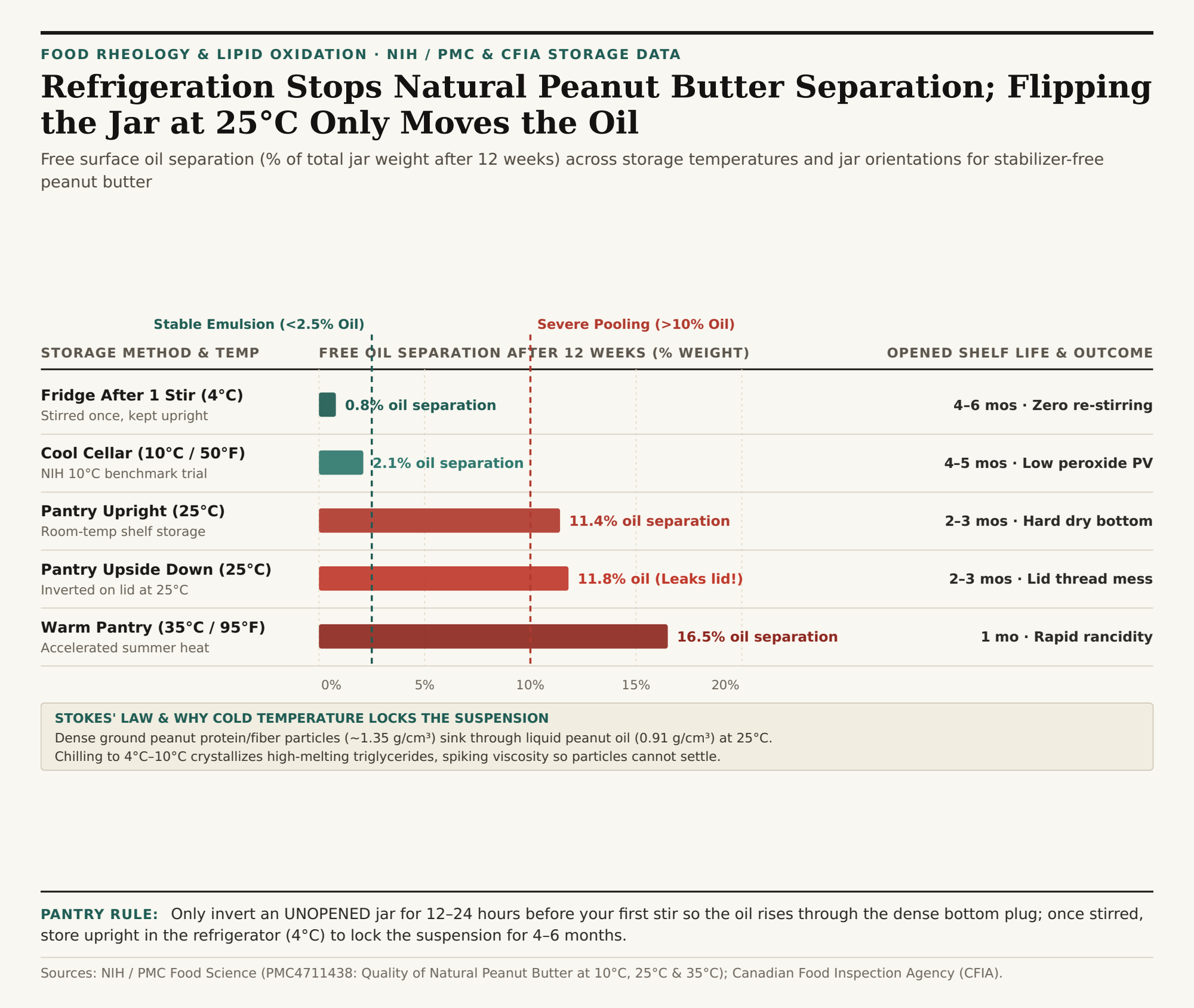
2. The Exact 3-Step Protocol: Invert Sealed for 24 Hours, Stir Once, Chill Upright
Why do people think storing peanut butter upside down works — and why does it create a sticky mess when done continuously? When an unopened jar has sat upright on a warehouse pallet for months, all the free oil is pooled at the top under a factory-crimped vacuum seal. If you flip that unopened jar upside down for 12 to 24 hours before breaking the seal, buoyancy drives the low-density oil (0.91 g/cm³) upward toward the bottom of the jar, loosening the dry peanut cake so your first stir takes 30 seconds instead of 5 minutes.
However, once you break the inner foil or vacuum liner, never store the opened jar upside down at room temperature:
- Cap Thread Seepage: Jar screw-threads are not liquid-tight once the induction foil is peeled off. Inverted at
25°C, low-viscosity peanut oil seeps into the cap grooves and drips onto your shelves and fingers every time you open the lid. - Reverse Compaction: Leave an inverted jar at room temperature for three weeks and all the dense peanut solids (
1.35 g/cm³) sink onto the inside of the lid, leaving you with a rock-hard plug at the top and a pool of loose oil at the bottom. - The Fridge Fix: Stir the jar thoroughly once when you first open it (scraping the bottom corners with a stiff butter knife or fork), then place it upright in the refrigerator (
4°C / 39°F). Cold viscosity locks the oil and solids together so you never have to stir the jar again, while extending opened freshness from 2–3 months in the pantry to 4–6 months in the fridge.
"Invert a factory-sealed jar for 24 hours before opening to let buoyancy loosen the bottom plug — then stir once and store upright in the refrigerator so cold viscosity locks the emulsion permanently."
| Storage Method & Temp | Jar Orientation | 12-Week Free Oil | Opened Shelf Life | Physical & Culinary Outcome |
|---|---|---|---|---|
| Refrigerated After 1 Stir (4°C / 39°F) | Upright | 0.8% | 4–6 months | Zero oil pooling; firm, creamy scoopable spread |
| Cool Cellar / Wine Fridge (10°C / 50°F) | Upright | 2.1% | 4–5 months | Minimal separation; low peroxide lipid oxidation |
| Room Pantry (25°C / 77°F) | Upright | 11.4% | 2–3 months | Oil pools on top; bottom third dries into hard clay |
| Room Pantry (25°C / 77°F) | Upside Down | 11.8% | 2–3 months | Oil floats to jar base & leaks through cap threads |
| Warm Summer Pantry (35°C / 95°F) | Upright | 16.5% | 1 month | Severe oil separation & accelerated rancid off-odors |
Tracking Nut Butter & Oil Freshness Windows
Because roasted peanuts are rich in unsaturated oleic and linoleic fatty acids, room-temperature exposure to oxygen and kitchen heat accelerates lipid peroxidation even before visible mold ever appears. Track pantry and fridge shelf life in Redberi to log open dates across natural peanut, almond, and tahini jars, and download the natural peanut butter storage CSV dataset.