
How Shared Baby Names Shift Between Girls and Boys
In 1963, Ashley appeared for 108 girls and 128 boys in the national files. By 1990, its count was 45,561 girls and 239 boys. That is a substantial shift in the sex balance of one spelling. Similar histories appear for Leslie and Aubrey.
But it does not establish a universal threshold after which boys abandon a name, or prove that change can never reverse. Some shared names retain substantial use for boys. Others become more male in recent years. The counts need to be read alongside the percentages.
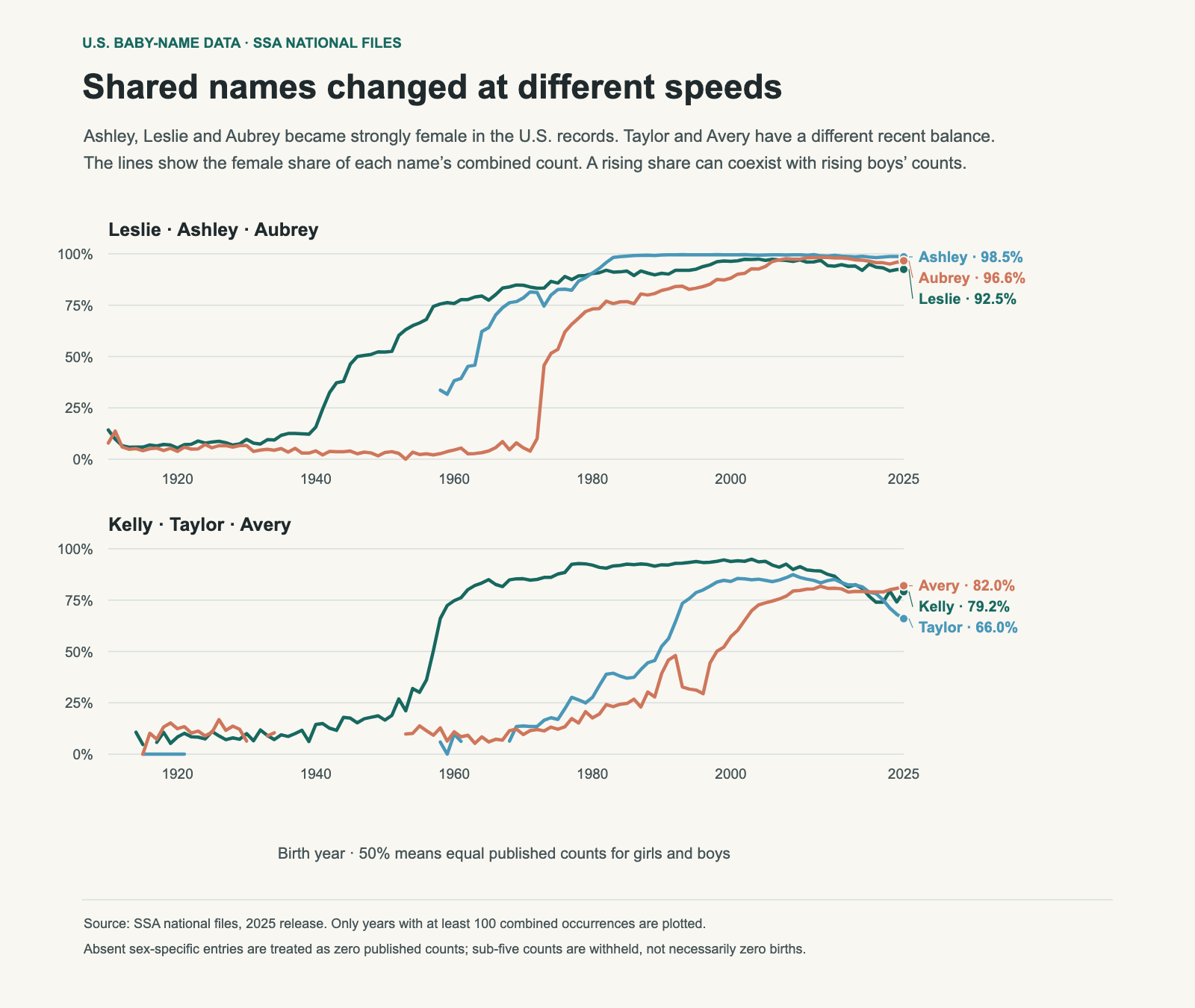
The names changed at different speeds
Leslie and Kelly begin a sustained run of female-majority years in 1946 and 1957 respectively. Ashley does so in 1964, Aubrey in 1974, Taylor in 1990 and Avery in 1998. Here “sustained” means at least five consecutive years with female share at or above 50%, each with at least 100 combined published occurrences.
That rule makes the table of turning points less sensitive to a single small year. It remains a descriptive convention. The files do not identify a tipping point that all parents react to, and the names were selected for their histories.
| Name | 1990 female share | 2025 female share | 2025 girls | 2025 boys |
|---|---|---|---|---|
| Leslie | 90.6% | 92.5% | 393 | 32 |
| Kelly | 92.2% | 79.2% | 319 | 84 |
| Ashley | 99.5% | 98.5% | 1,829 | 27 |
| Aubrey | 82.2% | 96.6% | 2,003 | 70 |
| Taylor | 52.5% | 66.0% | 772 | 398 |
| Avery | 39.2% | 82.0% | 5,267 | 1,156 |
A share can fall while both counts rise
Rowan’s female share fell from 38.9% in 2010 to 19.2% in 2025. Over the same years, the girls’ count rose from 608 to 1,240 and the boys’ count rose from 955 to 5,212. Girls did not have to stop using Rowan for its male share to increase; boys’ use grew faster.
River moved differently. Its female share rose modestly, from 29.2% to 30.9%, while the boys’ count rose from 634 to 3,139. A rising female share did not require a collapse in boys’ use in that comparison.
| Spelling | 2010 female share | 2025 female share | Boys’ count, 2010 → 2025 |
|---|---|---|---|
| Rowan | 38.9% | 19.2% | 955 → 5,212 |
| River | 29.2% | 30.9% | 634 → 3,139 |
| Rory | 44.6% | 43.0% | 304 → 1,768 |
| Remi | 75.4% | 86.2% | 65 → 323 |
| Remy | 34.1% | 33.3% | 243 → 781 |
Small spelling differences can hide large differences in use
Remi and Remy should not be combined without saying so. In 2025, Remi was 86.2% female in the published counts, while Remy was 33.3% female. A single combined percentage would obscure two different balances that a family choosing an exact spelling may care about.
The SSA keeps spellings separate. That is useful here, but it also means a spelling’s U.S. balance cannot be assumed to describe its use in every language or country. A national file does not contain enough information to explain the reasons for a shift through migration, media or changing social expectations.
Recent years need not continue the earlier direction
Taylor’s female share was 86.1% in 2010 and 66.0% in 2025. It remained female-majority, but its balance moved away from the earlier high. Kelly’s female share also fell between those dates. Calling those names permanently locked to one sex would hide a change visible in the records.
There are also examples that moved in the other direction from a small female base: Kyrie was 83.7% female in 2010 and 4.9% female in 2025. That does not make it a representative case for all names, but it is enough to reject an absolute claim that no spelling ever shifts toward male use.
Use these figures as history, not a deadline
A current percentage can help describe how a name is used in these U.S. records. It cannot predict that a child’s classmates will regard it a particular way in 2035, or supply a reason to avoid a name that your family likes. Local use, language and personal associations differ.
For a shortlist, compare the exact spelling, the two counts and several recent years. Then discuss whether the balance matters to you. See how to compare favourites with a partner and how to read the wider trend.
Data and method
These calculations use the SSA’s pinned 2025 national release. “Published counts” means the sum of the name counts available for that year and sex. Names with fewer than five occurrences are withheld, so this denominator is not a complete count of all births. Historical records before 1937 are also incomplete. Female share is F ÷ (F + M) for an exact spelling. Lines omit years with fewer than 100 combined occurrences. An absent sex-specific entry contributes zero published counts, although a suppressed count may be between zero and four.
Download the chart data (CSV). The SSA download page provides the original files, and its background notes describe coverage and spelling conventions.