
Why Does the US-UK Time Difference Change Twice a Year?
The time difference between the United States and the United Kingdom (or Europe) shrinks by one full hour for 28 days every year because North America and Europe change their Daylight Saving Time clocks on different weekends. Instead of the normal 5-hour gap between New York and London (or 8-hour gap between Seattle and London), the offset drops to 4 hours and 7 hours for three weeks every March and one week every late October — shifting recurring calendar invites by an hour for half the team.
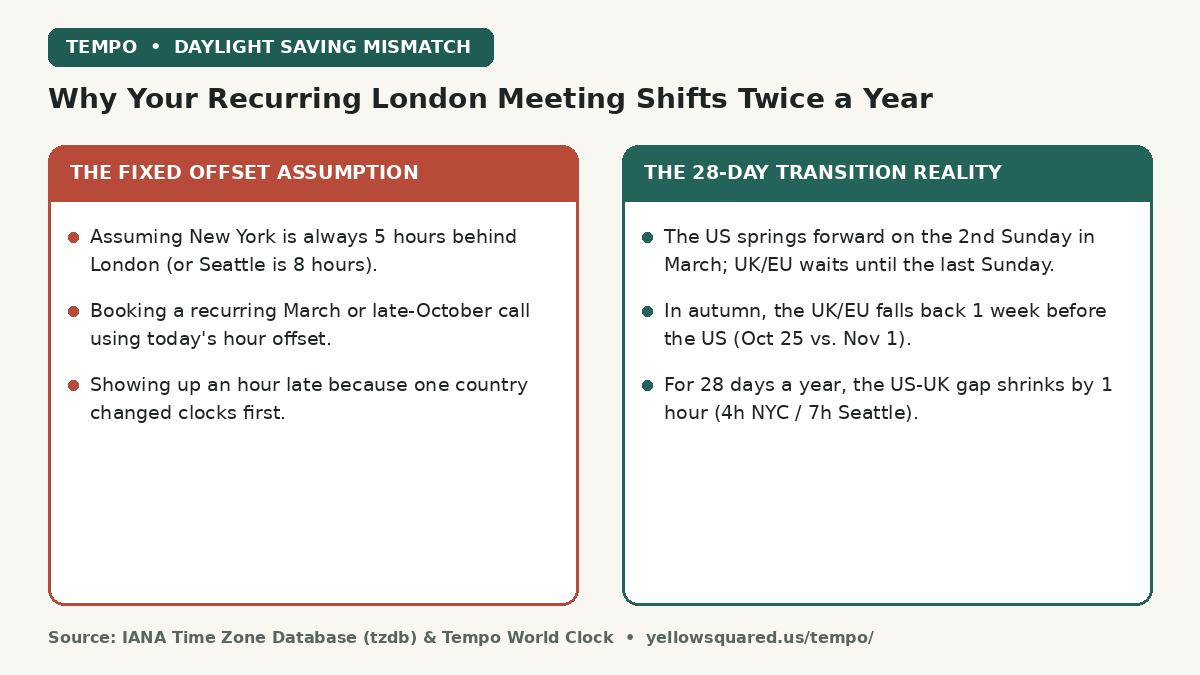
Anyone working on a distributed team spanning North America and Europe has lived through the twice-yearly calendar confusion. A recurring 9:00 AM New York / 2:00 PM London standup runs smoothly all winter. Then, on the second Monday of March, half the participants log in at 1:00 PM London time while the other half show up an hour later. Understanding the statutory statutes behind the IANA Time Zone Database (tzdb) makes it easy to anticipate both transition windows before you send an invite.
Time-zone offsets are not fixed geographic constants; they are legal schedules that drift out of alignment whenever two legislatures pick different Sundays.
Why the 2007 U.S. Energy Policy Act Created a 28-Day Transatlantic Gap
Prior to 2007, the United States and Europe switched to Daylight Saving Time on much closer dates. However, when the U.S. Congress enacted Section 110 of the Energy Policy Act of 2005 (which took effect in March 2007 and is administered by the U.S. Department of Transportation), American Daylight Saving Time was extended by four weeks — starting three weeks earlier in the spring and ending one week later in the autumn.
Meanwhile, both the United Kingdom (under the British Summer Time schedule) and the European Union (under Directive 2000/84/EC for Central European Summer Time, CEST) kept their synchronized transition dates on the last Sunday of March and the last Sunday of October:
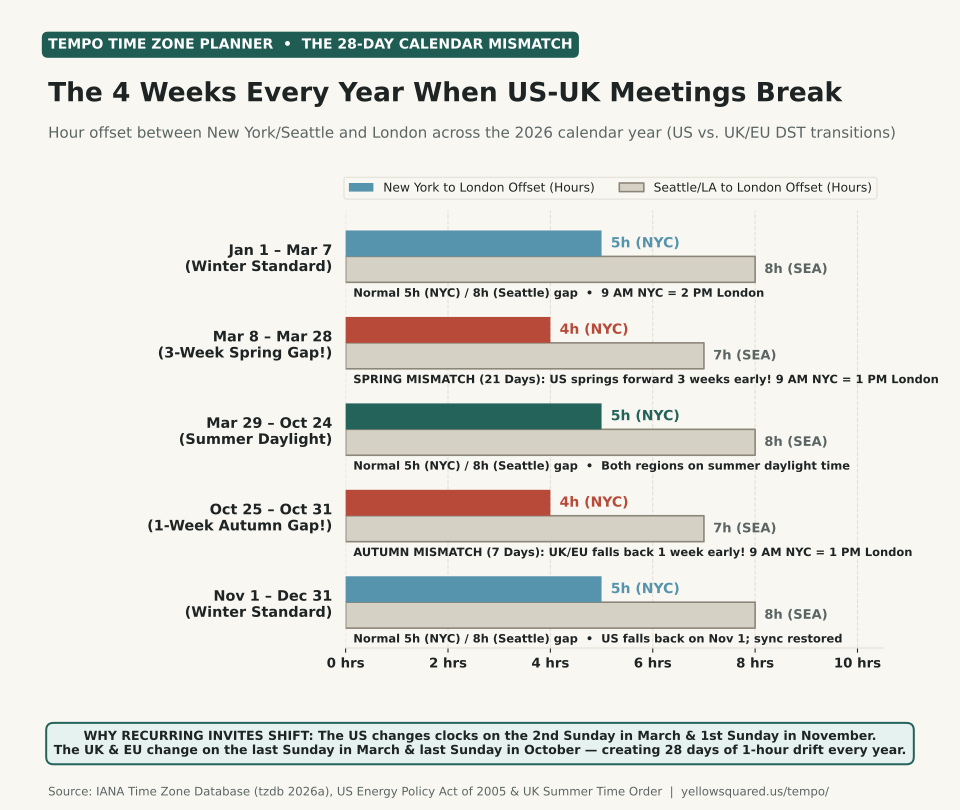
- The 21-Day Spring Mismatch (March 8 to March 28, 2026): The U.S. springs forward one hour on the second Sunday of March (March 8, 2026), shifting New York from EST (UTC-5) to EDT (UTC-4) and Seattle from PST (UTC-8) to PDT (UTC-7). Because London remains on Greenwich Mean Time (GMT, UTC+0) and Berlin remains on CET (UTC+1) until March 29, the transatlantic time gap shrinks by one hour for three full weeks.
- The 7-Day Autumn Mismatch (October 25 to October 31, 2026): On the last Sunday of October (October 25, 2026), London falls back from BST (UTC+1) to GMT (UTC+0) and Berlin falls back from CEST (UTC+2) to CET (UTC+1). The U.S. does not fall back until the first Sunday of November (November 1, 2026). For that single late-October week, the transatlantic gap once again shrinks to 4 hours (New York–London) and 7 hours (Seattle–London).
2026 Transatlantic Offset Calendar: New York, Seattle, London, and Berlin
Use the reference table below to verify exact UTC offsets and how a recurring 9:00 AM U.S. meeting lands in Europe across all five seasonal windows:
| 2026 Date Window | New York Zone | Seattle Zone | London / Berlin | NYC–UK Gap | 9:00 AM NYC Lands At |
|---|---|---|---|---|---|
| Jan 1 – Mar 7 (Winter) | EST (UTC-5) | PST (UTC-8) | GMT (0) / CET (+1) | 5 Hours | 2:00 PM London / 3:00 PM Berlin |
| Mar 8 – Mar 28 (Spring Gap) | EDT (UTC-4) | PDT (UTC-7) | GMT (0) / CET (+1) | 4 Hours (-1h) | 1:00 PM London / 2:00 PM Berlin |
| Mar 29 – Oct 24 (Summer) | EDT (UTC-4) | PDT (UTC-7) | BST (+1) / CEST (+2) | 5 Hours | 2:00 PM London / 3:00 PM Berlin |
| Oct 25 – Oct 31 (Autumn Gap) | EDT (UTC-4) | PDT (UTC-7) | GMT (0) / CET (+1) | 4 Hours (-1h) | 1:00 PM London / 2:00 PM Berlin |
| Nov 1 – Dec 31 (Winter) | EST (UTC-5) | PST (UTC-8) | GMT (0) / CET (+1) | 5 Hours | 2:00 PM London / 3:00 PM Berlin |
How to Prevent DST Mismatches When Booking Recurring Calls
- Anchor the invite to the team with fixed core commitments: A calendar invite created by a New York organizer at 9:00 AM America/New_York stays locked to 9:00 AM in New York all year — meaning London teammates suddenly see the call move to 1:00 PM (right over lunch) during the March and October mismatch weeks.
- Watch out for non-DST regions joining the call: Arizona (UTC-7 year-round), Hawaii (UTC-10), Japan (UTC+9), China (UTC+8), Singapore (UTC+8), and India (UTC+5:30) never change their clocks. Their offset relative to New York, Seattle, and London shifts every spring and autumn.
- Inspect the exact target date on a synchronized dial: Rather than guessing whether a future workshop falls inside a transition week, select the exact calendar date and compare aligned city columns side by side. You can Open Tempo in your browser to test date-specific time zone overlaps across any combination of global cities.