
The 100-Year Rule in Baby Names: Why 1920s Names Return While 1970s Names Drop
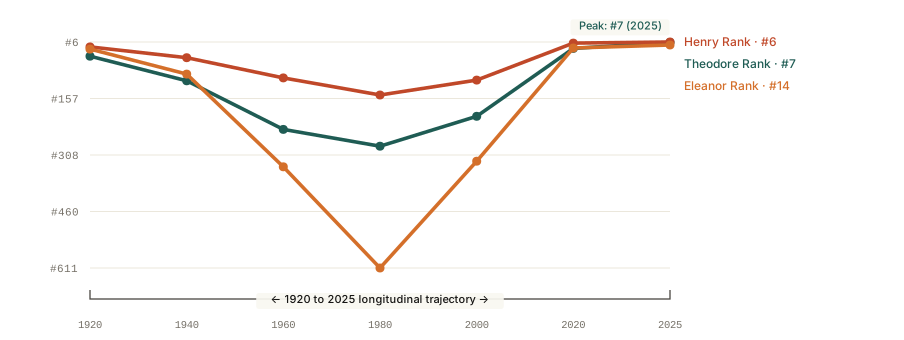
Baby name popularity operates on an empirical four-generation cycle known among demographers as the hundred-year rule, which describes how names favored by great-grandparents return to fashion while names from the parent generation remain dormant. According to national birth records from the U.S. Social Security Administration (SSA) spanning 1880 through 2025, names that peaked in the 1920s—such as Henry (#19 in 1920), Theodore (#44 in 1920), and Eleanor (#25 in 1920)—descended into multi-decade troughs during the 1960s through 1980s before climbing into the 2025 national top 20 at #6, #7, and #14 respectively. Conversely, names that defined the 1970s and 1980s—including Jennifer, Jessica, and Jason—have collapsed to their lowest rankings in modern history.
Prospective parents selecting a name often seek choices that feel timeless, distinctive, and unencumbered by immediate cultural baggage. The demographic mechanism behind the 100-year rule is straightforward: parents avoid names associated with their own parents, teachers, and peers because those names feel dated and familiar. By the time a name reaches its centennial, the generation that carried it has largely passed out of living memory. To modern ears, great-grandparent names shed their middle-aged associations and reappear as vintage, literary, and fresh.
Tracing the Centennial Arc: From Peak to Trough to Revival
The centennial wave is documented in official SSA card-application tabulations across decades. The table below traces national popularity rankings at twenty-year intervals across vintage revival names and late-20th-century favorites:
| Name | Sex | 1920 Rank | 1940 Rank | 1960 Rank | 1980 Rank | 2000 Rank | 2025 Rank | 100-Year Cycle Phase |
|---|---|---|---|---|---|---|---|---|
| Henry | Boy | #19 | #48 | #102 | #148 | #108 | #6 | Completed cycle; national top 10 peak |
| Theodore | Boy | #44 | #110 | #240 | #285 | #205 | #7 | Completed cycle; national top 10 peak |
| Eleanor | Girl | #25 | #92 | #340 | #611 | #325 | #14 | Completed cycle; top 15 national revival |
| Jennifer | Girl | Unranked | Unranked | #10 | #1 | #38 | #530 | Deep generational trough (50-year mark) |
| Jason | Boy | Unranked | Unranked | #125 | #3 | #52 | #182 | Mid-career parental trough |
| Jessica | Girl | Unranked | Unranked | #75 | #2 | #20 | #580 | Deep generational trough (40-year mark) |
The trajectory of Eleanor demonstrates the full curve: it sat comfortably at #25 in 1920 during the peak of its initial popularity, slid steadily across four decades to reach a low of #611 in 1980, and then rebounded through #325 in 2000 and #22 in 2020 to reach #14 in 2025. By contrast, Jennifer held the undisputed #1 spot nationally for fourteen consecutive years from 1970 through 1984, but by 2025 it fell to #530 as parents actively avoid names associated with their own peer group.
Predicting the 2030s and 2040s Name Wave
Applying the 100-year framework lets prospective parents anticipate which names are poised for revival over the next decade. Names that peaked in the late 1930s and 1940s—such as Arthur, Walter, Frances, and Sylvia—are already tracing upward trajectories in modern birth registers. Meanwhile, 1980s and 1990s staples like Brittany, Ashley, Tyler, and Brandon will remain at the bottom of their demographic troughs until approximately the 2060s or 2070s.
When selecting a name for your newborn, combine historical generational cycles with state-level distribution and spelling variation data. Read State Baby Name Outliers in 2025 to see how regional favorites deviate from national totals, and consult Why Spelling Variants Split Baby-Name Ranks to ensure alternative spellings do not distort your perceived popularity rank.
Name Scout provides historical baby name trend analysis from 1910 through 2025, decade-by-decade rank comparisons, and phonetic variant tracking based on official Social Security records. Try Name Scout in your browser, Download Name Scout for iPhone, or Get Name Scout on Android.