
What Are Airline Fuel Surcharges (YQ and YR Fees) on Award Flights, and Which Airlines Charge Them?
Few experiences surprise points travelers more than searching for a transatlantic business-class award, spotting a tempting 57,500-mile or 60,000-point price tag, and then clicking through to checkout only to see $750 to $970 in cash due for a single one-way ticket. Travelers often assume those cash fees are government airport taxes—but in reality, genuine U.S. and European departure taxes usually make up less than $120 of that bill. The rest is a carrier-imposed surcharge, labeled on airline fare breakdowns with the two-letter IATA ticketing codes YQ or YR.
As documented in award fee analyses from FlightPoints, AwardLocker's YQ/YR glossary, and RewardExpert's surcharge guide, airlines introduced YQ/YR "fuel surcharges" during 2004–2008 oil spikes and kept them permanently as discretionary revenue fees even when jet fuel fell. Compare airline award fees and transfer partners in Pointsuno before transferring flexible bank points to any carrier program.
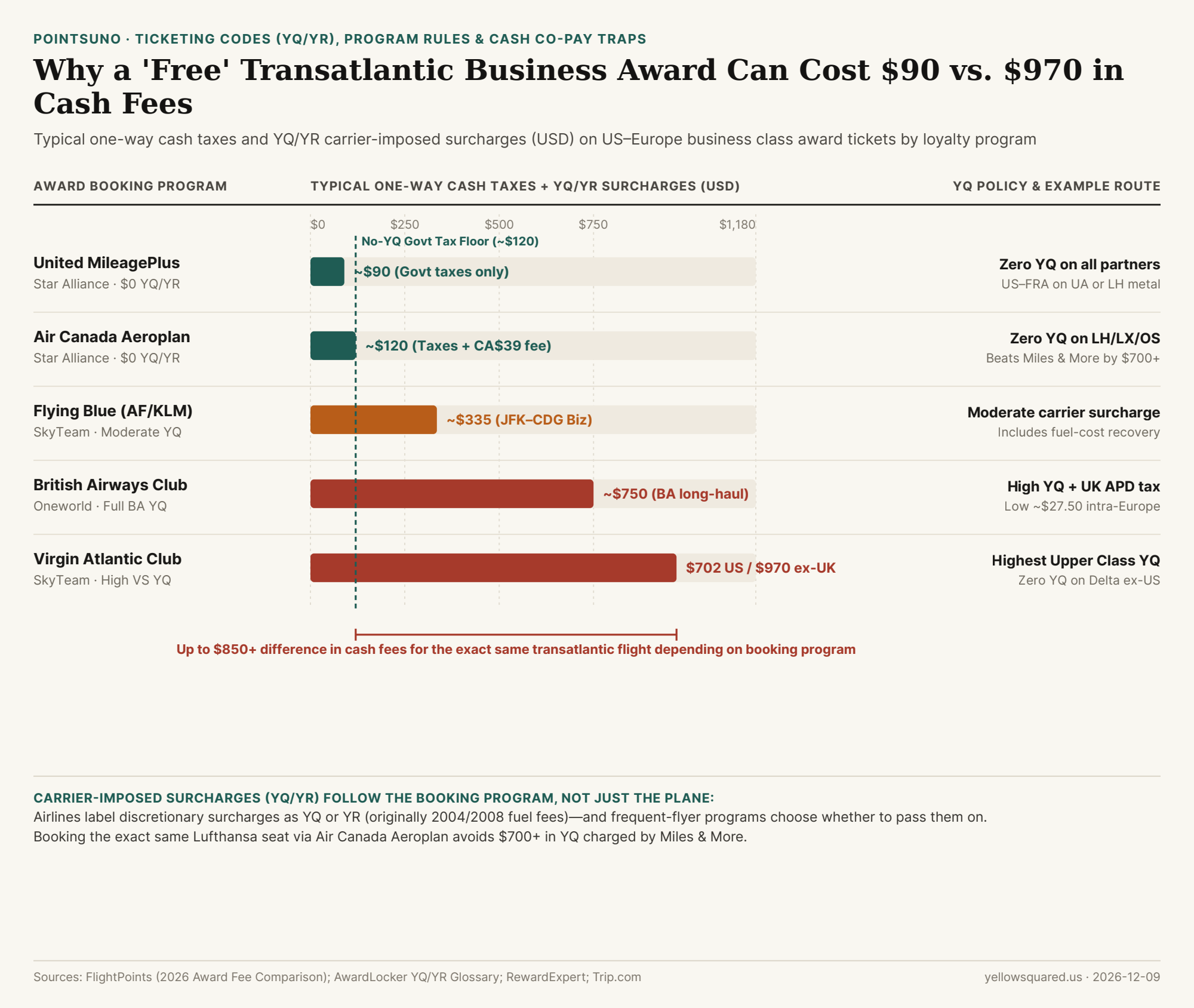
YQ/YR carrier-imposed surcharges (USD) on U.S.–Europe business class award tickets across five major frequent-flyer programs. Sources: FlightPoints, AwardLocker, and RewardExpert · Download CSV dataset.The Core Rule: Booking Program Controls Whether You Pay YQ
When you redeem miles, your points cover only the base fare—leaving you to pay mandatory government taxes plus any YQ/YR surcharge the issuing loyalty program chooses to collect. Crucially, the exact same airplane seat can carry wildly different cash fees depending on which partner program issues the ticket:
- Zero-
YQPrograms (United MileagePlus,Air Canada Aeroplan,American AAdvantageon most partners): As noted in FlightPoints' fee comparison, booking a Lufthansa Business Class seat from the U.S. to Frankfurt through Lufthansa's own Miles & More program can trigger nearly$980+in carrier surcharges, whereas booking that exact same Lufthansa seat through Air Canada Aeroplan ($0 YQ+ flatCAD $39partner booking fee) or United MileagePlus ($0 YQ) drops total cash fees to roughly$75–$180! - High-
YQPrograms (British Airways Club,Virgin Atlantic Flying Club,Lufthansa Miles & More): British Airways passes through steepYQon its own long-haul flights ($650–$1,000+round-trip in business), though it replaces long-haul surcharges with a low flat fee (~$27.50) on intra-European short-haul routes. Virgin Atlantic passes through roughly$702one-way ex-U.S. and$970ex-London on Virgin-operated Upper Class awards, while charging$0 YQon Delta-operated flights from the U.S.
"Carrier-imposed surcharges (YQ/YR) are determined by the loyalty program issuing your award ticket, not just the airline flying the plane—which is why booking Lufthansa via Air Canada Aeroplan saves $700+ in cash on the exact same seat."
Award Program YQ/YR Surcharge Comparison Table
The table below summarizes typical U.S.–Europe business-class cash co-pays and carrier-surcharge policies across six major programs (download the raw CSV dataset):
| Loyalty Program | Alliance | Typical 1-Way Cash (US–EU Biz) | YQ/YR Surcharge Policy |
Key Exception or Sweet Spot |
|---|---|---|---|---|
| United MileagePlus | Star Alliance | $60 to $120 |
$0 YQ/YR on all awards |
Never passes carrier surcharges on UA or partner metal |
| Air Canada Aeroplan | Star Alliance | $75 to $180 |
$0 YQ/YR (+CA$39 partner fee) |
Eliminates Lufthansa/Swiss/Austrian transatlantic YQ |
| American AAdvantage | Oneworld | $5.60 to $120 |
$0 YQ on AA, Iberia, JAL, Qantas |
Avoid British Airways metal to dodge $750+ BA YQ |
| Air France–KLM Flying Blue | SkyTeam | $250 to $350 |
Moderate YQ/YR (~$335 JFK–CDG) |
Look for Promo Rewards (25% fewer miles) to offset cash |
| British Airways Club | Oneworld | $650 to $1,000+ |
Full YQ/YR on BA long-haul |
Low flat ~$27.50 fee on intra-Europe; $0 YQ on AA US domestic |
| Virgin Atlantic Flying Club | SkyTeam | $702 (US) / $970 (UK) |
High YQ/YR on VS Upper Class |
$0 YQ on Delta flights originating in the U.S. |
How to Check for Hidden YQ Before You Transfer Points
As U.S. DOT all-in fare rules require cash tickets to display taxes and carrier charges upfront, always run a quick cash-fare breakdown or check the award checkout screen before transferring credit card points—since point transfers to airline programs are irreversible. Compare airline award fees and transfer partners in Pointsuno to calculate your true cents-per-point value after subtracting YQ/YR cash fees.