
What Causes a Sun Dog and a 22° Halo Around the Sun or Moon?
Look up at the sun on a crisp morning when a thin, milky veil of high cirrostratus clouds drifts across the sky—or look up at a bright full moon on a frosty winter night—and you will often spot one of two spectacular optical geometries: either a complete luminous ring encircling the sun or moon at a constant radius (a 22° halo), or two vivid, rainbow-tinted "mock suns" glowing directly to the left and right of the sun at the exact same elevation above the horizon (sun dogs, known in atmospheric physics as parhelia). As documented by the National Weather Service and HyperPhysics optical calculations, both phenomena are created by the exact same optical building block: six-sided hexagonal ice crystals acting as miniature 60° prisms in the upper troposphere.
Why do ice crystals lock onto an angle of 21.84° (~22°) regardless of where you stand on Earth, why is the sky inside a 22° halo noticeably darker than the rest of the sky, what determines whether you see a full circular halo versus a pair of sun dogs, and how do you measure and frame 22° in the field? Here is the complete atmospheric optics guide—and how to track solar elevation and golden-hour angles in PhotoSpots.
The 60° Hexagonal Ice Prism: Why Light Cannot Bend by Less Than 21.84°
In the upper troposphere—at altitudes between 5 and 10 kilometers (16,000 to 33,000 feet), or near the ground in sub-freezing winter air as diamond dust—water vapor freezes into microscopic six-sided (hexagonal) ice crystals. When a ray of sunlight or moonlight enters one of the six side faces of a hexagonal crystal and exits through an alternating side face (skipping one face in between), the two faces form a classic equilateral prism with an apex angle of A = 60°.
In classical optics, a prism of apex angle $A$ and refractive index $n$ bends light by a minimum possible angle—the angle of minimum deviation (D_min):
D_min = 2 * arcsin(n * sin(A / 2)) - A
Plugging in $A = 60^\circ$ ($\sin 30^\circ = 0.5$) and the refractive index of ice (n_ice = 1.31):
- Red Light (
650 nm,n_red = 1.306): Minimum deviation is2 * arcsin(1.306 * 0.5) - 60° = 21.54°. - Yellow-Green Mean Light (
n = 1.310): Minimum deviation is21.84°(rounded in meteorology to22°). - Blue-Violet Light (
430 nm,n_blue = 1.317): Minimum deviation is2 * arcsin(1.317 * 0.5) - 60° = 22.37°.
That simple prism equation explains two visual signatures you can spot immediately in any 22° halo or sun dog photograph:
- The Dark "Hole in the Sky" Inside
21.54°: Because it is physically impossible for a60°ice prism to refract a ray of light by less than21.54°, zero refracted rays are deflected into the disk of sky between the sun and the21.54°inner edge—making the sky inside the 22° halo look starkly darker than the sky outside! - Red Is Always on the Inside Edge: Because red light bends slightly less (
21.54°) than blue light (22.37°), red always forms the sharp inner border closest to the sun, while yellow, green, and blue fade outward into white light.
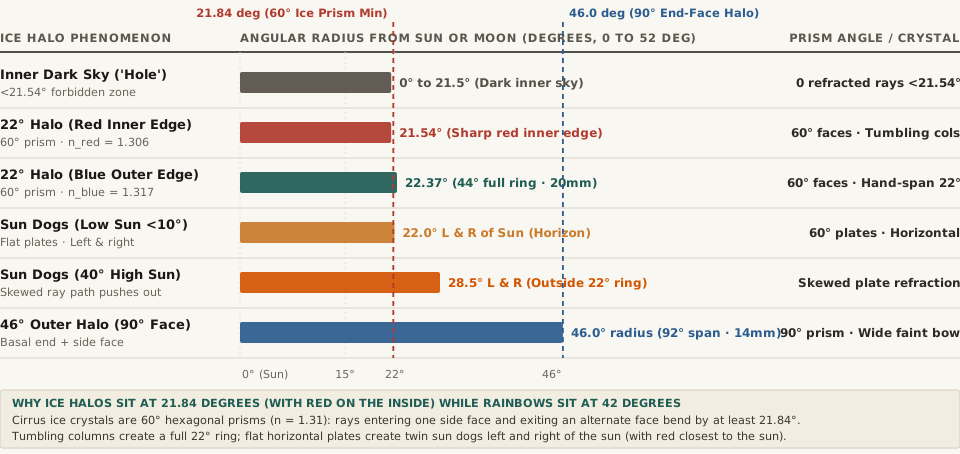
21.54°–22.37° circular halo, low-sun and high-sun parhelia (sun dogs), and the 46° 90-degree-prism halo. Source: Wikipedia — Sun Dog, Halo & HyperPhysics.22° Halo vs. Sun Dogs (Parhelia): Why Crystal Shape and Orientation Matter
If both 22° halos and sun dogs are caused by 60° hexagonal ice crystals, why do some days produce a full circle while other days produce two dazzling spots on either side of the sun?
- Tiny Tumbling Columns (
< 20.5 µm) → Full22°Circular Halo: When ice crystals grow as short, pencil-shaped hexagonal columns smaller than ~20.5 micrometers, air turbulence tumbles them randomly in all 3D orientations. Because crystals are tilted at every possible angle around the clock face, they refract sunlight equally in a complete 360-degree circle of22°radius around the sun or moon. - Larger Flat Hexagonal Plates (
> 30 µm) → Twin Sun Dogs (Parhelia): When ice crystals grow as flat, wafer-like hexagonal plates larger than ~30 micrometers, aerodynamic drag causes them to drift downward with their flat faces aligned horizontally like falling leaves. With their side faces standing vertically like windowpanes, they can only refract sunlight horizontally to the left and right of the sun—concentrating the light into two brilliant colored spots at the exact same altitude as the sun! - Why Sun Dogs Drift Outward When the Sun Climbs Higher: When the sun sits right on the horizon (
0°elevation), sun dogs sit directly on the22°halo ring. As the sun climbs higher in the sky (20°to40°elevation), sunlight enters the flat horizontal plates at a skewed diagonal angle, increasing the effective prism path and pushing the sun dogs outside the 22° halo (out to28.5°at a40°sun elevation, before vanishing entirely above61°!).
Extend your arm fully in front of you and spread your fingers wide: from the tip of your thumb to the tip of your pinky is almost exactly 20° to 22°—meaning if you cover the sun with your thumb, a sun dog or 22° halo will sit right at the tip of your pinky finger.
Field Photography & Weather Lore: The 20–24mm Lens Rule and Warm Fronts
For landscape photographers, ice halos offer both an optical framing rule and an accurate 24-hour weather forecast:
- Required Focal Length (
44°Full Ring Diameter): Because a 22° halo has a radius of22°around the sun, its full circular diameter is44°. On a 35mm full-frame camera in landscape orientation (where vertical field of view is the limiting dimension), a50 mmlens (27°vertical FOV) or35 mmlens (38°vertical FOV) will clip the top and bottom of the halo. To frame the entire44°circle (plus foreground), you need a20 mm to 24 mmfull-frame lens (47°–55°vertical FOV)—and if a rare46°halo (90°end-face refraction,92°full diameter) appears, you need a12 mm to 14 mmultra-wide lens. - Why a 22° Halo Predicts Rain or Snow Within 18–24 Hours: High cirrostratus ice clouds form at the leading upper wedge of an advancing warm front. Seeing a bright 22° solar or lunar halo is a classic empirical indicator that a frontal system is approaching and precipitation will likely arrive within
18 to 24 hours.
Complete Reference Table of Ice Halos, Sun Dogs & Camera Angles
The table below compares crystal geometries, prism angles, minimum deviation radii, color orders, and camera focal lengths across atmospheric ice halos (full dataset in sun-dog-and-ice-halo-refraction-angles-cirrus-crystal-optics.csv):
| Atmospheric Ice Halo | Crystal Shape & Orientation | Prism Angle | Angular Radius from Sun | Color Order (Inner → Outer) | Full-Frame Lens Needed |
|---|---|---|---|---|---|
| Dark Sky Inside 22° Halo | Hexagonal prisms (No rays) | 60° faces |
0.0° to 21.54° |
Dark unlit sky ("Hole") | 35–50 mm |
| 22° Halo (Red Inner Edge) | Random tumbling columns (< 20.5 µm) |
60° faces |
21.54° (n = 1.306) |
Sharp Red inner border | 20–24 mm (44° diameter) |
| 22° Halo (Blue Outer Edge) | Random tumbling columns (< 20.5 µm) |
60° faces |
22.37° (21.84° mean) |
Red → Yellow → Blue/White | 20–24 mm full-frame |
Sun Dogs (Low Sun < 10°) |
Horizontal flat plates (> 30 µm) |
60° vertical |
22.0° Left & Right |
Vivid Red inner → White tail | 24–28 mm (Both dogs) |
Sun Dogs (High Sun 40°) |
Horizontal flat plates (Skew path) | 60° skewed |
28.5° Left & Right |
Red → Blue (Outside 22° ring) | 16–20 mm ultra-wide |
| 46° Large Halo | Random columns (End + side face) | 90° faces |
45.3° to 46.4° (~46°) |
Red inner → Blue outer (Faint) | 12–14 mm (92° diameter) |
Planning sunrise, sunset, or moonrise shoots when sun dogs are brightest near the horizon? Track lighting ephemeris in PhotoSpots to see exact solar altitude and azimuth lines for any location.