
What Causes Sunstars in Landscape Photography, and Why Do Odd Aperture Blades Double the Points?
Count the glowing spikes radiating from the setting Sun in two landscape photographs taken at f/16: one photo displays 8 bold, symmetrical rays, while the next displays 18 delicate, needle-sharp rays. Neither photographer used a cross-screen star filter or post-processing brush. The difference comes entirely from a single mechanical detail hidden inside the lens barrel: whether the aperture diaphragm has an even or an odd number of blades.
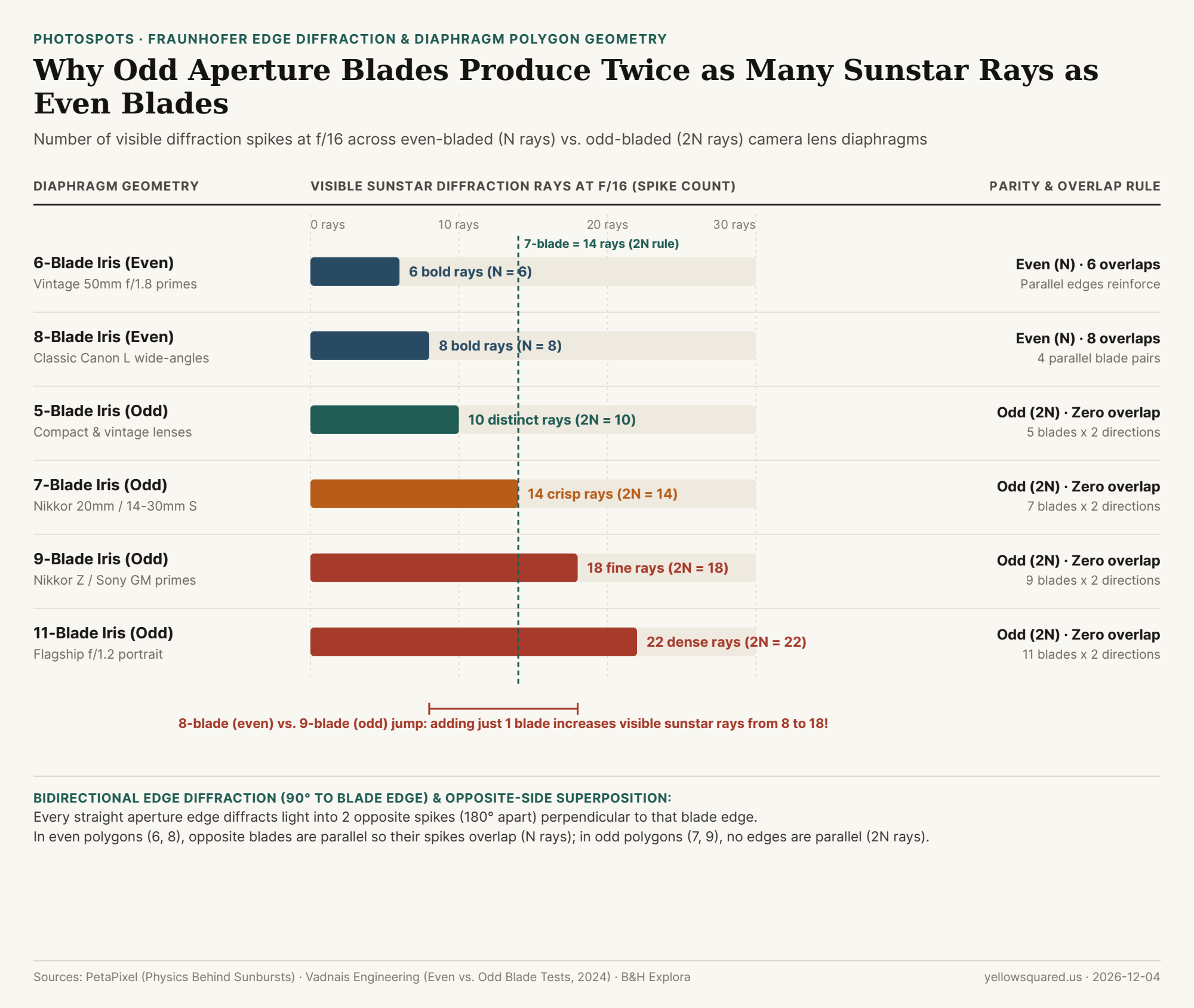
As demonstrated in optical bench comparisons by Vadnais Engineering and wave-optics explainers at PetaPixel, an aperture with an even number of blades (N) always produces exactly $N$ sunstar points (6 blades = 6 points, 8 blades = 8 points), whereas an aperture with an odd number of blades (N) always doubles its output to $2N$ sunstar points (7 blades = 14 points, 9 blades = 18 points, 11 blades = 22 points). Before hiking out to capture a ridge-line sunset or streetlamp starburst, you can Scout golden hour and blue hour angles in PhotoSpots to time the exact minute the solar disk grazes a mountain edge or tree trunk.
Fraunhofer Edge Diffraction: Why Every Straight Blade Edge Creates Two Opposite Rays
When a lens is shot wide open (f/1.4 to f/2.8), nearly all incoming light passes unimpeded through the center of the circular opening, and a bright point light source renders as a soft circular glow. As you stop the diaphragm down to f/11, f/16, or f/22, the physical diameter of the entrance pupil shrinks to just 1 to 3 millimeters, forcing a much larger fraction of the incoming wavefront to skim past the metallic edges of the iris blades.
By Christiaan Huygens' wavelet principle and Fraunhofer diffraction, whenever a coherent planar wavefront passes a straight knife edge, secondary wavelets spread out along an axis perpendicular (90°) to that straight edge in both directions (180° apart). Thus, a single straight blade edge does not create one ray—it creates a bidirectional line of two opposite rays (0° and 180° perpendicular to the blade).
"Every straight blade edge in your lens diaphragm generates two diffraction spikes 180 degrees apart: in an 8-blade octagon, four pairs of parallel opposite edges lay their spikes right on top of each other to make 8 bright rays; in a 9-blade nonagon, no two edges are parallel, fanning out into 18 separate rays."
The Geometry of Overlap: Even Polygons (N) vs. Odd Polygons ($2N$)
Once you know that every blade edge produces two 180°-opposite diffraction spikes, the mystery of why adding a single blade to an 8-blade lens jumps the sunstar count from 8 to 18 becomes pure polygon geometry, as illustrated in B&H Explora's starburst optics guide:
- Even-Bladed Polygons (
6, 8, or 10Blades →6, 8, or 10Rays): In any regular polygon with an even number of sides (a hexagon or octagon), every side has a strictly parallel partner directly across the center (180°opposite). Because both parallel edges share the exact same perpendicular normal vector, the two diffraction spikes from Blade #1 land directly on top of the two diffraction spikes from opposite Blade #5. The2Nspikes superimpose in pairs, yielding $N$ extra-bright, high-contrast rays. - Odd-Bladed Polygons (
5, 7, 9, or 11Blades →10, 14, 18, or 22Rays): In a regular polygon with an odd number of sides (a heptagon or nonagon), every flat side sits across from a pointed corner vertex rather than a parallel side. No two edges in the entire diaphragm are parallel! Consequently, none of the bidirectional diffraction spikes overlap, and all $2N$ rays fan out evenly around the clock (every 25.7° for a 7-blade lens, and every 20.0° for a 9-blade lens).
| Aperture Blade Count | Polygon Parity | Parallel Opposite Edges | Visible Sunstar Rays | Angular Ray Spacing | Representative Lens Examples |
|---|---|---|---|---|---|
6 Blades (Hexagon) |
Even (N) |
3 parallel pairs |
6 bold rays |
60.0° apart |
Vintage 50mm f/1.8 primes & Leica Summicron |
8 Blades (Octagon) |
Even (N) |
4 parallel pairs |
8 bold rays |
45.0° apart |
Canon EF 16-35mm f/2.8L II & classic wide-angles |
5 Blades (Pentagon) |
Odd (2N) |
0 parallel pairs |
10 distinct rays |
36.0° apart |
Compact pancake lenses & vintage primes |
7 Blades (Heptagon) |
Odd (2N) |
0 parallel pairs |
14 crisp rays |
25.7° apart |
Nikkor Z 14-30mm f/4 S, Canon EF 17-40mm f/4L |
9 Blades (Nonagon) |
Odd (2N) |
0 parallel pairs |
18 fine rays |
20.0° apart |
Nikkor Z 50mm f/1.8 S, Nikkor Z 24-70mm f/2.8 S |
11 Blades (Hendecagon) |
Odd (2N) |
0 parallel pairs |
22 dense rays |
16.4° apart |
Sony FE 50mm f/1.2 GM (stopped down to f/16) |
How to Shoot Razor-Sharp Sunstars Without Ruining Overall Image Sharpness
Two practical rules govern field technique when shooting sunstars: first, straight aperture blades produce needle-sharp rays by concentrating diffraction along a single normal angle, whereas modern rounded aperture blades (designed for circular wide-open bokeh) spread the diffracted light across a slight arc unless you stop down to f/14 or f/16 where the blade corners meet tightly. Second, shrink the apparent angular diameter of the Sun by partially occulting the solar disk behind a sharp ridge, rock spire, building corner, or tree trunk—turning a 0.5° solar disk into a tiny point source so you get crisp 14- or 18-point rays at f/11–f/16 without having to stop down to f/22 (where Airy-disk diffraction softens the rest of your landscape). To plan the exact azimuth and elevation where the Sun will clip a skyline or mountain ridge, Scout golden hour and blue hour angles in PhotoSpots.