
How Far Away Is Lightning? The 5-Second Flash-to-Bang Rule Explained
How Far Away Is Lightning? The 5-Second Flash-to-Bang Rule Explained
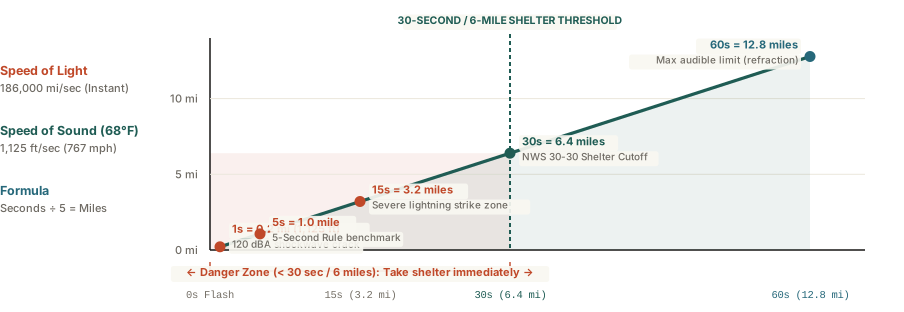
Because light travels at 186,000 miles per second while thunder propagates as a sonic shockwave at ~1,125 feet per second (767 mph at 68°F), counting 5 seconds between a lightning flash and thunder equals 1 mile of strike distance.
When a summer cumulonimbus anvil darkens the horizon and a jagged bolt of cloud-to-ground lightning illuminates the sky, everyone instinctively starts counting until the thunder arrives. Yet one of the most persistent outdoor myths holds that each second you count equals one mile of distance. In reality, equating one second to one mile overestimates your safety margin by a factor of five—leading hikers, boaters, and golfers to believe a storm is five miles away when the bolt just struck a mile down the trail.
Understanding the exact thermodynamic speed of sound in warm boundary-layer air—and why thunderstorms more than 12 to 15 miles away produce silent flashes often mislabeled as "heat lightning"—gives you an instant, reliable field gauge for severe weather safety.
50,000°F Plasma and the 5-Second-Per-Mile Formula
A cloud-to-ground lightning return stroke superheats a narrow channel of air (roughly an inch in diameter) to 50,000°F (27,700°C) in less than 30 microseconds—five times hotter than the surface of the sun. That sudden thermal spike increases air pressure inside the channel to 10 to 100 times normal atmospheric pressure, driving an outward supersonic shockwave at Mach 10. Within the first 10 to 30 feet, that shockwave decays into an ordinary acoustic sound wave that we hear as thunder.
Because the optical flash travels at the speed of light (186,282 miles per second), it reaches your eyes instantaneously. Sound, however, travels through 68°F (20°C) air at just 1,125 feet per second (343 meters per second, or 767 mph). Since one statute mile contains 5,280 feet:
- In Miles (Divide Seconds by 5): It takes 4.69 seconds (rounded to 5 seconds) for thunder to travel 1 mile. A 10-second delay equals 2 miles; a 15-second delay equals 3 miles.
- In Kilometers (Divide Seconds by 3): At 343 meters per second, thunder travels 1 kilometer in 2.91 seconds (rounded to 3 seconds).
There is no such thing as "heat lightning." Silent summer flashes are simply ordinary thunderstorms located more than 12 to 15 miles away whose thunder has refracted upward over your head.
The 30-30 Safety Rule and Why Thunder Vanishes Past 15 Miles
Lightning bolts frequently travel horizontally through the upper anvil of a thunderstorm before striking the ground—so-called "bolts from the blue"—up to 6 to 10 miles away from the rain core. For that reason, the NOAA National Weather Service and OSHA enforce the 30-30 Rule: if your flash-to-bang count is 30 seconds or less (<= 6 miles), you are already inside the active strike zone and must enter a substantial building or hard-topped vehicle immediately, waiting 30 minutes after the final clap of thunder before resuming outdoor activity.
Why can you see lightning from 40 miles away at night but rarely hear thunder beyond 12 to 15 miles? Because sound travels faster in warm air than in cold air. Since atmospheric temperature normally decreases with altitude, the upper part of a sound wave slows down while the lower part near the warm ground speeds up—bending (refracting) the sound wave upward into the sky so it passes miles above the head of a distant observer. You can Analyze atmospheric soundings on Eranorms to inspect boundary-layer temperature lapse rates and convective instability profiles in real time.