
What Is a 'Fifth Freedom' Flight? How to Fly Emirates and Singapore Airlines Without Visiting Their Home Hubs
If you search for a nonstop transatlantic flight from New York (JFK) to Frankfurt (FRA), you expect to see German flag carrier Lufthansa or US carriers like Delta and United. Yet sitting right at the top of the schedule is Singapore Airlines Flight SQ25/SQ26—and on the route from New York (JFK) to Milan (MXP) or Newark (EWR) to Athens (ATH), you can book a standalone ticket aboard an Emirates widebody jet without ever setting foot in Singapore or Dubai. In international aviation law, these routes are known as Fifth Freedom flights. As documented in the MyFlightRoutes 2026 Fifth Freedom route directory, Mainly Miles's guide to Singapore Airlines fifth freedom routes, Point Hacks, and Skyplus, fifth freedom routes are among the highest-value sweet spots in points and miles travel.
Why did 20th-century aviation treaties create nine distinct "Freedoms of the Air," why do ultra-long-haul aircraft still fly multi-stop tag routes in 2026, and why do these specific legs offer markedly better Business and First Class award availability than legacy hub monopolies? Here is the complete regulatory and route breakdown.
1. The Nine Freedoms of the Air: How 5th Freedom Differs from Technical Stops and Cabotage
Established under the framework of the 1944 Chicago Convention on International Civil Aviation, commercial airspace rights are negotiated between governments using nine standardized Freedoms of the Air. As outlined by Point Hacks and Skyplus, understanding the difference between the Second, Fifth, Sixth, and Eighth Freedoms explains which flights you are legally allowed to book:
- First & Second Freedoms (Transit & Technical Refueling): The First Freedom grants the right to fly over a foreign country's airspace without landing. The Second Freedom grants the right to make a technical stop in a foreign country solely for refueling or maintenance—without boarding or deplaning local passengers.
- Third, Fourth & Sixth Freedoms (Standard Hub-and-Spoke Traffic): The Third and Fourth Freedoms allow an airline to carry passengers from its home country to a foreign country and back (e.g., Emirates flying
DXB ↔ JFK). Combining the two creates the Sixth Freedom: carrying passengers between two foreign countries via a connection in the airline's home hub (e.g., flying New York to Bangkok via a layover in Dubai). - Fifth Freedom (Foreign-to-Foreign Tag with Local Traffic Rights): The Fifth Freedom of the Air allows an airline to carry revenue and award passengers solely between two foreign countries on a flight that originates or terminates in the airline's own home country. Because all three nations (Home Country A, Stopover Country B, and Destination Country C) must sign off on the bilateral treaty rights, fifth freedom routes are relatively rare.
- Seventh, Eighth & Ninth Freedoms (Standalone Foreign & Domestic Cabotage): The Seventh Freedom operates between two foreign countries without touching the home hub at all. The Eighth Freedom ("consecutive cabotage") allows a foreign carrier to pick up local domestic passengers between two cities inside the same foreign country on an international extension. As Point Hacks notes, when Qantas operated its famous
Sydney (SYD) → Los Angeles (LAX) → New York (JFK)tag flight, the US government denied Qantas Eighth Freedom cabotage rights—meaning nobody could buy a standaloneLAX ↔ JFKticket unless they were connecting onto a Qantas flight to or from Australia.
2. Why Airlines Still Fly Fifth Freedom Routes—And Why Seats Are Easier to Book
In the mid-20th century, fifth freedom stops were an engineering necessity: a Boeing 707 or early 747 could not fly nonstop from Singapore to New York or from Dubai to Mexico City without stopping to refuel. Today, aircraft like the Airbus A350-900ULR can fly 9,500+ miles nonstop—yet airlines deliberately keep flagship fifth freedom routes alive for three strategic reasons documented by MyFlightRoutes and Skyplus:
- High-Altitude & Range Physics (e.g., Mexico City at
7,349 feet): Mexico City International Airport (MEX) sits at an elevation of7,349 feet(2,240 meters). Thin high-altitude air reduces wing lift and engine thrust on takeoff, preventing a fully loaded Boeing 777 from flying nonstop all the way to Dubai. By routingDubai (DXB) → Barcelona (BCN) → Mexico City (MEX)(6,049 mileson theBCN–MEXleg), Emirates solves the hot-and-high weight restriction while capturing the lucrative Spain-to-Mexico market. - Filling Empty Seats After Hub Passengers Disembark: On a flight like Singapore Airlines
SQ26(SIN → FRA → JFK) or EmiratesEK205(DXB → MXP → JFK), a large share of passengers boarding at the home hub get off at the intermediate European city. Without Fifth Freedom rights, the widebody jet would fly across the Atlantic half-empty. - Zero Local Domestic Feeder Network = Better Award Space & Fares: When Lufthansa flies
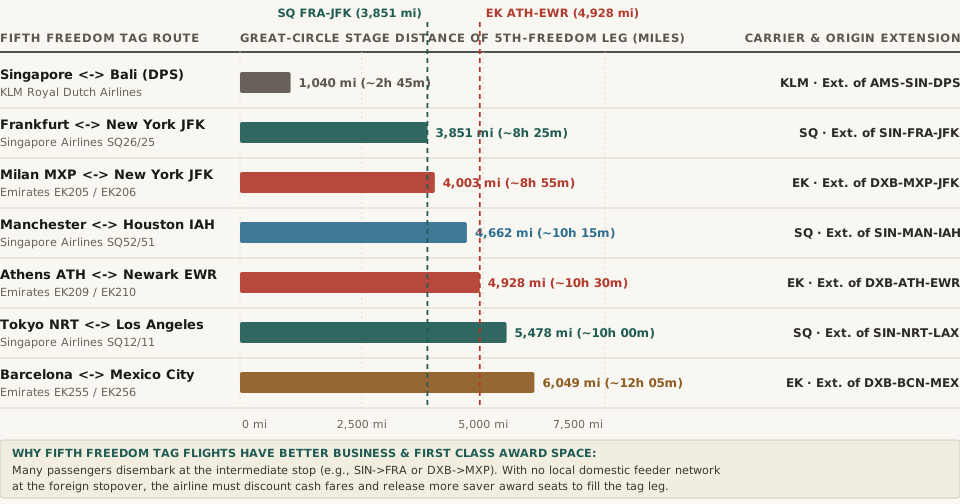
Frankfurt → New York, it feeds that Boeing 747 with connecting passengers from 50 European spoke cities. When Singapore Airlines flies the exact sameFRA → JFK(3,851 miles) route, it has zero European domestic feeder flights—it must attract local point-to-point travelers in Frankfurt and New York. As Skyplus highlights, that lack of local hub feed forces fifth-freedom carriers to release significantly more saver-level Business and First Class award inventory and price promotional cash fares up to 30%–50% below legacy hub monopolies.
"Because the airline is essentially 'passing through' rather than operating out of a primary hub, these flights often have less demand from local loyalists, leading to better award availability for savvy travelers using points and miles."
3. Complete Data Table: Flagship Emirates, Singapore Airlines & KLM Fifth Freedom Routes
The reproducible table below—matching the companion CSV dataset (fifth-freedom-flights-emirates-singapore-airlines-route-distances-and-freedoms.csv)—lists the stage distances, flight numbers, and booking sweet spots verified in MyFlightRoutes and Mainly Miles:
| Fifth Freedom Tag Route | Carrier & Flight No. | Full Hub Routing | Stage Distance | Block Time | Why Points & Cash Flyers Target This Leg |
|---|---|---|---|---|---|
Singapore (SIN) ↔ Bali (DPS) |
KLM (KL835 / KL836) |
AMS → SIN → DPS |
1,040 mi |
~2h 45m |
Long-haul Boeing 777 World Business Class lie-flat seats on a short intra-Asia hop |
Frankfurt (FRA) ↔ New York (JFK) |
Singapore Airlines (SQ26 / SQ25) |
SIN → FRA → JFK |
3,851 mi |
~8h 25m |
Book KrisFlyer / Aeroplan Business Class across the Atlantic with low carrier surcharges |
Milan (MXP) ↔ New York (JFK) |
Emirates (EK205 / EK206) |
DXB → MXP → JFK |
4,003 mi |
~8h 55m |
Flagship Airbus A380 First Class Shower Spa & onboard lounge nonstop US-to-Italy |
Manchester (MAN) ↔ Houston (IAH) |
Singapore Airlines (SQ52 / SQ51) |
SIN → MAN → IAH |
4,662 mi |
~10h 15m |
Airbus A350-900 nonstop between Northern England and Texas; strong saver award space |
Athens (ATH) ↔ Newark (EWR) |
Emirates (EK209 / EK210) |
DXB → ATH → EWR |
4,928 mi |
~10h 30m |
Only year-round nonstop from the New York area to Greece; 3-cabin Boeing 777-300ER |
Tokyo Narita (NRT) ↔ Los Angeles (LAX) |
Singapore Airlines (SQ12 / SQ11) |
SIN → NRT → LAX |
5,478 mi |
~10h 00m |
Consistently higher Business Class award seat counts than ANA or JAL transpacific |
Barcelona (BCN) ↔ Mexico City (MEX) |
Emirates (EK255 / EK256) |
DXB → BCN → MEX |
6,049 mi |
~12h 05m |
2-class Boeing 777-200LR bypassing 7,349-ft Mexico City altitude constraint |
4. How to Maximize Cent-per-Point Value on Fifth Freedom Award Redemptions
When booking fifth freedom flights with transferable credit card points (such as Chase Ultimate Rewards, American Express Membership Rewards, Capital One Miles, or Wells Fargo Rewards), two redemption rules protect your cent-per-point yield:
- Compare Partner Distance Bands vs. Dynamic Carrier Surcharges: Singapore Airlines passes zero fuel surcharges on its own
KrisFlyerprogram and on partnerAir Canada Aeroplanredemptions forFRA ↔ JFK(3,851 miles, falling neatly inside Aeroplan's≤ 4,000-miletransatlantic distance band). By contrast, Emirates levies substantial carrier-imposed surcharges onMXP ↔ JFKandATH ↔ EWR, so always deduct cash taxes and fees from the retail fare before calculating your net cent-per-point value. - Check fifth-freedom schedules during shoulder season: Because airlines use fifth freedom tags to absorb excess long-haul widebody capacity, Business Class saver releases on
MAN ↔ IAH,FRA ↔ JFK, andNRT ↔ LAXfrequently open 2 to 4 seats per flight during autumn and winter shoulder months.
Before transferring bank points to KrisFlyer, Aeroplan, or Skywards for a fifth-freedom redemption, Compare award tax valuations on Pointsuno to calculate your exact net cents-per-point return after carrier surcharges and transfer bonuses.