
What Is a Haboob Dust Storm, and Why Do Thunderstorm Outflows Trigger Miles-Wide Walls of Dust?
Every summer during the North American monsoon—and across the Sahara, the Arabian Peninsula, and interior Australia—social media fills with dramatic footage of a towering, miles-wide wall of reddish-tan dust rolling across desert highways at sunset. Meteorologists call this phenomenon a haboob (from the Arabic root habb, meaning "to blow"). Unlike ordinary windstorms driven by large-scale regional pressure gradients, a haboob is an atmospheric density current triggered by the collapse of a thunderstorm.
As defined in the American Meteorological Society (AMS) Glossary of Meteorology, Haboob storm mechanics, and Arizona State University's desert monsoon guide, a haboob can loft fine silt and clay 1,500 to 2,000 meters (5,000 to 7,000 feet) into the sky and race outward at 35 to 62 mph (55 to 100 km/h)—often arriving minutes before any rain falls. Compare seasonal monsoon humidity, wind, and temperature normals in Eranorms to see when arid regions enter peak haboob season.
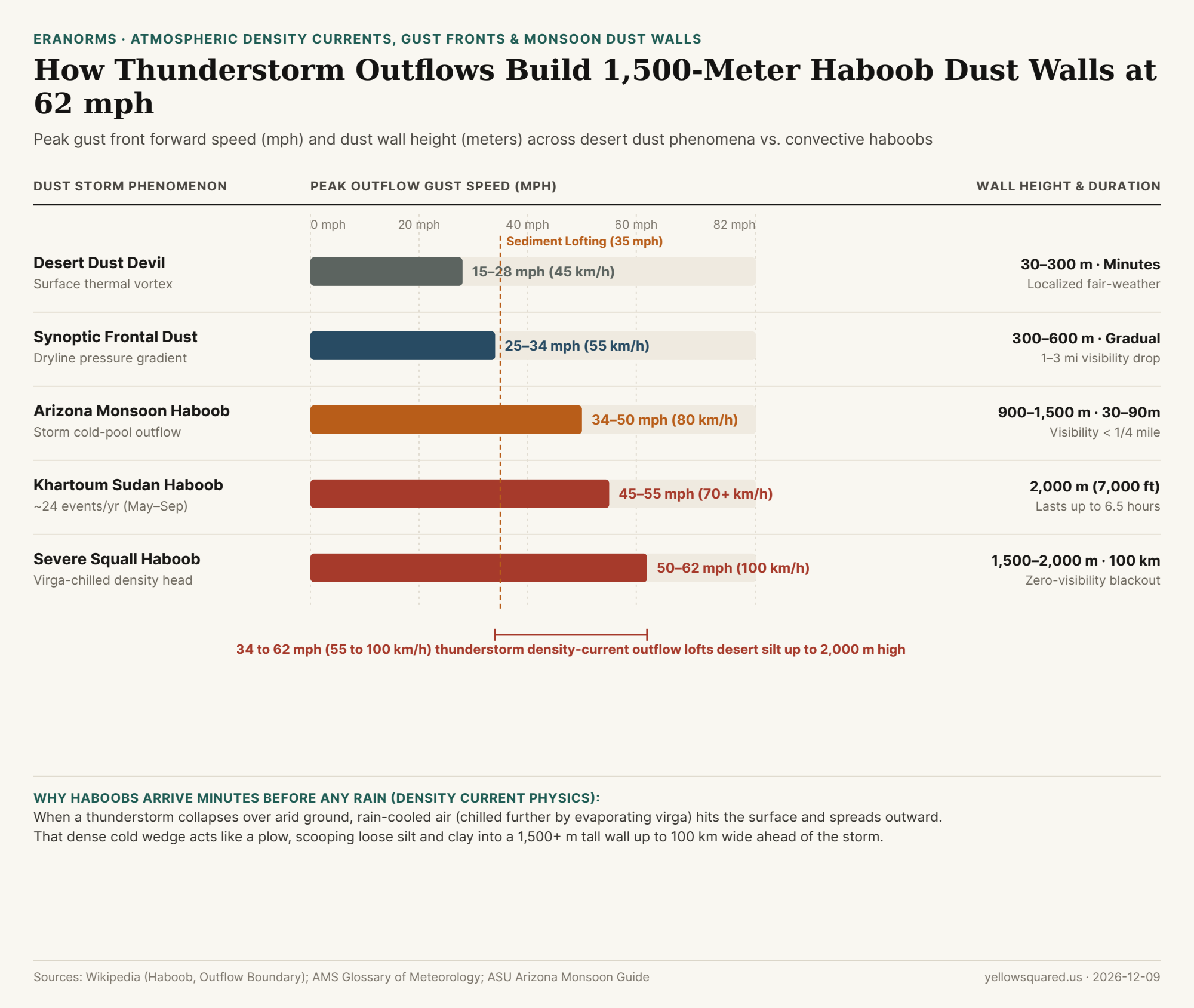
mph) and dust wall height (meters) across desert dust regimes, showing how thunderstorm cold-pool density currents generate towering haboobs. Sources: Haboob (Wikipedia), AMS Glossary of Meteorology, and ASU Monsoon Guide · Download CSV dataset.The 3-Stage Engine: Downdraft → Cold Pool → Density Current
Why does a haboob look like a solid, churning cliff of dirt rather than a diffuse haze? As documented in Outflow boundary physics, the secret is density:
- Evaporative Chilling Aloft: As a mature desert thunderstorm begins to rain, much of that precipitation falls into hot, dry sub-cloud air and evaporates mid-air (virga). Evaporation absorbs massive latent heat, chilling the descending column of air by
10°C+compared to the surrounding desert air. - Ground Impact & Outflow Surge: Because cold air is denser than warm air, the chilled downdraft plunges to the desert floor and spreads horizontally outward in all directions—creating a leading edge called a gust front or outflow boundary.
- The Density-Current Head: Like a heavy wedge of cold ocean water sliding beneath warm surface water, the leading "head" of the cold outflow lifts warm air sharply upward while turbulent winds of
35 to 62 mphbehind it scour loose silt, clay, and sand off dry lakebeds and desert scrub, rolling the sediment upward into a sharp, billowing wall up to100 km (62 miles)wide.
"In Khartoum, Sudan—where the term haboob originated—monsoon thunderstorm outflows average roughly 24 haboobs per year between May and September, reaching 2,000 meters (7,000 feet) high and lasting up to 6.5 hours."
Haboob vs. Dust Devil vs. Frontal Dust Storm Table
The table below compares atmospheric drivers, wall heights, peak gust speeds, and highway visibility impacts across five desert dust regimes (download the raw CSV dataset):
| Dust Phenomenon | Atmospheric Driver | Typical Wall Height | Gust Speed (mph) |
Duration & Visibility Impact |
|---|---|---|---|---|
| Desert Dust Devil | Local solar surface heating vortex | 30 to 300 m |
15 to 28 mph |
Minutes; narrow localized swirl < 50 m wide |
| Dryline / Cold Front Dust | Synoptic pressure gradient | 300 to 600 m |
25 to 34 mph |
Hours; gradual visibility drop to 1–3 miles |
| Arizona Monsoon Haboob | Thunderstorm cold-pool outflow | 900 to 1,500 m |
34 to 50 mph |
30–90 min; abrupt wall drops visibility < 0.25 mi |
| Khartoum Sudan Haboob | Tropical squall density current | 2,000+ m (7,000 ft) |
45 to 62 mph |
Up to 6.5 hours; ~24 events/year |
| Severe Squall Haboob | Multi-cell gust front + virga | 1,500 to 2,000 m |
50 to 62 mph |
Up to 100 km wide; zero-visibility blackout |
Highway Safety Rule Inside a Haboob
As emphasized by desert weather safety advisories, if you are driving when a haboob approaches, never stop in a travel lane: pull completely off the highway shoulder, set your parking brake, turn off all headlights and taillights, and take your foot off the brake pedal so trailing drivers do not mistakenly follow your lights off the road into a rear-end collision. Compare seasonal monsoon humidity, wind, and temperature normals in Eranorms to check dry-season and monsoon wind windows before desert road trips.