
What Is Alpenglow in Photography, and When Does the Mountain Peak Turn Pink After Sunset?
Many landscape photographers pack up their tripod the moment the sun dips below the western horizon—missing the brief, luminous window when high granite or snow peaks opposite the sun ignite in soft rose-pink and magenta. That phenomenon is alpenglow (known in the Dolomites as enrosadira and in German as Alpenglühen).
As documented in Wikipedia's Alpenglow reference, Afterglow, Atmospheric optics, and Dan Bailey's field analysis, there is an important optical distinction between late golden-hour sunlight and true post-sunset alpenglow. Plan golden hour, alpenglow, and Belt of Venus windows in PhotoSpots so you stay on location through civil twilight.
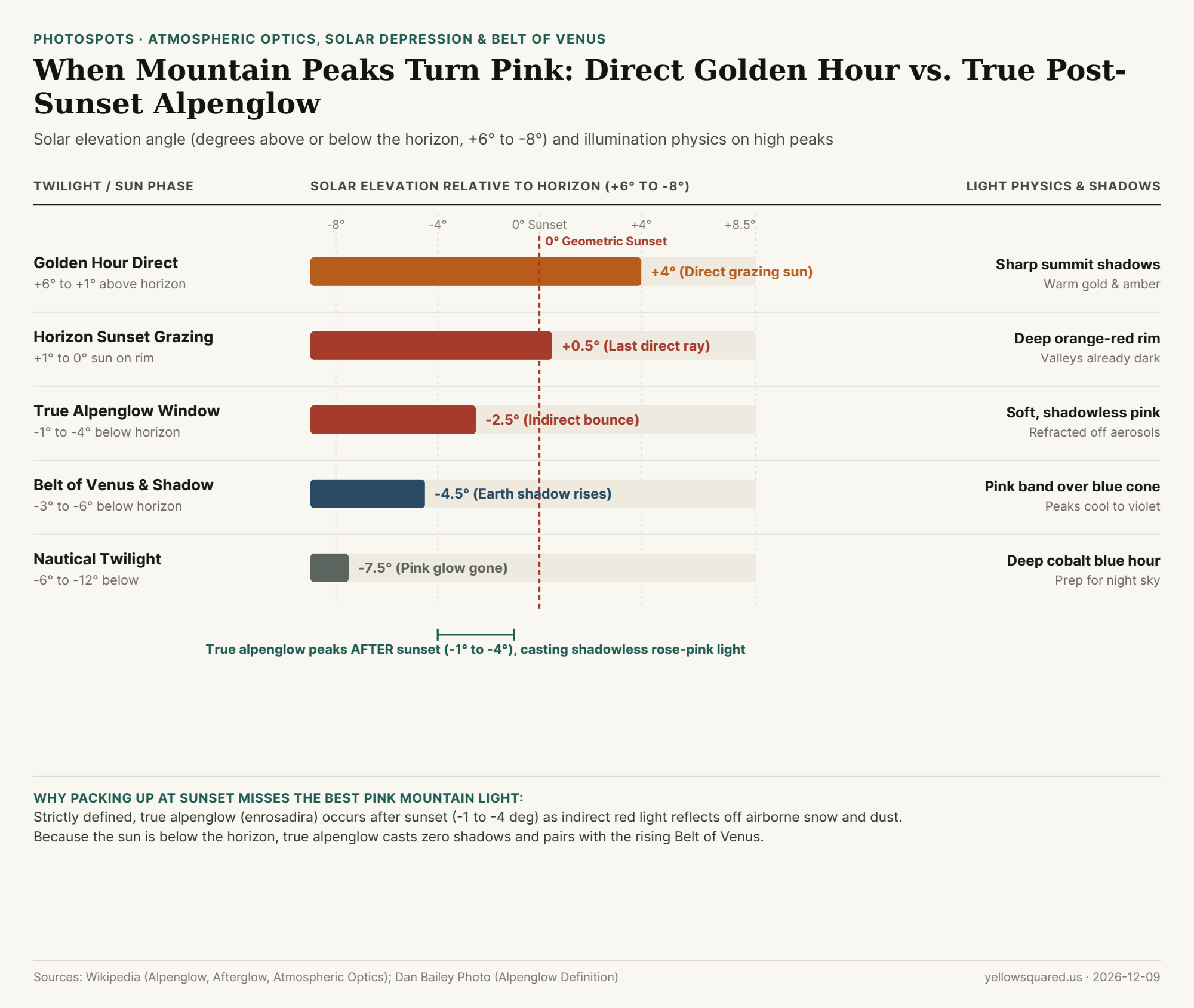
+6° to -8°) and mountain illumination physics. Sources: Alpenglow (Wikipedia) and Dan Bailey Photo · Download CSV dataset.Direct Golden Hour vs. True Post-Sunset Alpenglow
- Loosely Defined (
+6°to0°): Just before sunset, low-angle direct sunlight travels through a long atmospheric path that scatters away short blue wavelengths (Rayleigh scattering), leaving warm gold, orange, and red light on high peaks while valleys sit in shadow. Because the sun is still above the horizon, these rays cast sharp shadows. - Strictly Defined True Alpenglow (
-1°to-4°): Once the solar disk drops below the horizon, direct rays can no longer strike the mountain. Instead, reddish light refracts and backscatters off airborne snow, ice crystals, or atmospheric particulates—bathing the peak in soft, shadowless pink illumination.
"True alpenglow occurs after sunset or before sunrise when the sun is below the horizon: indirect red-pink light reflects off airborne aerosols, casting zero shadows above the rising Belt of Venus."
How the Belt of Venus and Earth's Shadow Frame the Peak
Looking east after sunset (between -2° and -6° solar depression), you will often see a dark slate-blue wedge rising from the horizon—Earth's shadow—topped by a glowing pink band called the Belt of Venus. High peaks that pierce through that pink band catch the cleanest alpenglow right before fading into cool blue hour at nautical twilight (-6°).
Solar Elevation & Mountain Light Phases
Use this solar-elevation timeline to time your twilight exposures (download the raw CSV dataset):
| Twilight Phase | Solar Elevation | Light Source | Shadow Behavior | Peak Color Palette |
|---|---|---|---|---|
| Golden Hour (Direct) | +6° to +1° |
Direct low-angle sun | Sharp directional shadows | Warm gold to amber-orange |
| Sunset Horizon | +1° to 0° |
Last direct grazing rays | Long crisp summit shadows | Deep orange to crimson |
| True Alpenglow | -1° to -4° |
Indirect aerosol scatter | Soft, shadowless glow | Rose-pink to magenta |
| Belt of Venus | -2° to -6° |
Backscatter above shadow cone | Fades into cool blue-violet | Pink band over dark blue |
| Nautical Twilight | -6° to -12° |
Upper-sky scatter only | No pink peak glow | Deep cobalt blue hour |